


Nutraceutical OEM vs ODM vs Private Label: Understanding the Key Differences
Choosing the right nutraceutical manufacturing model can determine how quickly a product reaches the market, how much control a brand has over its formulation, and how effectively it can differentiate from competitors. For nutraceutical brands, startups, distributors and established consumer-health companies, the three commonly discussed models are OEM, ODM and private label.
Although these terms are sometimes used interchangeably by manufacturers, they can represent different levels of formulation involvement, customization, product development and commercial control. The exact meaning can also vary between suppliers, so brands should evaluate the underlying agreement rather than rely only on the terminology.
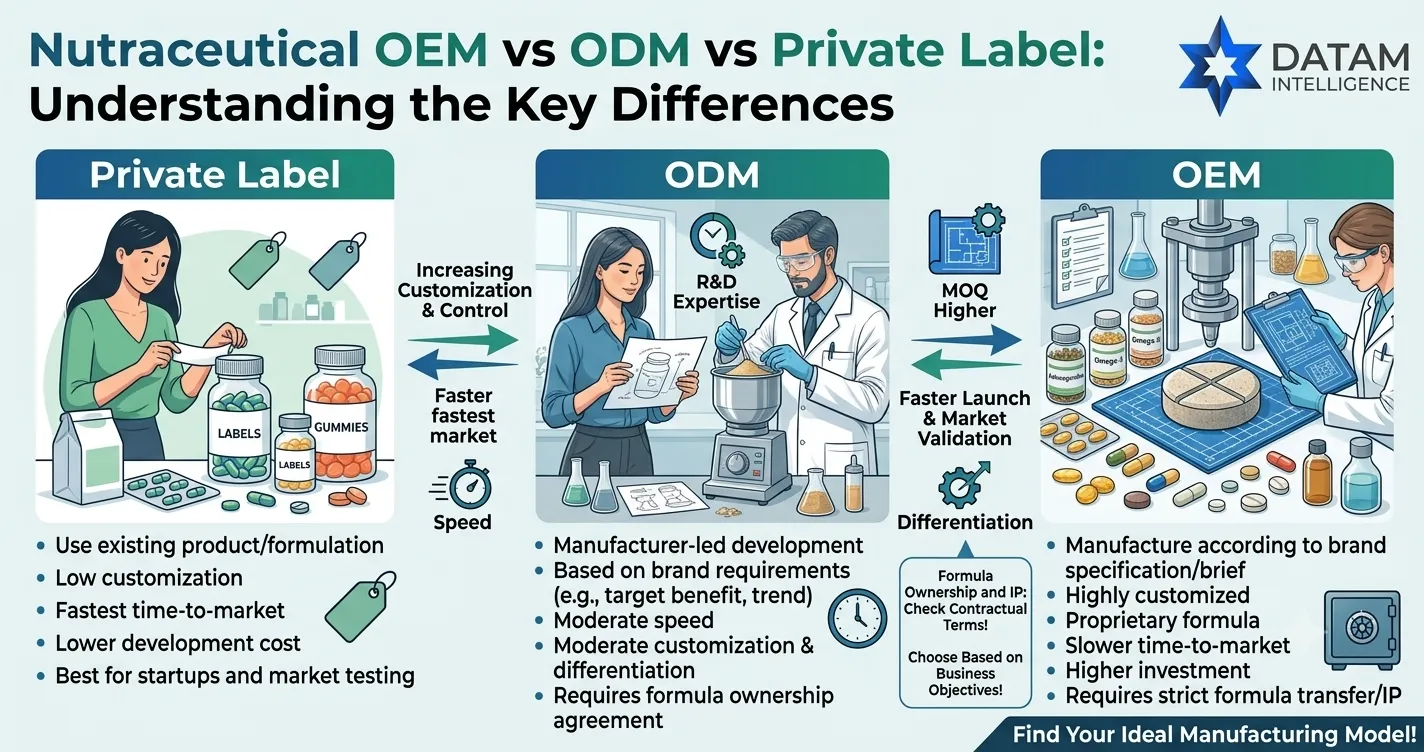
The simplest way to understand the three models is:
- Private label: Choose an existing product or formulation and sell it under your own brand.
- ODM: Work with a manufacturer that provides product development and formulation expertise based on your requirements.
- OEM: Manufacture according to your defined formula, specifications or substantially customized product brief.
For brands deciding between these models, the right choice depends on product differentiation, budget, development capabilities, expected volumes, launch timelines and long-term intellectual-property strategy.
Identify Strategic Partners for Sustainable Growth
Identify, evaluate, and prioritize high-value partners aligned with your market strategy, growth objectives, and supply-chain requirements. Gain an actionable partner shortlist and strategic roadmap to accelerate engagement, strengthen market positioning, and support informed partnership decisions.
What Is Nutraceutical OEM Manufacturing?
Nutraceutical OEM manufacturing generally refers to a manufacturing arrangement in which the brand provides a defined product specification, formula or detailed development brief, while the manufacturer handles production.
Depending on the supplier, OEM may include formulation support, ingredient sourcing, dosage-form development, testing, packaging and commercial-scale production.
The major advantage is greater control over the product specification. A brand can define ingredients, dosages, delivery formats, quality requirements, flavor profiles, packaging specifications and other technical parameters.
OEM is particularly attractive when the product itself is intended to be a competitive advantage.
When should a brand choose OEM?
OEM can be appropriate when:
- The brand already has a proprietary formulation or detailed product concept.
- Product differentiation is strategically important.
- The company wants greater control over ingredients and specifications.
- The product is intended to become a flagship or hero SKU.
- The business has sufficient volume potential to support development and production requirements.
- Formula ownership and exclusivity are important commercial considerations.
However, brands should confirm formula ownership, exclusivity, development responsibilities and transfer rights in the manufacturing agreement rather than assuming these rights automatically come with the term "OEM."
What Is Nutraceutical ODM Manufacturing?
ODM, or Original Design Manufacturing, typically means that the manufacturer contributes more heavily to product design and development.
Instead of entering the relationship with a fully developed formula, the brand may provide a market opportunity, target consumer, desired benefit, dosage form, ingredient preferences or price point. The manufacturer's R&D team then develops or adapts the product around those requirements.
This can reduce the technical burden on a brand that understands its target market but does not have extensive formulation capabilities internally.
When should a brand choose ODM?
ODM can be suitable when:
- The company has a strong market concept but lacks an internal R&D team.
- The brand wants formulation support from an experienced manufacturer.
- Speed and technical expertise are important.
- The company wants more differentiation than a standard private-label product.
- The brand wants to develop a product around a specific consumer trend or application.
For example, a brand targeting healthy aging may have a clear consumer segment and positioning but require a manufacturing partner to translate that concept into a stable capsule, powder, gummy or liquid formulation.
What Is Private Label Nutraceutical Manufacturing?
Private label is generally the most straightforward model.
The manufacturer already has an existing product or formulation, and the brand selects that product and sells it under its own branding. Depending on the supplier, customization may be limited to packaging, flavor, dosage, format or other predefined options.
The main attraction is speed and lower development complexity.
Because the underlying product may already exist, brands can avoid much of the formulation-development process associated with a fully customized product.
When should a brand choose private label?
Private label is often appropriate for:
- New nutraceutical startups.
- Brands testing market demand.
- Retailers introducing a new supplement category.
- E-commerce businesses launching initial SKUs.
- Distributors seeking branded products.
- Companies prioritizing speed-to-market over formula differentiation.
The main limitation is differentiation. If several brands can purchase the same or substantially similar formulation from the same manufacturer, the competitive advantage must come from branding, positioning, distribution, customer experience, packaging or marketing.
OEM vs ODM vs Private Label: Key Differences
| Factor | OEM | ODM | Private Label |
|---|---|---|---|
| Formula source | Brand specification or custom brief | Manufacturer-developed or co-developed | Existing manufacturer formulation |
| Customization | High | Medium to high | Low to medium |
| R&D involvement | High or brand-led | Manufacturer-led/co-developed | Low |
| Speed to market | Slower | Moderate | Generally fastest |
| Development cost | Higher | Moderate to high | Generally lower |
| Product differentiation | High | Medium to high | Lower |
| Technical involvement | High | Medium | Lower |
| Formula ownership | Must be contractually defined | Must be contractually defined | Usually manufacturer-controlled |
| Best suited for | Established/custom-product brands | Brands needing formulation expertise | Startups and market testing |
Important: These labels are not standardized commercial definitions across every manufacturer. One supplier may describe a semi-custom formulation as ODM, while another may market the same service as OEM or private label. The contract, formulation-development process and ownership terms matter more than the acronym.
OEM vs ODM vs Private Label: Which Is Cheapest?
Private label will generally require the least upfront product-development investment because the formulation already exists.
ODM usually requires additional development work, which can increase formulation and sampling costs.
OEM can require the greatest investment when the brand needs a new or substantially customized formulation, ingredient sourcing, testing, stability work, packaging development and production validation.
However, the cheapest model is not necessarily the most profitable.
A private-label product may launch quickly but compete with similar products. An OEM or ODM product may require more upfront investment but potentially provide stronger differentiation and pricing power.
Brands should therefore evaluate total commercial economics, not simply initial manufacturing cost.
OEM vs ODM vs Private Label: Which Is Fastest to Market?
If speed is the primary objective, private label generally provides the shortest route because the underlying product already exists.
ODM can take longer because formulation development, sampling and revisions may be required.
OEM development can require additional time when the product needs a new formulation, specialized ingredients, testing or production validation.
A practical decision framework is:
Private label → fastest launch
ODM → faster customization with manufacturer expertise
OEM → greater control and differentiation, usually with more development work
Actual timelines vary significantly by product type, formulation complexity, testing requirements, ingredient availability, packaging and target market.
Which Model Gives the Most Product Differentiation?
For brands whose competitive advantage depends on the product itself, customization should be a major consideration.
Private label generally provides the least differentiation because the underlying formulation may be available to multiple customers.
ODM can provide greater differentiation because the manufacturer develops or adapts the product according to the brand's requirements.
OEM can provide the highest degree of specification control when the brand has a proprietary formulation or commissions a substantially customized product.
However, customization does not automatically mean exclusivity.
Before signing an agreement, clarify:
- Who owns the final formula?
- Who owns modifications to the formula?
- Can the manufacturer sell the same formulation to another customer?
- Is exclusivity limited by geography, channel or product category?
- Can the brand transfer the formula to another manufacturer?
- Who owns testing and technical documentation?
These questions can become strategically important when a nutraceutical product gains market traction.
Formula Ownership and Intellectual Property: What Brands Should Check
Formula ownership is one of the most important commercial issues when choosing a manufacturing model.
A manufacturer may provide formulation expertise, but that does not automatically mean the brand owns every formulation or modification created during development.
Before starting product development, brands should establish written terms covering:
Formula ownership
Define whether the final formulation belongs to the brand, manufacturer or both parties.
Exclusivity
Specify whether the manufacturer can supply an identical or substantially similar formulation to competing brands.
Confidentiality
Use appropriate confidentiality provisions for proprietary ingredient combinations, doses, processes and commercial information.
Formula transfer
Determine whether the brand can obtain the master formula and technical documentation if it changes manufacturing partners.
Development costs
Clarify who pays for formulation, prototypes, testing, stability studies and reformulation.
A clear agreement can reduce disputes later, particularly when a successful product becomes commercially valuable.
MOQ and Production Volume Considerations
Minimum order quantity, or MOQ, can influence the best manufacturing model for a new brand.
Private-label products may offer more accessible production quantities because the manufacturer already produces the formulation for other customers.
Customized OEM and ODM products can require higher volumes because manufacturers may need to dedicate production capacity, source specialized ingredients or recover development costs.
Brands should evaluate MOQ against:
- Expected first-year demand.
- Working capital.
- Shelf life.
- Storage requirements.
- Packaging commitments.
- Reorder frequency.
- Sales-channel capacity.
- Product launch strategy.
A low unit cost is not beneficial if the business is forced to purchase more inventory than it can realistically sell.
Regulatory and Quality Considerations
Selecting OEM, ODM or private label does not remove a brand's responsibility to understand the regulatory requirements of its target market.
Requirements differ by country and product category. In the United States, for example, FDA explains that dietary supplement companies are responsible for ensuring products meet applicable safety and labeling requirements, while manufacturers, packagers and holders are subject to current good manufacturing practice requirements.
In the European Union, nutrition and health claims for foods are subject to specific rules, and health claims must meet applicable authorization and scientific-evidence requirements.
Therefore, brands should assess:
- Ingredient legality in the target market.
- Product classification.
- Labeling requirements.
- Permitted nutrition and health claims.
- Testing and quality specifications.
- Certificates of analysis.
- Microbiological and contaminant controls.
- Traceability.
- Stability and shelf-life requirements.
- GMP and applicable manufacturing standards.
The manufacturing model may change who performs particular activities, but it does not eliminate the need for regulatory due diligence.
How to Choose Between OEM, ODM and Private Label
Use the following decision framework:
Choose Private Label if:
Your priority is speed.
You want to launch quickly, validate consumer demand and minimize formulation-development work.
Choose ODM if:
Your priority is a balance between customization and technical support.
You have a market concept but want the manufacturer to contribute formulation and product-development expertise.
Choose OEM if:
Your priority is product control and differentiation.
You have a defined formulation or want to develop a highly customized product that supports a long-term competitive strategy.
A Hybrid Strategy Can Reduce Launch Risk
Brands do not necessarily have to choose one model permanently.
A startup can begin with private-label products to test its target market, identify successful categories and build distribution. Once demand becomes predictable, it can invest in ODM or OEM development for differentiated hero products.
This creates a staged product strategy:
Stage 1: Private label for market validation.
Stage 2: ODM for targeted customization.
Stage 3: OEM for proprietary or highly differentiated products.
This approach can help businesses balance speed, investment and differentiation as they scale.
Questions to Ask a Nutraceutical Manufacturer Before Signing
Before selecting a manufacturing partner, ask:
- Is the formulation existing, semi-custom or fully custom?
- Who owns the formula?
- Can competitors purchase the same formula?
- What customization options are available?
- What is the MOQ?
- What are the development and production lead times?
- Which testing services are included?
- Can you provide certificates of analysis?
- Which quality and GMP standards does the facility follow?
- Who is responsible for regulatory documentation?
- Can the formula and technical documentation be transferred if we change suppliers?
- What happens to unused packaging and ingredients if the relationship ends?
- Which markets can the manufacturer support?
- What are the payment and production terms?
- Can the manufacturer scale production if demand increases?
The answers can reveal more about a supplier's suitability than the manufacturer's use of the terms OEM, ODM or private label.
Final Verdict: Which Nutraceutical Business Model Is Right for Your Brand?
There is no universally superior manufacturing model.
Private label is generally best for brands prioritizing speed, lower development complexity and market validation.
ODM is suited to brands that need manufacturer-led formulation expertise while seeking more customization.
OEM is most appropriate when product specifications, customization, differentiation and long-term formulation strategy are central to the business.
The key is to choose the manufacturing model according to your commercial objective, not simply the terminology used by a supplier.
For nutraceutical brands entering new markets, expanding product portfolios or evaluating manufacturing partnerships, understanding the wider value chain—from ingredient sourcing and formulation to production, regulatory requirements and distribution—is equally important.
Related FAQs
What is the difference between nutraceutical OEM and ODM?
OEM generally refers to manufacturing according to a brand's defined formula, specifications or product brief, while ODM generally involves greater manufacturer participation in product design and formulation development. Definitions vary between suppliers, so contractual responsibilities should be confirmed.
Is OEM better than private label for supplements?
Not necessarily. OEM can provide greater customization and differentiation, while private label can offer faster market entry and lower development complexity. The better option depends on the brand's objectives, budget and product strategy.
Is ODM cheaper than OEM?
It can be, but there is no universal pricing rule. ODM may reduce the brand's internal R&D burden because the manufacturer contributes formulation expertise. Actual costs depend on formulation complexity, ingredients, testing, MOQ and customization.
Which is faster: OEM, ODM or private label?
Private label is generally the fastest because the product formulation already exists. ODM and OEM may require formulation development, sampling, testing and production validation.
Can I customize a private-label nutraceutical?
Often, yes, but the available customization depends on the manufacturer. Options may include flavor, dosage, ingredients, format or packaging. Some suppliers use the term private label for semi-custom products, so confirm the exact scope.
Who owns an OEM nutraceutical formula?
It depends on the manufacturing agreement. Brands should explicitly establish ownership of the formula, modifications, technical documentation and associated intellectual property before development begins.
Can two supplement brands use the same private-label formula?
Yes, potentially. If the manufacturer sells a standard formulation to multiple customers, different brands may sell substantially similar products. Exclusivity must be confirmed with the manufacturer.
What should I consider besides manufacturing cost?
Evaluate MOQ, lead time, formulation ownership, ingredient quality, testing, regulatory support, scalability, packaging, supply reliability and total landed cost.
Is private label good for a new nutraceutical brand?
It can be an effective entry strategy when the priority is testing demand and launching with limited formulation-development investment. Once a brand identifies successful products, it may consider customized ODM or OEM development.
How do I select a nutraceutical contract manufacturer?
Compare manufacturing capabilities, quality systems, formulation expertise, ingredient sourcing, testing, certifications, MOQ, production capacity, regulatory support, formula ownership and the manufacturer's ability to scale with your business.