


Mining Equipment Technology & Commercial Intelligence | 2026
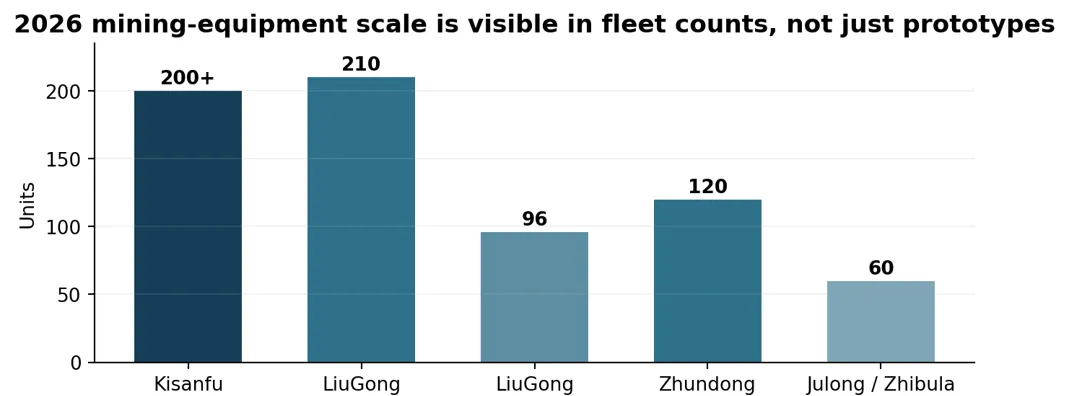
| FLEET SCALE | Zoomlion now has more than 200 wide-body mining trucks operating at CMOC's Kisanfu copper-cobalt mine in the DRC after a repeat order of 100+ units. |
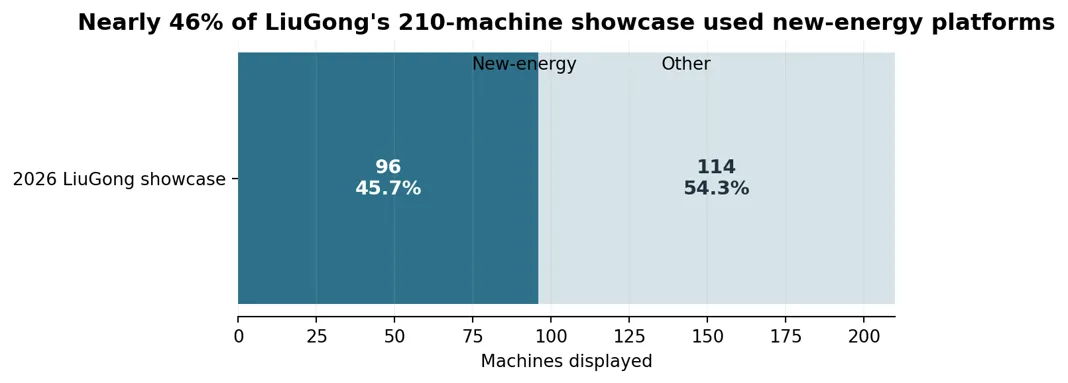
| PRODUCT SCALE | LiuGong displayed 210 machines at its November 2026 global dealer conference, including 96 new-energy machines. Eleven machines demonstrated integrated mining operations across seven scenarios. |
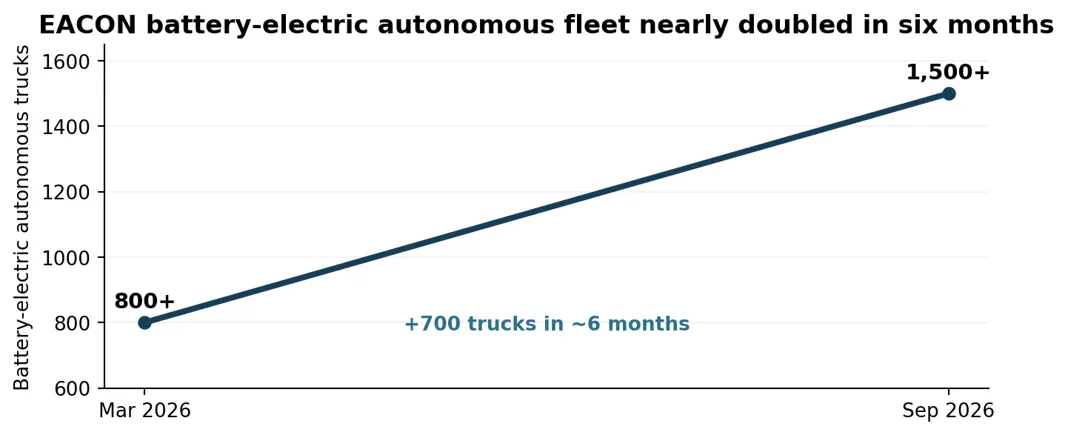
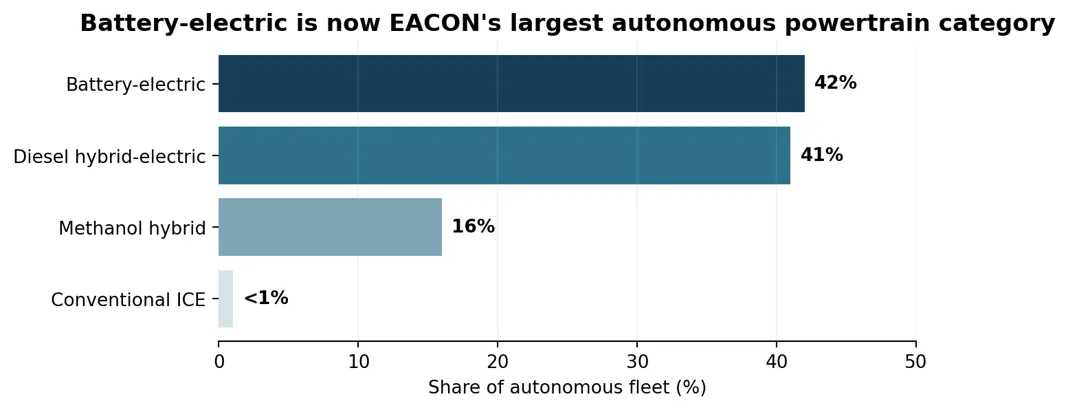
| AUTONOMY SCALE | EACON says its autonomous solution is deployed on 1,500+ battery-electric mining trucks, up from about 800 in March 2026. Battery-electric units are now its largest autonomous powertrain category. |
The Mining-Equipment Story Has Changed From “Can It Work?” to “How Fast Can It Scale?”
Mining electrification and autonomy are no longer defined by isolated prototypes. The stronger 2026 signal is repeat purchasing, fleet growth and the arrival of equipment ecosystems large enough to influence mine planning, dealer strategy, charging infrastructure, software procurement and aftermarket service.
The shift is happening through different commercial pathways. At Kisanfu in the Democratic Republic of Congo, CMOC has expanded its Zoomlion wide-body truck fleet beyond 200 units. These are conventional 80 t payload trucks rather than an electric-autonomous fleet, but the order matters because it proves that Chinese mining-equipment OEMs can win repeat, high-volume business at a major African copper-cobalt operation and support it with local service and spares.
In China, the technology transition is moving further. LiuGong used its November E-Intelligence event to display 210 machines, including 96 new-energy units, while autonomous battery-electric haulage fleets are already operating in triple-digit numbers at active mines. The commercial question is therefore moving from technology validation to fleet conversion timing.
Request Executive Sample: https://www.datamintelligence.com/download-sample/mining-equipment-market
Kisanfu Shows Why Fleet Penetration Can Matter More Than a Product Launch
Zoomlion's Kisanfu delivery is strategically important because it is a repeat-order story. CMOC had already purchased more than 100 mining trucks and then added another 100+ units, taking the operating fleet above 200. The ZT115G trucks carry an 80 t payload and are being deployed in demanding terrain at one of the world's most important copper-cobalt operations.
The equipment order also sits beside a production expansion. Kisanfu Phase II is expected to enter operation in 2027, adding 7.26 Mt/y of ore-processing capacity and 100,000 t/y of copper-metal capacity. For mining-equipment suppliers, that linkage matters: mine expansion, haulage demand, dealer presence, parts availability and lifecycle support are becoming one commercial package.
| 200+ Zoomlion trucks now operating | 80 t Payload of ZT115G fleet | 7.26 Mt/y Phase II processing addition | 100,000 t/y Added copper capacity |
Source: International Mining, 10 November 2026.
LiuGong Is Commercializing an Equipment Ecosystem, Not a Single Electric Machine
The LiuGong summit is a different signal. The company brought together about 2,000 dealers and customers and displayed 210 machines across mining, quarrying, roads, infrastructure, industrial applications and other sectors. Ninety-six were new-energy machines, equal to 45.7% of the total display.
For mining specifically, 11 machines demonstrated integrated operations across seven scenarios, combining electric equipment, autonomous functions and remote control. That is more important than the headline machine count. Mine operators do not electrify one truck in isolation. They need loaders, haulage, charging, control systems, dispatch software, maintenance support and interoperable work cycles. OEM competition is therefore shifting toward complete operating ecosystems.
Autonomous Battery-Electric Haulage Has Crossed the Thousand-Truck Threshold
EACON provides the clearest evidence that electric-autonomous haulage is moving beyond demonstration scale. By early September 2026, its autonomous solution had been deployed on more than 1,500 battery-electric mining trucks, nearly double the 800 units reported in March. Battery-electric trucks represented about 42% of the company's autonomous fleet, just ahead of diesel hybrid-electric at 41%.
Request a Customized Report According to Your Business Strategy: https://www.datamintelligence.com/customize/mining-equipment-market
The Proof Is Now in Operating Kilometres and Material Moved
Fleet count alone can still exaggerate maturity if vehicles are only commissioned intermittently. Several 2026 operating records provide a stronger test. At the Zhundong open-pit coal mine, 120 battery-electric 90 t trucks using EACON autonomy had accumulated more than 7 million km of safe operation. At the high-altitude Zhibula copper mine, 60 SANY battery-electric trucks entered full autonomous operation above 5,400 m.
At Shougang's Shuichang iron ore mine, a 27-truck autonomous battery-electric fleet had travelled more than 350,000 km and hauled over 11 million tonnes of material after the first 10 factory-fit vehicles were joined by 17 retrofit units. These operating metrics matter because they move the discussion from vehicle specification to production economics, utilization and fleet replacement decisions.
| 7+ million km Zhundong autonomous-fleet safe operation | 11+ million t Material hauled at Shuichang | 5,400+ m Elevation of Zhibula autonomous BEV operation |
Sources: International Mining reports on Zhundong, Zhibula and Shuichang deployments, 2026.
Chinese OEM Expansion Is Becoming a Two-Part Competitive Threat
The first threat to incumbent OEMs is manufacturing scale. The second is the ability to bundle hardware with batteries, autonomy, telematics and local service. Kisanfu shows the international fleet-penetration side. EACON, SANY, Tonly, XCMG and LiuGong show the electric-intelligent side. As these capabilities converge, Chinese suppliers can compete on more than acquisition price.
| MINE EXPANSION New haulage demand | OEM SCALE Repeat fleet orders | ELECTRIFICATION Battery + charging | AUTONOMY AHS + remote control | LIFECYCLE Parts + software + service |
That changes what mine owners and competitors need to benchmark. Purchase price remains important, but so do charging architecture, battery strategy, autonomous-system compatibility, dealer footprint, spare-parts availability, remote diagnostics, software economics and the ability to support mixed fleets over a decade or more.
Five Commercial Signals Mining-Equipment Companies Should Track
| Signal | What it reveals | Likely equipment opportunity | Commercial action |
| 100+ unit repeat order | Supplier has moved beyond trial status | Fleet replacement, parts, service | Target adjacent mines and contractors |
Mine expansion enters construction | Production growth will require new mobile fleet | Trucks, loaders, drills, support equipment | Engage before fleet spec is frozen |
Charging / energy study starts | Electric fleet decision is becoming operational | BEVs, chargers, substations, controls | Sell system architecture, not vehicle only |
| AHS retrofit begins | Operator wants autonomy without full fleet replacement | Autonomy kits, sensors, software | Position OEM-agnostic integration |
Dealer / service footprint expands | OEM is preparing for sustained local scale | Parts, maintenance, training, finance | Map channel partners and local gaps |
Why This Matters for the Mining Equipment Report
The market is no longer adequately explained by counting excavators, trucks and loaders. The commercial value is moving toward understanding which mines are actually converting fleets, which OEMs are winning repeat orders, where autonomy is retrofit versus factory-integrated, which powertrain technologies are moving into production and how dealer and service networks are expanding around those fleets.
A mine announcing an electrification target is not the same as a purchase order. A product launch is not the same as a 120-truck operating fleet. A 200-unit repeat order in Africa tells a different story again: it signals vendor acceptance, support capability and local competitive displacement. Separating those signals is where market intelligence becomes commercially useful.
| WHAT THE DATAM MINING EQUIPMENT REPORT HELPS ANSWER • Which equipment categories are shifting fastest toward electric, hybrid and autonomous platforms? • Which mine operators are moving from pilots to fleet-scale deployment? • How are Chinese OEMs expanding across Africa, Australia and other international mining markets? • Which companies lead in autonomous haulage, battery equipment, underground electrification and digital fleet systems? • Where do dealer networks, aftermarket service and local parts availability create competitive advantage? • Which current mine expansions are likely to translate into the next major equipment orders? |
Use the report to move from “mining automation is growing” to mine-by-mine, OEM-by-OEM decisions on fleet conversion, competitive positioning and sales opportunity: View the DataM Intelligence Mining Equipment Market Report