


Executive Summary
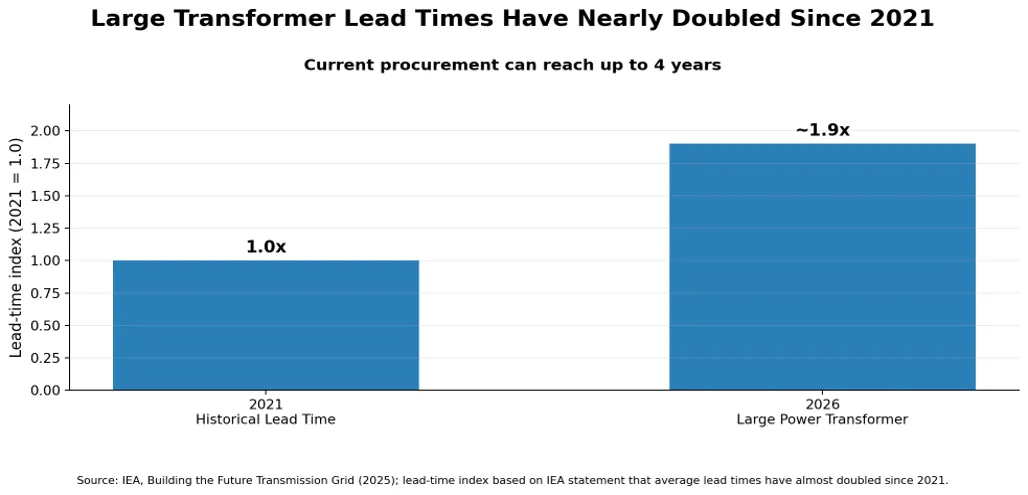
Utility-scale power transformers have shifted from a procurement line item into a critical-path asset for Middle East grid expansion. The global market now requires up to four years to secure large power transformers, with average lead times almost double 2021 levels. At the same time, transformer prices have risen around 75% in real terms since 2019. The Middle East is entering this squeeze while Saudi Arabia and the UAE are accelerating 380-400 kV grid expansion, renewable interconnections, data-center loads and major generation additions.
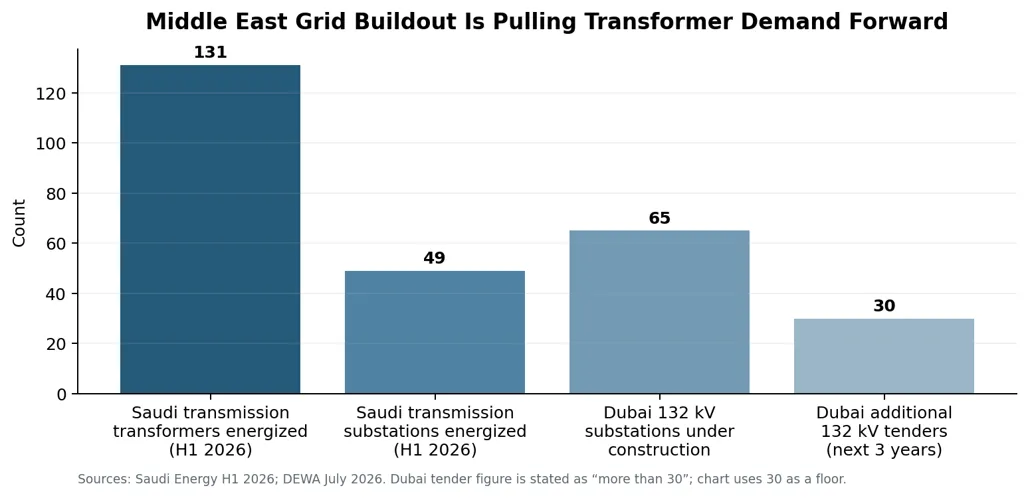
The regional problem is timing. Saudi Energy energized 131 transmission transformers and 49 transmission substations in H1 2026 alone, while Dubai is building 65 new 132 kV substations and plans more than 30 additional tenders over the next three years. Local manufacturing is expanding, but key new capacity in Saudi Arabia is scheduled to move from construction in late 2026 into pilot and commercial production through 2027. Procurement teams therefore face a period when project demand is rising faster than local factory relief.
| Up to 4 years | 75% | 131 | Q3 2027 |
Large power-transformer procurement | Transformer price increase vs. 2019 | Saudi transmission transformers energized in H1 2026 | Planned commercial start for SPTC EHV expansion |
Request For Demo: https://www.datamintelligence.com/electroiq#demo
At a Glance
- Large power-transformer lead times have almost doubled since 2021, while cable and transformer procurement is now increasingly determining grid project schedules rather than civil construction alone.
- Saudi transmission substation capacity reached 559,831 MVA in H1 2026, up 9% year on year, with 49 new transmission substations and 131 transmission transformers energized during the half.
- Dubai commissioned 1,200 MVA of 132 kV substation capacity plus a 2,000 MVA 400/132 kV substation in H1 2026, while 65 additional 132 kV substations are under construction.
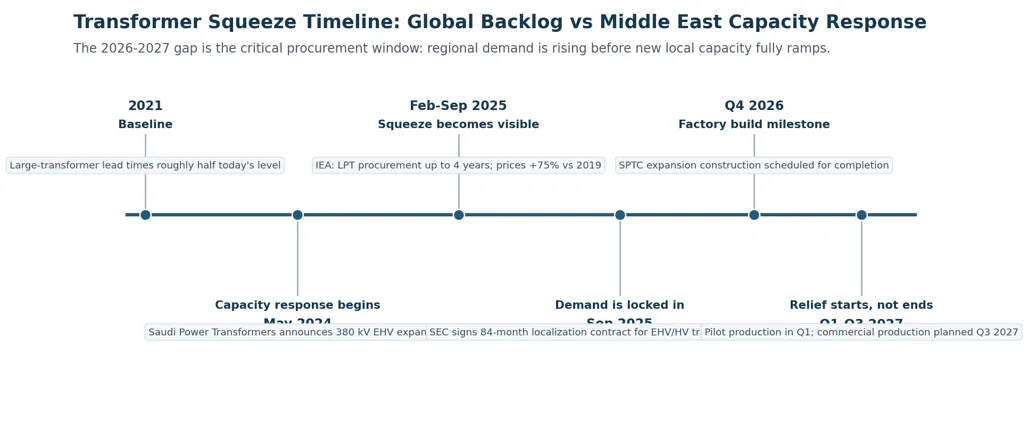
- Saudi Power Transformers is expanding into 380 kV EHV transformers and reactors; construction was scheduled for Q4 2026 completion, pilot production for Q1 2027 and commercial production for Q3 2027.
- Siemens Energy is also expanding Dammam with a new large-power-transformer factory aimed at Saudi 380 kV demand, indicating that localization is moving from policy into manufacturing capacity.
Four Forces Are Tightening the Middle East Transformer Market at the Same Time
The squeeze is not being caused by one project type. Grid reinforcement, renewable integration, generation additions and AI/data-center infrastructure are all competing for the same transformer manufacturing slots. Large units are engineered-to-order, factory-tested and difficult to substitute late in a project. Once a utility has frozen MVA rating, voltage ratio, impedance, cooling arrangement, tap changer, loss requirements and transport envelope, switching suppliers can trigger redesign and requalification rather than a simple purchase-order change.
This is why supply-chain risk becomes more severe at the high-voltage end of the market. Standard distribution transformers can be sourced from a wider manufacturing base. A 380 kV autotransformer, generator step-up unit or HVDC converter transformer requires specialist engineering, winding capacity, test bays, high-voltage bushings and heavy transport logistics. The bottleneck sits across the full production chain, not just final assembly.
Source: Saudi Energy H1 2026 earnings release; DEWA, July 2026
Explore ElectroIQ Intelligence
Discover how ElectroIQ helps you track electrical equipment demand, monitor lead times and identify emerging market opportunities: https://www.datamintelligence.com/electroiq#demo
Transformer Supply Risk: Price vs. Availability
The most important distinction for buyers is whether a risk can be solved by paying more or whether capacity is physically unavailable. Copper and steel volatility primarily raise price. Factory slots, test capacity and qualified high-voltage components create availability risk. The latter is harder to manage because a higher budget does not automatically create an earlier delivery date.
| Risk | Primary impact | Typical duration | Middle East implication |
Copper / aluminium / GOES | Price | Weeks to months | Raises bid validity risk and escalation clauses |
Large-transformer factory slots | Availability | 2-4 years | Can determine substation energization date |
HV bushings / OLTCs / specialty insulation | Availability + price | Months to >1 year | Single-component delay can hold final assembly |
High-voltage test-bay capacity | Availability | Months | Completed unit may still queue for FAT / dielectric testing |
Heavy-haul / port logistics | Schedule | Weeks to months | 380-500 kV units require route studies and controlled transport |
Utility qualification / specification changes | Schedule | Months | Late supplier substitution can reset approvals |
The Lead-Time Shift Is Now Large Enough to Change Project Sequencing
The IEA reports that large power transformers can now take up to four years to procure and that average transformer and cable lead times have almost doubled since 2021. This changes the order of operations. Transformer sourcing can no longer wait until detailed design is complete. Utilities and EPCs increasingly need to reserve manufacturing capacity during front-end engineering, then lock specifications progressively while protecting the production slot.
Source: International Energy Agency, Building the Future Transmission Grid
Turn Market Signals into Business Opportunities
Explore equipment-level intelligence to support procurement planning, supplier evaluation and strategic market expansion: https://www.datamintelligence.com/electroiq#demo
Timeline: The Backlog Is Arriving Before New Regional Capacity Fully Ramps
The Middle East is responding with localization, but the manufacturing response has its own lead time. The gap between project awards and commercial factory ramp-up is therefore the most important sourcing window to watch.
Source: IEA; Saudi Exchange / Electrical Industries Co.; Saudi Electricity Co.
Saudi Arabia Shows How Demand Visibility Can Unlock Manufacturing Capacity
Saudi Arabia is turning long-term utility demand into factory investment. Electrical Industries Co. approved a SAR 192 million expansion of Saudi Power Transformers to manufacture 380 kV extra-high-voltage transformers and reactors while increasing existing high-voltage capacity. In September 2025, the subsidiary signed an 84-month contract with Saudi Electricity Company for localization and supply of EHV and HV transformers and reactors valued at SAR 1.411 billion, with SEC retaining an option to increase the value by up to 40%.
The contract matters because it gives a manufacturer demand visibility across multiple years. Large-transformer plants require specialized winding, drying, assembly and test infrastructure plus scarce engineering talent. Without a credible order pipeline, manufacturers are reluctant to add capacity that may sit underutilized later. Framework-style commitments reduce that risk and can pull local investment forward.
Case Study: A 380 kV Localization Cycle
| Stage | Timing | What changes |
Factory expansion approved | May-24 | Adds 380 kV EHV transformer/reactor capability and raises HV capacity |
Long-term utility contract signed | Sep-25 | Creates multi-year demand visibility and localization commitment |
Construction completion planned | Q4 2026 | Physical capacity becomes available for commissioning and qualification |
| Pilot production | Q1 2027 | Process validation, testing and customer qualification begin |
Commercial production planned | Q3 2027 | Regional supply starts to provide meaningful backlog relief |
Source: Saudi Exchange filings by Electrical Industries Co.
Global Supply Chains Still Matter Even When Assembly Localizes
Localization will reduce exposure to long-distance finished-unit imports, but it will not immediately eliminate global dependencies. Grain-oriented electrical steel, copper, bushings, tap changers, specialty insulation, monitoring systems and engineering expertise remain internationally sourced in many transformer value chains. The IEA has identified copper, aluminium and grain-oriented electrical steel as upstream materials contributing to cost and supply pressure.
The Saudi HVDC buildout illustrates this continued global dependence. Hitachi Energy manufactured 14 transformer units in Brazil for a Saudi HVDC project; each unit is rated at 580 MVA and 380 kV, weighs roughly 342 tonnes for transport and exceeds 512 tonnes fully installed. The associated HVDC systems are designed for up to 9 GW. Even a market pursuing localization will therefore continue to depend on global factory networks for specialized designs during the transition.
The UAE Adds a Second Demand Center for Regional Transformer Capacity
Dubai is expanding its transmission system at the same time. In H1 2026, DEWA commissioned eight 132 kV substations with 1,200 MVA of conversion capacity and one 400/132 kV substation with 2,000 MVA of capacity. It is currently building 65 more 132 kV substations and one 400 kV substation, with more than 30 additional 132 kV tenders planned over the next three years. That pipeline competes with Saudi projects for many of the same international OEM factories, components and engineering resources.
DEWA is also standardizing digital 132 kV substation designs. Its reusable design has supported 90 substations and reduced design and implementation time by more than two months. This highlights an important procurement lesson: utilities can compress engineering and civil schedules faster than transformer factories can add specialized production. Standardization therefore increases the value of securing transformer capacity early because downstream execution can move more quickly once equipment is available.
Explore ElectroIQ Intelligence
Discover how ElectroIQ helps you track electrical equipment demand, monitor lead times and identify emerging market opportunities: https://www.datamintelligence.com/electroiq#demo
Strategic Synthesis: Why the Transformer Squeeze Could Persist Beyond 2027
The current shortage is unlikely to disappear as soon as new factories open. Capacity expansions must still recruit and train specialist labor, qualify processes, pass utility approvals and build supplier ecosystems. At the same time, regional demand is not static. Saudi Arabia is expanding transmission, renewables, storage, interconnections and new power generation while the UAE continues to add transmission substations and large loads. New transformer capacity may therefore be absorbed quickly rather than creating a period of oversupply.
For procurement teams, the key question is not whether global lead times eventually improve. It is whether a specific project can secure a qualified slot early enough to preserve its energization date. For manufacturers, the opportunity is to translate local content into delivery certainty: regional engineering, local test capability, component inventory, repair capacity and long-term utility frameworks can be as valuable as final assembly itself.
Executive Imperatives: Five Transformer Sourcing Actions for Middle East Projects
1. Reserve factory slots before detailed design is fully frozen?
The production queue can now exceed the design cycle; commercial teams should secure capacity during FEED and manage specification closure against the reserved slot.
2. Separate price exposure from physical-capacity exposure?
Copper hedging can manage cost, but it cannot solve a missing 380 kV test slot or unavailable bushing. Procurement dashboards should track both.
3. Qualify second-source designs before the project becomes critical?
Alternate OEMs and component substitutions are most useful before final protection studies, civil interfaces and utility approvals are locked.
4. Use localization contracts to create capacity, not just meet local-content scoring?
Multi-year commitments can justify new winding lines, test bays, training and spares that directly improve delivery resilience.
5. Track factory ramp-up against project energization dates?
The highest-risk projects are those whose required-on-site date falls before regional capacity expansions reach stable commercial production.
The Next Layer of Intelligence: Mapping Factory Slots to Projects
DataM Intelligence’s ElectroIQ platform can add a commercial layer to this supply-chain view by linking project-level transmission, generation, renewable and data-center developments with equipment lead-time intelligence. For transformer suppliers, the opportunity is not only to know that lead times are long, but to identify which 132 kV, 220 kV, 380 kV and HVDC projects have near-term energization dates, where incumbent delivery windows are slipping and where alternate qualified capacity could change the project schedule.