


India’s semiconductor ambitions are entering a more demanding phase. Announcements around design centres, chip assembly and policy incentives created early momentum. The next test is whether the country can establish a reliable industrial ecosystem that supports advanced manufacturing from materials and components through engineering, validation and talent.
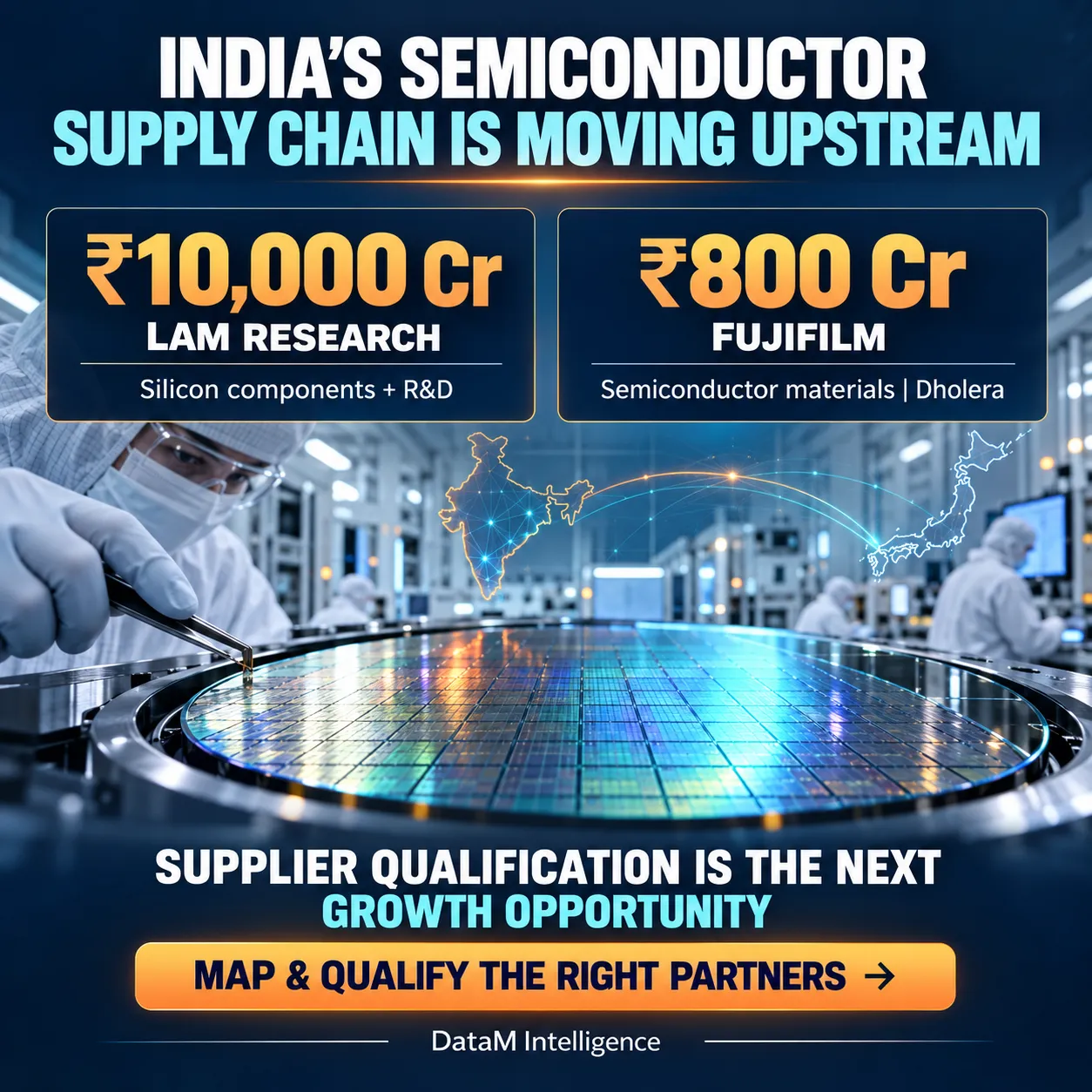
Lam Research’s plan to invest nearly ₹10,000 crore in India is a significant signal in that transition. The semiconductor equipment company intends to establish its first silicon-component manufacturing facility in the country and expand research and development capabilities. Its proposed manufacturing activity would span silicon-ingot production and processing for advanced semiconductor technologies and leading-edge nodes.
For India’s semiconductor ecosystem, this is more than a capital-expenditure headline. It creates a partnership challenge. A high-specification silicon-component operation cannot scale through construction alone. It needs a qualified network of material providers, precision-engineering firms, process specialists, metrology partners, academic institutions, infrastructure providers and workforce-development collaborators. The companies that identify those partners early-and assess them with discipline-will be better placed to capture new revenue while avoiding expensive supplier and execution mistakes.
Request for FREE Trial Access: https://www.datamintelligence.com/capabilities/partnership-identification
What Lam Research has announced
Lam Research has said it intends to invest nearly ₹10,000 crore over the coming years to establish a silicon-component facility in India and augment R&D operations. The company’s existing India Center for Engineering already contributes to design, testing, validation and next-generation technology development for global customers. The new plan strengthens that platform with a manufacturing dimension.
The announcement is also tied to talent and ecosystem development. Lam has indicated that it will continue collaborating with government, academia, suppliers, start-ups and other stakeholders. Its workforce initiatives include an education partnership involving the Indian Institute of Science and India Semiconductor Mission, with a stated ambition to provide semiconductor-manufacturing learning access to up to 60,000 students over the next several years.
This creates a useful distinction for market participants. The investment intent is clear, but several operating details have not yet been publicly set out, including facility location, commissioning milestones, production capacity, vendor list and local-content requirements. That uncertainty should not be treated as a reason to wait. It is the window in which potential partners should decide where they fit, close qualification gaps and develop an outreach strategy before the supplier base becomes crowded.
Why silicon components matter to India’s semiconductor strategy
Silicon-component manufacturing is not a simple extension of conventional electronics production. The applications associated with advanced semiconductor production require exacting standards for material quality, purity, dimensional consistency, contamination control, traceability and process reliability. A supplier that performs well in general industrial manufacturing may still be unprepared for semiconductor-grade requirements.
That reality expands the opportunity beyond one plant. A new silicon-component ecosystem can create demand for ultra-pure materials, specialist chemicals, high-precision machining, cleaning and surface-treatment services, metrology equipment, testing laboratories, cleanroom services, industrial automation, secure logistics and maintenance support. It can also bring fresh demand for university collaboration and specialist technical training.
For global equipment suppliers and Indian industrial companies, the strategic question is not merely, “Can we supply this project?” It is, “Can we become a credible long-term partner in a value chain where quality failures can delay customer qualifications and disrupt costly manufacturing operations?”
The partnership opportunity map
The Lam Research announcement can be viewed as a catalyst for six partnership areas.
High-purity silicon and material inputs. Companies with relevant material-processing, purity-control and traceability capability may have a route into the ecosystem. However, buyers will assess feedstock reliability, quality documentation, import exposure and the ability to scale without compromising specifications.
Precision engineering and advanced components. Silicon processing depends on manufacturing partners that can meet tight tolerances and maintain repeatability. Machining, tooling, specialty components and contamination-controlled handling are areas where technical evidence matters more than proximity alone.
Specialty chemicals, gases and process support. Semiconductor manufacturing uses highly controlled chemicals and gases. Suppliers must be able to demonstrate purity, safety, storage, transportation and continuity plans, alongside their commercial competitiveness.
Metrology, testing and validation. New manufacturing capability also increases the need for inspection, testing, failure analysis and qualification support. This can create opportunities for instrument suppliers, laboratories and engineering service providers with semiconductor-relevant capability.
R&D, talent and co-development. India’s engineering talent base is a strength, but semiconductor manufacturing requires application-specific skills. Universities, research institutions, simulation providers, design-service companies and workforce partners can play a direct role in shortening the path from learning to production readiness.
Operations, infrastructure and lifecycle services. Cleanroom infrastructure, utilities, automation, secure logistics, maintenance and waste-management solutions can become important components of the operating model. These partners need to demonstrate response speed, EHS discipline and familiarity with high-availability manufacturing environments.
India’s opportunity is an execution challenge
Many companies will respond to this type of investment news by building a broad prospect list. That is an understandable first step, but it is not a partnership strategy. A directory cannot show whether a potential supplier is ready for semiconductor-grade qualification, whether a technology company has the right intellectual-property model, or whether an engineering partner can meet the volume requirements of a multi-year programme.
The risk of weak partner selection is material. A manufacturer can encounter delayed qualification cycles, inconsistent material quality, compliance issues, single-source dependence or a lack of capacity at precisely the point demand begins to rise. For a prospective partner, poorly targeted outreach can waste months and weaken credibility with a strategic customer.
Leadership teams therefore need a smaller set of better questions:
- Which supply-chain gaps are likely to require external partners?
- Which Indian companies have the right technical and quality credentials today?
- Who can scale over the next three to five years?
- Which partnerships should be pursued as supply agreements, co-development relationships, channel arrangements or potential investments?
- Which candidates carry commercial, financial, regulatory or geopolitical risks that should prevent early engagement?
The answers require market mapping, but they also require qualification. The most valuable partner is rarely the most visible name in an online search. It is the company whose capability, growth direction, quality systems and appetite for engagement align with the specific operating need.
A more disciplined approach to partner identification
For semiconductor businesses evaluating India, partner identification should begin with the strategic requirement, rather than a generic company list. First, define the precise gap: an alternate source of high-purity materials, a precision-manufacturing collaborator, an R&D relationship, a distribution route or a local services capability. This establishes the success criteria against which every candidate can be evaluated.
Next, map the partner universe across the full value chain. The right target may be a specialist supplier, a local manufacturer with an underused capability, an engineering-services company, a research institution, a distributor or an emerging technology business. Mapping should capture not only capacity and location, but also customer mix, quality accreditations, investment activity, technology partnerships and expansion signals.
The shortlisted companies should then be scored against six practical dimensions: strategic fit, market access, capability fit, scalability, risk profile and likelihood of engagement. This prevents the common mistake of choosing partners only because they are established, nearby or inexpensive. A candidate may be commercially attractive but lack semiconductor-grade process control; another may have excellent technology but limited appetite to support a multi-year partnership.
Finally, a partnership programme needs an outreach roadmap. The immediate goal is not simply to send introductory messages. It is to determine who should be engaged now, who should be monitored as capability develops and who should be excluded from the current strategy. That sequence helps business-development and procurement teams use their time where the probability of conversion is strongest.
How DataM Intelligence supports semiconductor partnership decisions
DataM Intelligence’s Partnership Identification service helps teams move from market interest to a prioritised, outreach-ready partner strategy. The framework identifies and qualifies potential suppliers, technology collaborators, manufacturers, distributors and commercial partners across the relevant value chain.
For a semiconductor company entering India, this work can begin by defining priority technologies, target states, product applications and local capability gaps. The partner universe is then mapped and evaluated against the company’s business model: whether the requirement is to sell with a partner, sell through a channel, secure an alternate supplier, co-develop technology or explore investment and acquisition options.
Rather than delivering a raw list of names, the process produces a ranked shortlist with each company’s value-chain role, strategic rationale, capability assessment, scale outlook and risk profile. The aim is to give leadership teams a clear basis for deciding whether to engage, build, acquire or monitor. A 60- or 90-day outreach roadmap then turns research into sequenced commercial action.
This is especially relevant in semiconductor markets, where the cost of selecting the wrong partner can be greater than the cost of taking time to qualify the right one. As India attracts investment across materials, equipment, electronics manufacturing and advanced R&D, partner intelligence becomes a commercial capability-not a background research exercise.
What decision-makers should do next
The Lam Research development should prompt semiconductor leaders to review their India strategy before project ecosystems mature. Suppliers should assess whether their quality, traceability and capacity credentials can withstand advanced-manufacturing due diligence. Technology companies should identify the use cases where local co-development can create an advantage. Investors and strategic teams should track emerging component, material and engineering businesses that may become critical ecosystem nodes.
The key is to act with focus. India’s semiconductor opportunity will not be captured by every company that describes itself as a supplier to the industry. It will reward businesses that can identify a distinct value-chain role, demonstrate credible capability and engage the right partners before they become fully committed elsewhere.
Lam Research’s planned investment is a vote of confidence in India’s talent base and expanding semiconductor ecosystem. Its wider significance lies in what it could activate: a more connected, more technically demanding and more partnership-driven industrial network. Companies that build their partner strategy now can help shape that network-and secure a stronger position within it.
Ready to identify the right semiconductor partners?
DataM Intelligence helps businesses identify, qualify and prioritise suppliers, technology partners, manufacturers, distributors and market-entry collaborators. Our Partnership Identification framework gives leadership teams a scored shortlist and an outreach-ready roadmap so they can grow revenue, reduce dependency risk and scale with confidence.
Explore our Partnership Identification service to build an India semiconductor partnership strategy aligned to your commercial and operational goals.