


Automotive Wiring Harness Market Perspective | November 2026
| TRIGGER | JAMA and JAPIA have launched a cross-OEM effort to standardize wire-harness specifications, reduce wire varieties and coordinate production automation. |
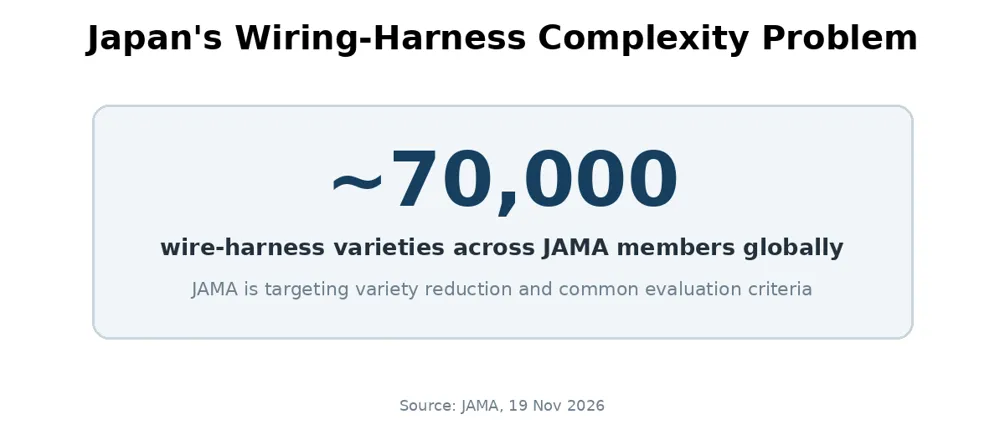
| SCALE | JAMA says its member automakers use roughly 70,000 wire-harness variants globally - an enormous SKU and validation burden. |
| COMMERCIAL QUESTION | Which suppliers gain from common platforms and automation, and which revenue pools are disrupted as proprietary harness specifications begin to converge? |
The Industry Is Standardizing the Friction, Not the Vehicle
On November 19, 2026, the Japan Automobile Manufacturers Association and the Japan Auto Parts Industries Association moved wire harnesses into the first wave of cross-OEM standardization, alongside steel and resin. The point is not to make Toyota, Honda, Nissan, Mazda or Subaru electrically identical. The point is to remove duplicated requirements that suppliers repeatedly engineer, validate and manufacture even when the underlying function is similar.
JAMA's own wiring-harness task force identified the scale of the problem: across its members' global operations there are roughly 70,000 harness varieties. That complexity is compounded by differences in high-voltage wire color specifications, connector insertion-load requirements, wire-type selections and OEM-specific evaluation criteria. These differences create engineering work, tooling variation, inspection burden and inventory that do not necessarily create customer-visible value.
Request Sample: https://www.datamintelligence.com/download-sample/automotive-wiring-harness-market
Three Workstreams Show Where the Cost Is Expected to Come Out
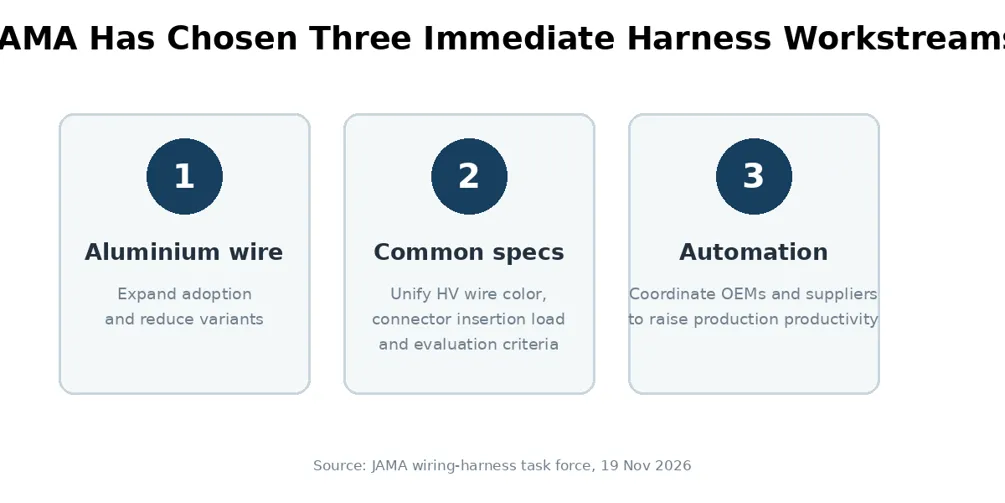
The wiring-harness program is being organized around three concrete tracks. First, JAMA wants to expand aluminium wire adoption while reducing the number of wire types and harmonizing evaluation methods. Second, it is targeting specification convergence, with examples including high-voltage cable color and connector insertion load. Third, it wants OEMs and suppliers to cooperate on production automation so the industry can move away from highly labor-intensive harness assembly.
That is a meaningful supplier-model shift. The traditional harness business has benefited from OEM-specific complexity because every platform can require its own validated combination of wires, terminals, connectors, branch lengths and assembly instructions. A common specification can reduce engineering duplication, but it also raises the importance of scale, modular design, automation capability and the ability to win common-platform content across several automakers at once.
Why This Is Happening Now: Harness Cost Is Becoming a Strategic Problem
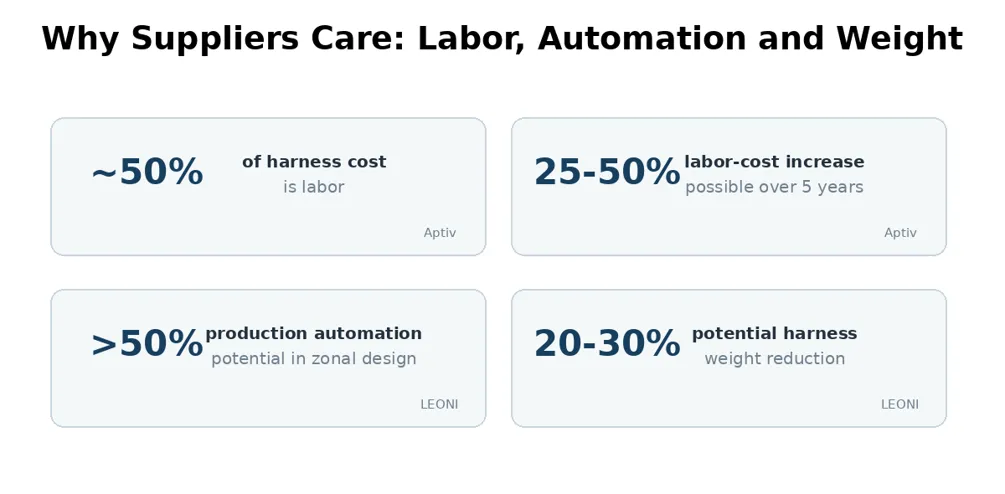
Aptiv estimates that roughly half of wiring-harness cost is labor and that labor costs in key manufacturing countries could rise 25%-50% over the next five years. LEONI argues that zonal architectures can increase the degree of harness-production automation to well above 50% and may reduce optimized harness weight by 20%-30%. JAMA's standardization push therefore lands at the same moment the supplier base is trying to automate a product that has historically resisted automation because of long, flexible, customer-specific assemblies.
The strategic implication is that standardization can make automation easier even before the vehicle moves fully to a zonal E/E architecture. Fewer wire variants, common connector requirements and common evaluation criteria increase the repeatability that automated cutting, terminating, routing and assembly equipment needs.
The Bigger Capital Shift: Standardize Today, Re-Architect Tomorrow
JAMA explicitly says the goal is to free development resources for new technologies, multi-pathway powertrains and software-defined vehicles. That matters because the wiring harness itself is moving from a passive bundle of point-to-point connections toward a physical layer built around zone controllers, high-speed Ethernet, localized power distribution and centralized computing.
Request a Customized Report According to Your Business Strategy: https://www.datamintelligence.com/customize/automotive-wiring-harness-market
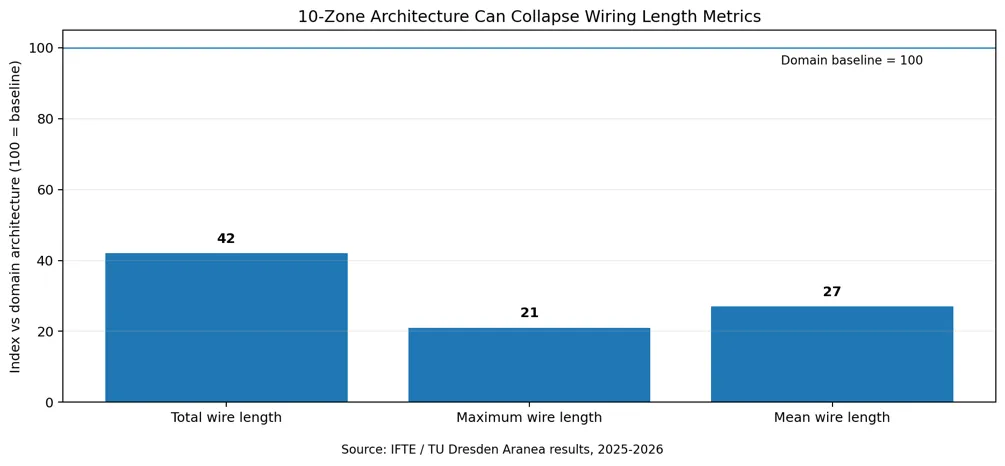
Academic and industrial architecture studies show why that matters. IFTE/TU Dresden's Aranea work found that a 10-zone architecture can reduce total wire length to roughly 42% of a comparable domain architecture, while maximum and mean wire lengths fall to around 21% and 27% of the domain baseline. A separate 2026 IEEE Access study using a battery-electric-vehicle model reported cable-length savings close to 69% across several zonal communication topologies. These are architecture-specific studies, not universal production guarantees, but they illustrate the direction of travel.
This means the JAMA initiative can be read as a two-stage competitiveness strategy: remove unnecessary variation from today's harnesses, then redirect engineering capacity toward tomorrow's zonal architecture. Suppliers that treat standardization only as a price-down exercise risk missing the larger transition in where wiring-system value is created.
What Changes for Yazaki, Sumitomo Electric, Furukawa and the Tier-2 Base
| Signal | Near-Term Effect | Supplier Pressure | Opportunity |
| Variant reduction | Fewer duplicate specifications | Lower engineering/validation revenue per variant | Higher common-platform volume |
| Aluminium wire | More lightweight conductor qualification | Material/process requalification | Copper substitution and lightweighting |
| Common criteria | Less OEM-specific testing | Lower differentiation through proprietary specs | Faster launch across multiple OEMs |
| Automation | More repeatable harness designs | Capex and process redesign | Higher local production viability |
| Zonal E/E | Shorter, modular sub-harnesses | Legacy harness content declines | Zone boxes, high-speed data and power distribution |
Yazaki is not a distant observer in this process. JAMA's November presentation identifies a Yazaki executive as one of the JAPIA working-level leaders participating in the supply-chain resilience effort. That makes the initiative less about automakers imposing a finished standard on suppliers and more about co-designing a common industrial base.
The likely competitive split is therefore not 'OEMs win, suppliers lose.' Large harness suppliers can benefit from longer production runs, fewer low-volume variants and greater automation, but they may face tougher price competition once specifications become more interchangeable. Smaller suppliers and connector specialists could gain access to multi-OEM volumes if common standards lower qualification barriers, while businesses built around highly customized validation work may see some of that complexity premium disappear.
The Aftermarket Effect Is Real - But It Comes Later
Common connectors, wire specifications and evaluation criteria could eventually simplify service-parts inventories, repair pigtails and cross-brand component sourcing. However, the November 19 announcement does not promise immediate interchangeability of complete harness assemblies. JAMA has not yet published the exact components covered, the first common specification or a mandatory adoption timetable. Participation is also voluntary under Japanese antitrust guidance.
The near-term commercial effect is therefore upstream: engineering standards, supplier quotations, tooling, qualification, sourcing and automation planning. Aftermarket simplification becomes meaningful only after common specifications enter production vehicles and those vehicles accumulate in the service parc.
Why This Creates a Research Buying Window
For wiring-harness manufacturers, connector suppliers, terminals companies, copper and aluminium conductor suppliers, automation vendors and aftermarket distributors, the key question is no longer whether Japan wants standardization. It is which specifications converge first, which OEMs adopt them, how fast supplier part numbers can be consolidated and how much content shifts from conventional harnesses into zonal controllers and high-speed networks.
A useful Automotive Wiring Harness Market report should therefore go beyond market value and volume. It should track OEM-by-OEM architecture roadmaps, harness material shifts, connector and terminal standardization, aluminium-wire adoption, supplier exposure by customer, automation investment, zonal E/E programs and the timing of aftermarket crossover. The November 19 JAMA announcement creates the policy and procurement trigger. The commercial opportunity lies in identifying who gains as 70,000 variants begin to converge.