


Request FREE Demo For ElectroIQ: https://www.datamintelligence.com/electroiq
DMI Analyst View
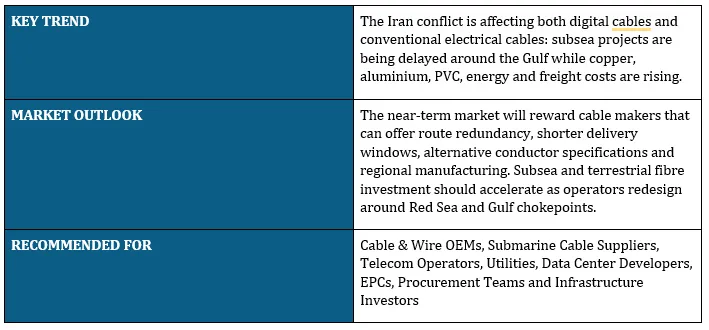
The Iran war is creating a two-sided shock for the cables and wires sector. The visible risk is to submarine fibre: cable-laying and repair activity in the Persian Gulf and Red Sea has become harder, more expensive and in some cases commercially unworkable. The less visible effect is moving through the electrical cable value chain as energy, shipping, copper, aluminium and polymer costs rise at the same time that power, data center and grid projects continue to demand more cable.
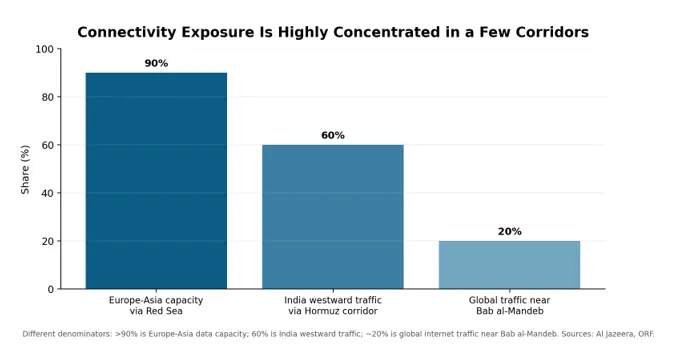
The key strategic point is that the Strait of Hormuz is regionally critical without being the single backbone of the global internet. The International Cable Protection Committee, citing TeleGeography, estimates that bandwidth traversing Hormuz is less than 1% of global international bandwidth. The vulnerability is concentrated: ORF estimates roughly 60% of India's westward data traffic uses the Hormuz corridor while Al Jazeera cites estimates that more than 90% of Europe-Asia data capacity passes through the Red Sea. A disruption can therefore be devastating for individual markets even when global traffic reroutes.
For cable manufacturers, the opportunity is emerging from redundancy spending. Telecom operators need new subsea and terrestrial routes. Data centers need diverse fibre entries plus resilient power feeds. Utilities and EPCs face higher conductor costs and longer procurement cycles. Suppliers that can qualify alternate routes, substitute conductor designs and secure production capacity can gain share from projects whose incumbent cable plan no longer fits the new risk environment.
Source: Al Jazeera; Observer Research Foundation
Request FREE Demo For ElectroIQ: https://www.datamintelligence.com/electroiq
Submarine Cable Projects Are Becoming the First Visible Casualty
The most immediate sector impact is on subsea fibre projects in and around the Persian Gulf. Submarine Networks reported that the Meta-led 2Africa Pearls extension was halted after active military operations made cable-laying unsafe. Alcatel Submarine Networks issued force-majeure notices and the cable vessel Ile De Batz was unable to complete its mission near Saudi Arabia. A significant portion of cable had already been placed on the seabed but remained unconnected to landing stations.
The broader 2Africa system spans roughly 45,000 km and was designed to serve connectivity needs for more than 3 billion people. The Pearls extension was intended to connect Oman, the UAE, Qatar, Saudi Arabia, Bahrain, Kuwait, Iraq, Pakistan and India. That scale turns a local construction stoppage into a regional capacity-planning problem.
Other systems face similar pressure. SEA-ME-WE 6 has already been delayed and its Gulf extension depends on a corridor through Hormuz. Ooredoo's Fibre in Gulf project is exposed for the same reason while its parallel terrestrial strategy through Iraq and Turkey has become more strategically valuable. Submarine Networks argues that the proposed US$700 million WorldLink Transit Cable Project has also lost much of the commercial logic that depended on the Gulf being a reliable alternative to the Red Sea.
| Project | Original strategic role | 2026 conflict impact | Cable-sector implication |
| 2Africa Pearls | Gulf extension of 45,000 km 2Africa system | Work halted / force majeure; unconnected sections remain | Deferred subsea revenue; future demand shifts toward safer routes and landing diversity |
SEA-ME-WE 6 / Gulf Extension | Asia-Europe capacity with hybrid subsea-terrestrial architecture | Completion uncertainty increases | More value in terrestrial bypass fibre and route diversity |
| Fibre in Gulf (FIG) | Connect seven GCC markets | Subsea component exposed | Parallel Iraq-Turkey terrestrial corridor becomes more valuable |
| WorldLink Transit | US$700m dual subsea + terrestrial Gulf-Iraq-Turkey concept | Core Gulf premise weakened | Higher hurdle for financing new Gulf subsea systems |
Request FREE Demo For ElectroIQ: https://www.datamintelligence.com/electroiq
The Red Sea and Hormuz Now Form a Dual Connectivity Risk
The problem is not simply that one cable route is risky. Operators are simultaneously managing instability around Bab al-Mandeb and the Red Sea plus military risk in the Persian Gulf. Al Jazeera reports that more than 90% of data capacity between Europe and Asia is routed through cables under the Red Sea. Bab al-Mandeb is only about 26 km wide at its narrowest, making route diversity difficult even when multiple cable systems exist.
Recent history shows how long physical restoration can take. In 2024, three Red Sea cables were damaged after a vessel disabled by a Houthi missile dragged anchor. ORF notes the event disrupted about 25% of internet traffic between Asia and Europe and one cable required roughly five months to repair because specialised vessels could not safely access the area.
That repair constraint is crucial for the cable industry. Subsea systems do not only require manufacturing capacity. They require specialised cable ships, permits, marine surveys, landing access, security guarantees and weather windows. A cable can therefore be physically repairable yet commercially unavailable for months if the maritime operating environment is unsafe.
India Is One of the Most Exposed Large Digital Markets
India illustrates why regional exposure matters more than headline global bandwidth share. ORF identifies seven significant undersea cable systems traversing the Strait of Hormuz and says four are directly important to India: FALCON, Gulf Bridge International, SEA-ME-WE 6 and AAE-1. Approximately 60% of India's westward data traffic is estimated to use the corridor.
This makes cable resilience an economic issue for banking, cloud, energy, IT services and data centers. ORF estimates a 24-hour internet disruption could cost India's IT and services economy as much as US$920 million. That creates a direct commercial case for alternative landing stations, eastbound routing, terrestrial bypasses and new submarine systems that avoid Hormuz entirely.
The response has already moved into investment planning. ORF points to Google's announced US$15 billion America-India Connect initiative, intended to create additional links toward Singapore, South Africa and Australia. Even where individual project schedules change, the direction of investment is clear: geopolitical redundancy is becoming a design specification for international fibre networks.
The War Is Also Raising the Cost of Conventional Cables & Wires
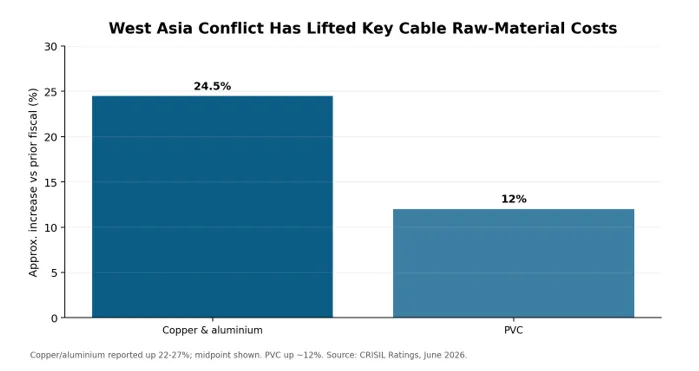
The second impact channel is raw materials. Cables and wires are heavily exposed to conductor and insulation costs, particularly copper, aluminium and PVC. CRISIL Ratings reported in June 2026 that copper and aluminium prices had risen 22-27% over the previous fiscal while PVC increased about 12%, with tightening supply linked partly to the West Asia conflict.
The pressure reaches further upstream. S&P Global modeled a 5.1% increase in global copper mining costs under 2026 assumptions that incorporated Strait of Hormuz disruption. Higher sulphur, sulphuric acid, fuel, electricity and transportation costs raise copper production economics even when the conflict does not remove a large volume of copper directly from the market.
That distinction matters. Iran itself accounted for only about 1.5% of global mined copper and 1.2% of refined copper production in 2025 according to S&P Global. The larger cable-market impact therefore comes from energy, reagents, logistics and risk premiums rather than the physical loss of Iranian copper supply.
Source: CRISIL Ratings
Request FREE Demo For ElectroIQ: https://www.datamintelligence.com/electroiq
Cable Prices Can Rise Even While Project Demand Remains Strong
Cable manufacturers are unusually well positioned to pass through raw-material inflation because cable typically represents a relatively small share of total project cost. CRISIL notes that cables and wires generally account for less than 5% of overall project cost. Delaying an entire data center, renewable plant or transmission project over a conductor-price increase can therefore be more expensive than accepting higher cable pricing.
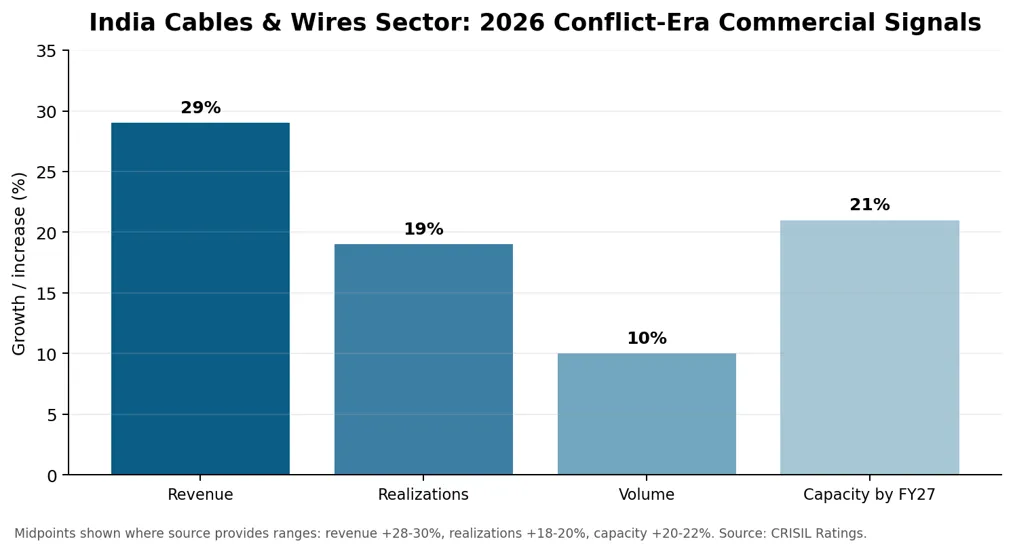
That is already visible in India. CRISIL expects organised cable and wire sector revenue to increase 28-30% in the current fiscal, driven partly by 18-20% higher realizations. Volume growth is expected at about 10%, supported by housing wires, power cables, renewables, thermal power, data centers and smart meters.
Capacity is responding as well. Sector utilization had reached roughly 75% in the prior fiscal while manufacturing capacity is expected to increase 20-22% by the end of fiscal 2027. Nearly half of that expansion is expected from new entrants. The war is therefore not simply a demand shock or a cost shock; it is accelerating a capacity race during a period when end markets remain structurally strong.
Source: CRISIL Ratings
Request FREE Demo For ElectroIQ: https://www.datamintelligence.com/electroiq
Which Cable Segments Are Most Exposed?
| Cable segment | Primary war exposure | Near-term impact | Commercial opportunity |
Submarine fibre-optic cable | Gulf/Red Sea security, vessel access, route concentration | Project delays, force majeure, repair uncertainty | New routes, landing diversity, maintenance contracts, terrestrial bypasses |
Terrestrial telecom fibre | Demand for bypasses around maritime chokepoints | Higher strategic value of Iraq-Turkey and other overland corridors | Long-haul backbone buildouts, border interconnects, redundant routes |
Data center power & fibre cables | Connectivity risk plus energy / raw-material inflation | Higher project costs and stronger redundancy requirements | Dual feeds, diverse fibre entrances, high-density power cable demand |
HV / MV power cables | Copper/aluminium inflation, freight and energy costs | Price escalation and working-capital pressure | Regional sourcing, aluminium substitution, secured conductor inventory |
Building wire / LV cable | Copper/PVC inflation | Faster price resets, possible discretionary demand deferral | Brand strength, channel inventory, dynamic pricing |
Industrial / control cable | Project delays and imported component exposure | Mixed demand depending on EPC schedule | Short lead times and local certification can win delayed projects |
Request FREE Demo For ElectroIQ: https://www.datamintelligence.com/electroiq
The Biggest Opportunity Is Route and Supplier Redundancy
The strongest demand response to the Iran war is unlikely to be a single replacement cable. It will be duplication. Operators that previously optimized for shortest route and lowest cost are now assigning greater value to geographically independent paths, multiple landing stations and spare capacity that can absorb rerouted traffic.
This shifts procurement toward suppliers that can offer a portfolio rather than a product: subsea cable plus terrestrial fibre, marine installation plus maintenance, power cables plus data center connectivity and regional manufacturing plus inventory support. A cable company that can only compete on conductor price is more exposed than one that can solve route, lead-time and resilience problems simultaneously.
The same logic applies to electrical cables. Buyers facing high copper costs may qualify aluminium conductor options, redesign cable sizing or split orders across more than one manufacturer. Suppliers with flexible engineering and faster approvals can capture projects that were originally awarded to competitors but have become commercially or logistically unworkable.
What Cable & Wire Companies Should Prepare for Through 2027
- Treat Red Sea and Persian Gulf route exposure as a commercial risk variable in every major telecom and data-center opportunity.
- Build sales propositions around redundancy, not only installed cable cost: alternate landings, terrestrial bypasses, spare routes and repair readiness now carry measurable value.
- Use dynamic raw-material clauses for copper, aluminium and PVC so bid validity does not become a margin risk during volatile commodity periods.
- Secure conductor and polymer supply earlier for projects with fixed energization dates, particularly data centers, renewable plants and grid upgrades.
- Qualify multiple conductor and insulation designs so engineering teams can offer cost and lead-time alternatives when the original specification becomes difficult to source.
- Prioritize regions building alternative digital corridors, including India, the Gulf, Iraq-Turkey routes, East Africa and Europe-Asia bypass networks.
ElectroIQ Can Help Identify Projects Where Cable Availability Has Become the Constraint
DataM Intelligence's ElectroIQ platform can help cable and electrical-equipment suppliers connect market disruption to commercial action. Its Project Tracker can identify data center, grid, renewable, oil & gas and infrastructure projects by geography and status, while the Lead-Time Tracker helps commercial teams monitor where electrical-equipment and cable availability is extending project schedules.
For cable suppliers, the value is in prioritization. A project delayed by incumbent lead times, a route redesign or a change in technical specification becomes a sales trigger. ElectroIQ can help teams focus on those projects early, identify the companies involved and position alternate cable supply before procurement is locked again.