


Until November 18, a U.S. competitive assessment of treatments for neurological symptoms of Type 3 Gaucher disease began with an empty approved-drug category. Infilbray now occupies it. For teams reviewing the next candidate, the first question is which patients and outcomes its clinical evidence actually covers. Three programs in the Gaucher landscape illustrate why that distinction matters.
What did the FDA approve, and who was studied?
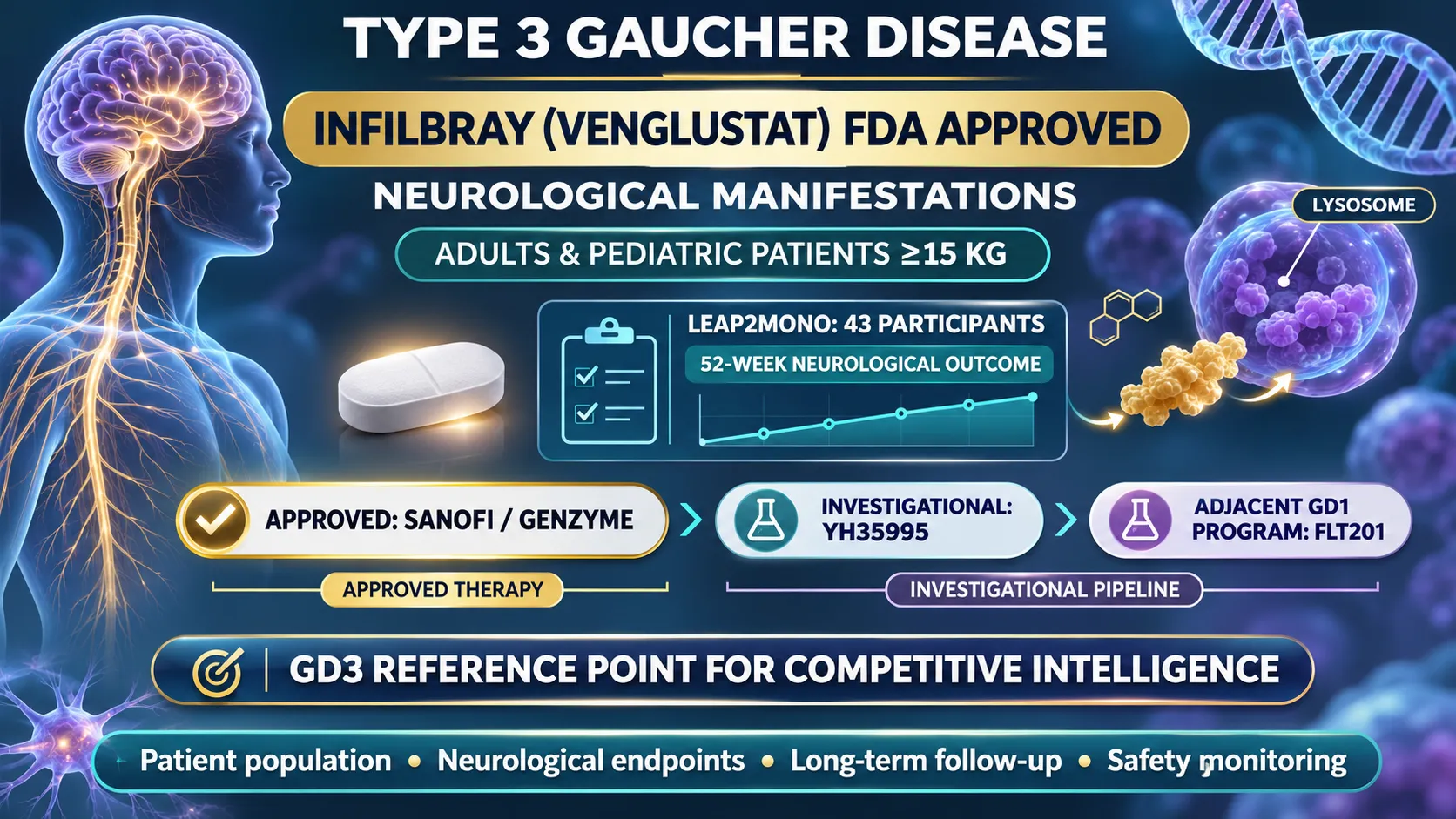
The FDA approved Infilbray (venglustat) tablets to treat neurological manifestations of Type 3 Gaucher disease (GD3) in adults and pediatric patients weighing at least 15 kg. Venglustat is a once-daily oral glucosylceramide synthase inhibitor designed to cross the blood-brain barrier. This is a U.S. approval for the neurological manifestations of GD3; it should not be broadened into a claim that Infilbray treats every Gaucher subtype or all systemic manifestations.
The approved population and the pivotal trial population are related, but not identical descriptions. LEAP2MONO enrolled 43 participants aged 12 years and older with GD3, neurological manifestations, and systemic disease stabilized after at least three years of enzyme replacement therapy (ERT). Participants received daily oral venglustat or intravenous imiglucerase every two weeks for 52 weeks. The FDA’s approved population is defined by weight-at least 15 kg-while the pivotal study’s minimum age was 12 years. That distinction matters when translating a label into a competitor brief or assessing the evidence base for younger patients.
At Week 52, the trial’s prespecified global test combining changes in the modified Scale for the Assessment and Rating of Ataxia (mSARA) and the Repeatable Battery for the Assessment of Neuropsychological Status (RBANS) favored venglustat over imiglucerase. Sanofi reported a statistically significant result (p=0.0137). This is a combined neurological assessment; it should not be rewritten as proof that every component or every individual symptom improved independently. The FDA also described improvement on a measure combining ataxia and cognition assessments.
Safety belongs in the same summary as efficacy. The FDA and Sanofi identify warnings for suicidal ideation and behavior, lens opacification in pediatric patients, and embryo-fetal toxicity. The FDA also reports gastrointestinal symptoms and mood-related adverse effects among commonly reported side effects. These label warnings are important diligence considerations; they do not replace review of the full prescribing information or individual clinical judgment.
Request For Exclusive Sample: https://www.datamintelligence.com/strategic-insights/sample/gauchers-disease-gd
Which Gaucher assets belong in the same competitive review?
The table separates the newly approved neurological treatment from two programs that are strategically relevant to Gaucher disease but differ in indication, stage, and evidence. It is a focused comparison-not a ranking or a claim that all three are direct GD3 competitors.
| Sponsor and asset | What the evidence covers | Why it belongs in the article |
Sanofi/Genzyme - Infilbray (venglustat) | U.S.-approved for neurological manifestations of GD3 in adults and pediatric patients weighing at least 15 kg. Phase III LEAP2MONO assessed neurological outcomes against imiglucerase in 43 participants aged 12+ whose systemic disease was stabilized on ERT. | The approved U.S. reference point for assessing treatments aimed at GD3 neurological manifestations. |
| Yuhan - YH35995 | Investigational oral glucosylceramide synthase inhibitor being developed for Gaucher disease, with FDA orphan-drug designation. Yuhan reports first-in-human testing in healthy volunteers focused on safety, tolerability, and pharmacokinetics/pharmacodynamics. | The closest strategic comparison here by development objective and oral substrate-reduction approach. Neurological benefit in GD3 patients remains unestablished. |
Spur Therapeutics - FLT201 (avigbagene parvec) | Investigational gene therapy in the Phase III GALILEO-3 program for Type 1 Gaucher disease (GD1). Spur announced first patient dosing in July 2026. | Relevant to a broader Gaucher portfolio review, but not a direct GD3 neurological competitor: its current Phase III population is GD1. |
Explore the Gaucher disease pipeline by company, subtype, and clinical stage →
What would make the next GD3 candidate commercially distinct?
Infilbray changes the reference point for future development, but it does not answer every clinical or commercial question. Teams assessing a follow-on asset should ask four things.
Which patients have actually been studied? Review age, weight, genotype where reported, neurological status, prior treatment, and systemic disease stability. Results from patients stabilized on ERT may not automatically generalize to untreated patients or those with different disease severity.
Was neurological function measured directly? A GD3 program needs outcomes aligned with the neurological manifestations it aims to address. Examine the scales used, how they combine motor coordination and cognition, the prespecified endpoint, and whether improvements are clinically interpretable. Biomarker change may support biological activity, but it is not a substitute for a meaningful neurological outcome.
How long were patients followed? A 52-week controlled period provides a defined window; long-term extension data may add information about durability, disease progression, treatment persistence, and safety. Those questions remain distinct from the initial approval result.
What safety information is available? For an oral therapy, assess adverse events and monitoring across the studied age groups. For gene therapy or other modalities, review the relevant modality-specific risks and the durability of follow-up. Avoid comparing safety across small or differently designed studies as if the evidence were equivalent.
These questions help separate direct competition from adjacent portfolio activity. YH35995 is an early-stage oral candidate whose target and development aim make it relevant to monitor, but its current healthy-volunteer study does not establish benefit in GD3 patients. FLT201 is a later-stage gene therapy program, yet its GALILEO-3 trial addresses GD1. For a GD3 neurological competitor map, subtype and endpoint fit matter as much as the company or technology name.
Which regulatory decisions should teams track next?
The next immediate watch point is geography. Sanofi reported on November 18 that venglustat was under regulatory review for GD3 in both the European Union and Japan. The FDA decision is U.S.-specific; it does not itself establish approval, label, or access in either market. For Japan-focused teams, the pending review is a reason to monitor the local regulatory pathway, potential label language, and timing separately from the U.S. authorization.
For clinical strategy and business development teams, Infilbray creates a clearer benchmark for neurological endpoints in GD3. The next candidate will need to show not only a plausible mechanism or brain penetration, but evidence in the intended patient population, outcomes that capture neurological function, adequate follow-up, and a safety profile that can be evaluated against the approved reference. That is the more useful competitive question than asking which pipeline asset is “next” based only on phase or platform.
To evaluate companies, subtypes, clinical stages, and broader Gaucher pipeline activity, explore Gaucher Disease Pipeline Insights. Request a sample of the Gaucher Disease Pipeline Insights report