


Introduction
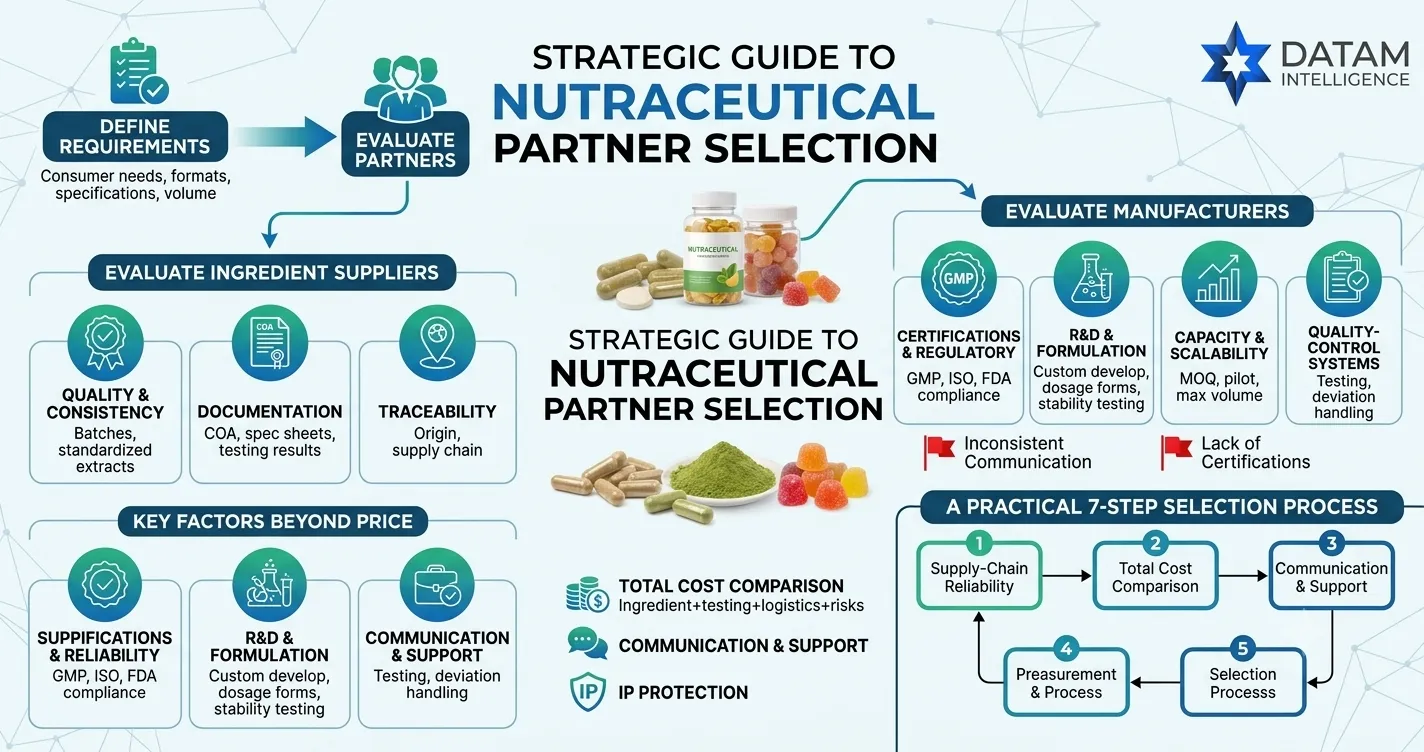
Choosing the right ingredient supplier and manufacturing partner can determine whether a nutraceutical product reaches the market on time, meets quality expectations, and scales profitably. Companies need more than competitive pricing: they must evaluate ingredient quality, documentation, regulatory readiness, manufacturing capabilities, supply reliability, formulation expertise, and long-term scalability.
This guide explains how nutraceutical companies can systematically identify, evaluate, and select ingredient and manufacturing partners that support product quality, regulatory compliance, innovation, and sustainable growth.
Find the Right Partners to Accelerate Growth
Identify, qualify, and prioritize high-value partners aligned with your market strategy, growth objectives, and supply-chain needs. Get an actionable partner shortlist and roadmap designed to move from research to meaningful engagement faster.
Why the Right Nutraceutical Partner Matters
Nutraceutical companies operate across a complex value chain involving ingredients, formulation, testing, manufacturing, packaging, regulatory compliance, and distribution. A weakness at any stage can affect the final product.
An unreliable ingredient supplier can create problems such as inconsistent potency, delayed shipments, incomplete documentation, or raw-material substitutions. Similarly, an unsuitable manufacturing partner can lead to production delays, quality inconsistencies, higher minimum order quantities, limited formulation support, or difficulties scaling production.
The right partner should therefore be viewed as a strategic extension of the business rather than simply another vendor.
1. Start With Clear Product and Ingredient Requirements
Before approaching suppliers or manufacturers, define exactly what the product requires.
Companies should establish:
- Target consumer and health benefit
- Product format, such as capsules, tablets, powders, gummies, liquids, or softgels
- Required active ingredients and dosage levels
- Ingredient specifications and purity requirements
- Expected annual production volume
- Target markets and regulatory requirements
- Desired launch timeline
- Packaging requirements
- Target cost and margin structure
- Shelf-life expectations
A clearly defined specification makes supplier comparisons more meaningful and reduces the risk of receiving quotations based on different assumptions.
2. Evaluate Ingredient Suppliers Beyond Price
Ingredient cost is important, but the lowest quotation does not necessarily represent the lowest total cost.
Nutraceutical companies should evaluate suppliers based on:
Ingredient Quality and Consistency
Ask whether the supplier can consistently meet agreed specifications across multiple batches. Standardized botanical extracts, vitamins, minerals, probiotics, amino acids, and specialty ingredients may require different analytical approaches.
Documentation
Request relevant documentation such as:
- Certificate of Analysis (COA)
- Product specification sheet
- Allergen information
- Microbiological testing
- Heavy-metal testing where applicable
- Pesticide or contaminant testing for relevant botanicals
- Stability information
- Country-of-origin information
- Manufacturing and processing details
Documentation should correspond to the actual material supplied, not simply a generic product brochure.
Traceability
A strong supplier should be able to explain where the ingredient originates and how it moves through the supply chain.
Traceability becomes particularly important for botanical ingredients and products where origin, processing method, cultivation practices, or batch consistency influence quality.
3. Verify Certifications and Regulatory Readiness
Certifications should be treated as a qualification criterion, not a marketing checkbox.
For companies selling in the United States, dietary supplement manufacturers are subject to FDA current Good Manufacturing Practice requirements under 21 CFR Part 111. FDA also maintains guidance covering dietary supplement CGMP, labeling, new dietary ingredients, and other compliance areas.
Depending on the market and product category, companies may also evaluate:
- GMP or cGMP compliance
- ISO certifications
- HACCP
- FSSAI licensing for applicable Indian operations
- Halal certification
- Kosher certification
- Organic certification
- Destination-market regulatory registrations
Companies should verify certificates directly, including the issuing organization, scope, certificate number, and validity period.
4. Assess the Manufacturer's R&D and Formulation Capabilities
A manufacturing partner that only produces an existing formula may not be enough for companies developing differentiated products.
Evaluate whether the manufacturer provides:
- Custom formulation
- Ingredient compatibility assessment
- Dosage-form development
- Stability testing
- Pilot batches
- Taste and sensory optimization
- Scale-up support
- Packaging development
- Technical documentation
A strong R&D team can also help identify formulation challenges before commercial production, reducing costly reformulation and launch delays.
5. Check Manufacturing Capacity and Scalability
The manufacturing partner that works for a pilot launch may not necessarily be suitable for a high-volume product.
Ask:
- What is the minimum order quantity?
- What is the pilot-batch capacity?
- What is the maximum production capacity?
- How quickly can production be scaled?
- What are standard lead times?
- How are urgent production requirements handled?
- Is there backup production capacity?
- Which dosage forms can the facility manufacture?
Scalability should be evaluated against the company's expected growth rather than current demand alone.
6. Audit Quality-Control Systems
Quality assurance should extend from incoming raw materials to finished products.
Ask potential manufacturers how they manage:
- Raw-material qualification
- Incoming material testing
- Batch identification
- In-process quality checks
- Finished-product testing
- Deviation management
- Complaint handling
- Batch traceability
- Product release
- Recall procedures
The ability to provide consistent batch-level documentation is an important indicator of operational maturity.
7. Evaluate Supply-Chain Reliability
Ingredient availability can become a major risk when products depend on imported raw materials, seasonal botanicals, specialized extracts, or limited-source ingredients.
Evaluate:
- Supplier lead times
- Geographic sourcing
- Inventory policies
- Safety-stock practices
- Alternative suppliers
- Import dependencies
- Logistics capabilities
- Historical delivery performance
- Ability to manage demand increases
Building dual-source options for critical ingredients can reduce exposure to supply disruptions.
8. Compare Total Cost, Not Just Unit Price
A supplier offering the lowest ingredient price may generate higher overall costs if it has inconsistent quality, long lead times, high MOQs, or frequent documentation problems.
A better comparison includes:
Total Cost = Ingredient Cost + Testing + Logistics + Inventory + Quality Risk + Delays + Reformulation Costs
This approach helps procurement teams evaluate the commercial value of a supplier rather than focusing exclusively on the quoted price.
9. Request Samples and Conduct a Pilot Run
Before entering a long-term agreement, companies should test the relationship.
Start with:
- Ingredient samples
- Laboratory verification
- Small formulation trials
- Pilot manufacturing
- Packaging compatibility checks
- Stability assessment where appropriate
The objective is to determine whether the supplier's stated capabilities translate into consistent real-world performance.
A successful sample should lead to successful pilot production and, ultimately, repeatable commercial batches.
10. Evaluate Communication and Technical Support
Technical responsiveness can become a major differentiator when products are being reformulated, scaled, or launched into new markets.
Evaluate how quickly the partner responds to:
- Specification questions
- COA requests
- Quality issues
- Formulation changes
- Regulatory documentation
- Forecast changes
- Production delays
- Shipment requirements
A supplier that communicates clearly during the evaluation stage is more likely to support efficient collaboration after commercial agreements are signed.
11. Check Intellectual Property and Confidentiality
For proprietary formulations, branded blends, or differentiated delivery systems, intellectual-property protection should be addressed before sharing sensitive information.
Companies should clarify:
- Formula ownership
- Confidentiality obligations
- Exclusivity arrangements
- Data ownership
- Product-development responsibilities
- Restrictions on sharing formulations with other customers
These terms should be documented contractually rather than relying solely on informal assurances.
12. Use a Structured Partner-Selection Scorecard
Instead of choosing a supplier based on a single quotation, create a weighted evaluation model.
| Evaluation Factor | Suggested Priority |
|---|---|
| Quality & regulatory compliance | Very High |
| Ingredient consistency | Very High |
| Manufacturing capability | Very High |
| Supply reliability | High |
| R&D/formulation support | High |
| Scalability | High |
| Documentation & traceability | High |
| Cost competitiveness | Medium-High |
| MOQ flexibility | Medium |
| Communication & technical support | Medium |
| Geographic/logistics advantages | Medium |
This makes the selection process more objective and allows procurement, R&D, quality, regulatory, and commercial teams to evaluate candidates using the same criteria.
Ingredient Supplier vs. Manufacturing Partner: What Should Companies Choose?
The right model depends on the company's internal capabilities.
Ingredient supplier: Best when a company already has formulation and manufacturing capabilities but needs reliable access to specialized raw materials.
Contract manufacturer: Best when a brand has a product concept or formula but does not want to operate its own manufacturing facility.
End-to-end development partner: Best when a company needs support across ingredient sourcing, formulation, testing, manufacturing, packaging, and regulatory documentation.
For growing nutraceutical brands, an integrated partner can reduce coordination between multiple vendors and simplify product development.
Red Flags to Watch Before Signing a Partnership
Nutraceutical companies should investigate partners that:
- Cannot provide current certification documentation
- Avoid providing batch-level quality records
- Offer unusually low prices without explaining the cost structure
- Cannot demonstrate ingredient traceability
- Have unclear manufacturing locations
- Refuse reasonable quality audits
- Have inconsistent communication
- Cannot support pilot production
- Lack documented quality-control procedures
- Promise unrealistic production timelines
- Cannot explain how they manage supply disruptions
These warning signs do not automatically disqualify a company, but they should trigger additional due diligence.
A Practical 7-Step Partner Selection Process
A repeatable process can make partner selection faster and more reliable:
Step 1: Define product, ingredient, volume, and market requirements.
Step 2: Build a longlist of qualified suppliers and manufacturers.
Step 3: Screen candidates for certifications, capabilities, and regulatory fit.
Step 4: Request specifications, COAs, pricing, MOQs, and technical documentation.
Step 5: Test samples and conduct formulation or pilot-production trials.
Step 6: Audit quality systems, capacity, traceability, and supply-chain processes.
Step 7: Select the partner based on quality, reliability, scalability, technical capability, and total cost.
This approach shifts partner selection from a price-based procurement exercise to a strategic quality and growth decision.
How Data and Market Intelligence Can Improve Partner Selection
Partner selection becomes more effective when companies combine supplier due diligence with market intelligence.
Market research can help identify:
- High-growth nutraceutical categories
- Emerging ingredient opportunities
- Consumer demand shifts
- Competitive product positioning
- Regional market opportunities
- Pricing trends
- Regulatory developments
- Supply-chain risks
- Potential whitespace for new formulations
For companies entering new nutraceutical categories or geographic markets, this information can help determine not only who can manufacture a product, but also which ingredients, formats, markets, and product concepts deserve investment.
Conclusion
Finding the right ingredient and manufacturing partners is a strategic decision that directly affects nutraceutical product quality, launch speed, regulatory compliance, margins, and scalability.
The strongest partnerships are built around verified quality systems, transparent documentation, reliable supply, formulation expertise, manufacturing capacity, technical communication, and long-term alignment.
Rather than selecting partners solely on price, nutraceutical companies should evaluate the complete relationship from raw-material sourcing and quality testing through formulation, manufacturing, documentation, and commercial scale-up.
Related FAQs
How can nutraceutical companies find the right ingredient and manufacturing partners?
Nutraceutical companies should compare potential partners across eight core areas: quality and certifications, ingredient consistency, documentation and traceability, formulation and R&D capabilities, manufacturing capacity, supply-chain reliability, total cost, and scalability. Companies should request samples and documentation, conduct quality and facility due diligence, run pilot batches where appropriate, and evaluate partners using a weighted scorecard before signing a long-term agreement.
What should nutraceutical companies look for in an ingredient supplier?
Companies should evaluate ingredient quality, consistency, specifications, COAs, testing capabilities, traceability, regulatory documentation, supply reliability, pricing, and scalability.
How do I choose a nutraceutical contract manufacturer?
Start by verifying applicable licenses and certifications, then assess formulation capabilities, manufacturing capacity, quality-control systems, MOQ, lead times, testing, documentation, scalability, and audit readiness.
Why is ingredient traceability important in nutraceutical manufacturing?
Traceability helps companies identify the origin and movement of raw materials and supports quality investigations, consistency, regulatory compliance, and supply-chain risk management.
What documents should a nutraceutical ingredient supplier provide?
Depending on the ingredient and market, companies may request COAs, specifications, allergen statements, microbiological testing, contaminant testing, stability information, origin documentation, and relevant certifications.
Should nutraceutical companies choose one supplier or multiple suppliers?
For critical ingredients, multiple qualified sources can reduce supply-chain dependency. However, qualification should focus on maintaining consistent specifications and quality across suppliers.
What is the difference between a nutraceutical ingredient supplier and contract manufacturer?
An ingredient supplier provides raw materials, while a contract manufacturer produces finished products. Some integrated partners can support both ingredient sourcing and manufacturing.
How can companies evaluate a nutraceutical manufacturer's scalability?
Review production capacity, equipment, dosage-form capabilities, MOQ, pilot-batch capacity, lead times, inventory management, quality systems, and the manufacturer's ability to increase output as demand grows.
Is the lowest-cost nutraceutical supplier always the best option?
No. The lowest quoted price may result in higher total costs if the supplier has inconsistent quality, delays, weak documentation, high testing requirements, or unreliable supply.
What questions should I ask a nutraceutical manufacturer before signing a contract?
Ask about certifications, manufacturing capacity, MOQ, lead times, quality testing, raw-material sourcing, traceability, formulation support, pilot batches, IP protection, regulatory documentation, and complaint or recall procedures.
How can market research help nutraceutical companies select partners?
Market intelligence can identify high-growth product categories, emerging ingredients, regional opportunities, competitive gaps, pricing dynamics, and regulatory trends, helping companies align partner capabilities with market opportunities.