


| KEY TREND | Hitachi Energy is investing across final transformer assembly, insulation, bushings, tap changers and other grid-equipment components to reduce bottlenecks and regionalize supply. |
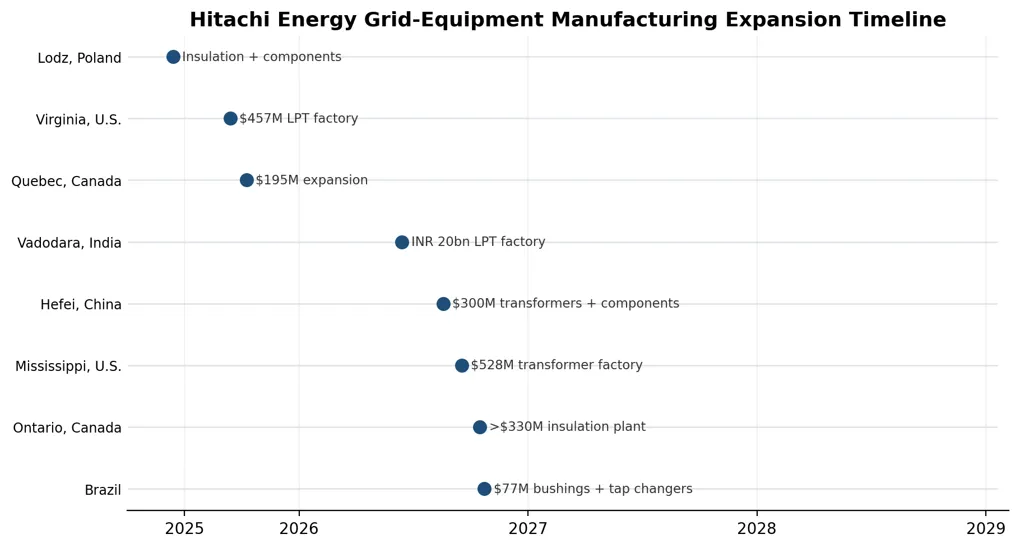
| MARKET OUTLOOK | The company’s current expansion program points to a multi-year capacity build through 2028-2029, meaning today’s transformer scarcity will ease gradually rather than immediately. |
| RECOMMENDED FOR | Transformer OEMs, utilities, EPCs, data center developers, grid equipment suppliers, component manufacturers and industrial strategy teams. |
DMI Analyst View
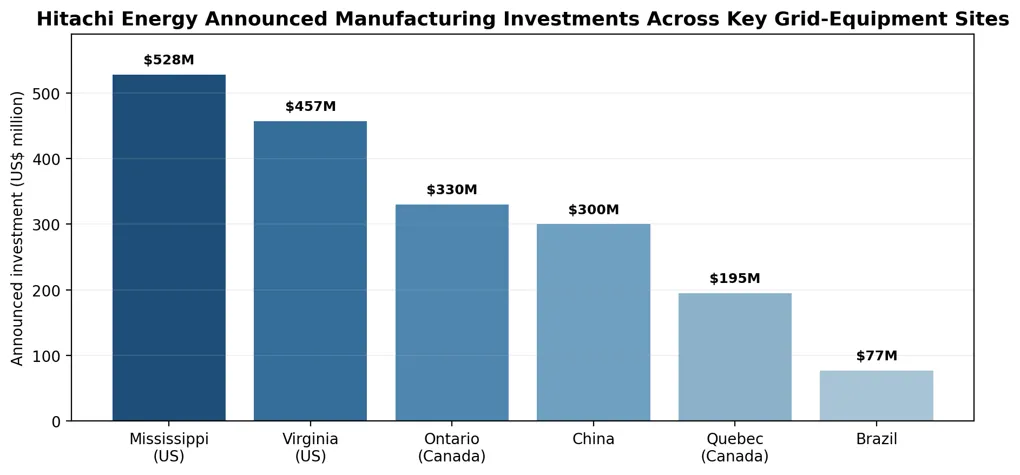
Hitachi Energy’s latest manufacturing announcements show a company responding to the grid-equipment shortage by investing at multiple points of the supply chain rather than relying only on additional transformer assembly. In 2026 alone, the company announced a new $210 million large power transformer factory in Vadodara, a $300 million transformer and component expansion in China, a $528 million transformer factory in Mississippi, more than $330 million for a transformer-insulation factory in Ontario and a $77 million Brazil investment focused on bushings and tap changers.
The strategic logic is straightforward. Transformer lead times are being driven by more than a shortage of final factory bays. Insulation materials, bushings, tap changers, windings, testing capacity and skilled labor can all become binding constraints. By adding capacity across these layers, Hitachi Energy is attempting to increase both throughput and supply-chain resilience at the same time.
This builds on a much larger investment cycle. Hitachi Energy announced a $6 billion portfolio-wide investment program in 2024, including $1.5 billion dedicated to transformer production. It added more than $250 million in transformer-component investments by 2027 in March 2025, followed by more than $1 billion in U.S. grid-equipment manufacturing commitments in September 2025. By 2026, the company’s expansion strategy is being supported by more than $9 billion of investment.
Source: Hitachi Energy, ElectroIQ Project Tracker
Explore ElectroIQ Intelligence
Discover how ElectroIQ helps you track electrical equipment demand, monitor lead times and identify emerging market opportunities: https://www.datamintelligence.com/electroiq
India Is Becoming a Strategic Large-Power-Transformer Manufacturing Base
In June 2026, Hitachi Energy announced an investment of approximately $210 million to establish a new large power transformer factory at Karjan, Vadodara. The site is scheduled for completion in FY28 and will support high-voltage transmission, HVDC, power generation, AI data centers and large industrial applications.
The investment is particularly important because India is simultaneously becoming a large end market and a manufacturing/export base. Hitachi Energy India reported that exports represented 33.6% of Q1 FY27 orders excluding HVDC, while data centers were a significant contributor to order intake. The company also reported its highest-ever order backlog of INR 32,222.1 crore in August 2026.
India’s grid buildout provides the demand backdrop. Hitachi Energy cited Central Electricity Authority estimates that India will require INR 7.93 lakh crore of transmission investment to integrate more than 900 GW of non-fossil-fuel capacity by 2035. The new factory therefore does not depend solely on export growth. It is being positioned against a domestic transmission, data-center and industrial-electrification cycle.
The U.S. Expansion Is Moving From One Factory to a Manufacturing Network
The $528 million Gallman, Mississippi transformer factory announced in September 2026 is Hitachi Energy’s largest single U.S. investment to date. The facility will be more than twice the size of the existing Crystal Springs plant, more than double production capacity and create more than 700 jobs. Construction is expected to begin in late 2026, with production scheduled to start in 2029.
The Mississippi project is one part of an approximately $1.5 billion U.S. manufacturing expansion program. Other major investments include a $457 million large power transformer facility in South Boston, Virginia, a $106 million expansion in Alamo, Tennessee for transformer components and a $70 million Pennsylvania expansion focused on high-voltage equipment.
The timing matters. U.S. electricity demand is being lifted by data centers, advanced manufacturing, industrial electrification and grid modernization. Yet a large part of the new Hitachi capacity comes online progressively through 2027-2029. Buyers therefore gain a more localized supply base, but near-term procurement pressure is likely to persist before the new lines reach full output.
Brazil Shows Why Component Localization Matters as Much as Transformer Assembly
Hitachi Energy’s October 2026 Brazil announcement adds R$385 million, approximately $77 million, for local production of transformer bushings and tap changers. The new facility will be co-located with the power-transformer industrial complex under construction in Pindamonhangaba, São Paulo, while insulation-material production in Guarulhos will also expand.
The strategy goes beyond adding nameplate transformer capacity. Bushings and tap changers are specialized, qualification-sensitive components that can delay a transformer even when the main manufacturing bay is available. Hitachi Energy said Brazil will become the only location in Latin America producing these critical components locally, reducing exposure to global disruptions and improving cost and lead-time predictability.
The new investment takes Hitachi Energy’s disclosed Brazil investment program above $350 million and supports the country’s role as a Latin American manufacturing hub. It also complements the expansion of the Guarulhos power-transformer factory and a new São Paulo service center focused on maintenance, modernization and life extension.
Canada Is Being Used to Internalize a Critical Insulation Bottleneck
In October 2026, Hitachi Energy announced a C$479 million investment, more than $330 million, to build a transformer-insulation factory in London, Ontario. The 21,000-square-meter site is expected to be completed by 2028 and will establish Canada’s first pressboard manufacturing line and Hitachi Energy’s first pressboard manufacturing capability in the Americas.
This is strategically important because transformer pressboard and laminates are not commodity packaging materials. They are critical electrical-insulation components that influence transformer performance, compactness, reliability and cooling. Building this capability inside North America reduces reliance on long-distance supply and gives Hitachi more control over a bottleneck material needed across multiple transformer factories.
The Ontario project complements Hitachi Energy’s C$270 million, approximately $195 million, expansion in Varennes, Quebec announced in 2025. That expansion is expected to nearly triple large power transformer production capacity at the site.
Europe and China Complete the Regionalization Strategy
Hitachi Energy is following a similar approach in Europe and China. In Lodz, Poland, the company is expanding a century-old transformer production campus with a new 5,000-square-meter building to increase production of transformer insulation and components. The project adds component depth inside Europe at a time when grid expansion and energy-security priorities are increasing demand for locally available high-voltage equipment.
In China, Hitachi Energy announced a $300 million investment in August 2026 to expand power-transformer and component manufacturing capacity in Hefei. The company explicitly linked the investment to easing transformer supply bottlenecks and strengthening the resilience of the global value chain.
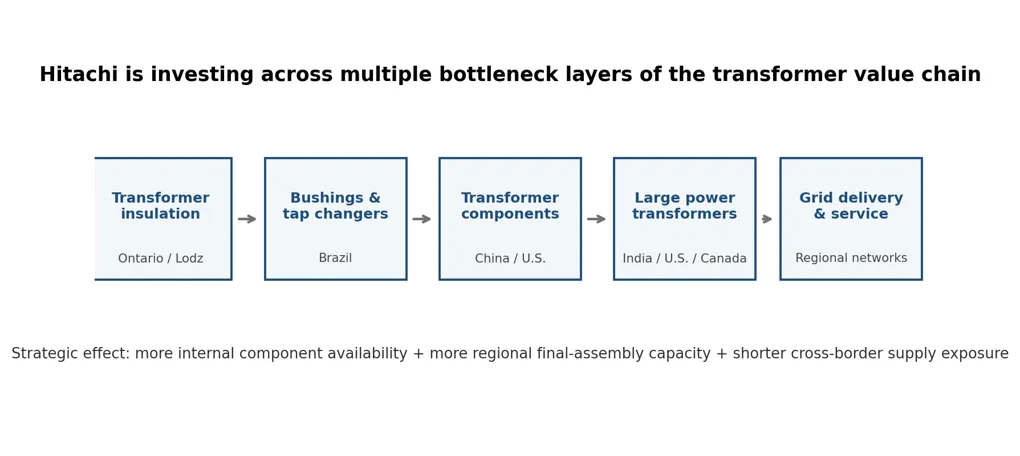
Together, these projects show that Hitachi is not treating North America, Europe, India, China and Latin America as interchangeable export destinations. It is creating regional manufacturing nodes with enough component depth to support local demand while retaining the ability to serve global projects.
Source: Hitachi Energy, Lodz June 2025 and China August 2026.
Request Demo: https://www.datamintelligence.com/electroiq
The Investment Cycle Is Moving Upstream Into Bottleneck Components
The transformer shortage has exposed a recurring industry problem: adding an assembly line does not automatically create an additional completed transformer. Final output depends on synchronized availability of insulation, bushings, tap changers, steel, copper conductors, winding capacity, drying/processing equipment, test bays and skilled engineering labor.
Hitachi Energy’s expansion pattern suggests that the company is responding by integrating more of these bottleneck layers into its regional footprint. Ontario adds pressboard and laminates. Brazil adds bushings and tap changers. China expands transformer components. Poland adds insulation and component capacity. U.S. investments include both complete transformers and critical components. This is closer to building a resilient production system than simply enlarging factories.
Table 1. Major Hitachi Energy Manufacturing Expansions
| Location | Announcement | Investment | Primary Scope | Timing | Strategic Role |
| Vadodara, India | Jun-26 | INR 20bn | Large power transformers | Complete FY28 | India demand + export base |
| Hefei, China | Aug-26 | $300M | Power transformers + components | Expansion program | Global transformer value chain |
| Gallman, Mississippi | Sep-26 | $528M | Transformer manufacturing | Production 2029 | More than 2x local capacity |
| London, Ontario | Oct-26 | >US$330M | Pressboard + laminates | Complete 2028 | First pressboard line in Canada |
Pindamonhangaba, Brazil | Oct-26 | $77M | Bushings + tap changers | New facility | LATAM component localization |
| Varennes, Quebec | Sep-25 | $195M | Large power transformers | Expansion | Nearly 3x annual capacity |
South Boston, Virginia | Sep-25 | $457M | Large power transformers | Expansion/new factory | Largest U.S. LPT facility |
| Lodz, Poland | Jun-25 | Not disclosed | Insulation + components | 5,000 sq m addition | European component capacity |
Source: Hitachi Energy announcements, ElectroIQ Project Tracker
What the Expansion Means for Hitachi Energy’s Competitive Position
- More control over delivery reliability. A broader internal component network reduces the risk that a completed transformer assembly slot sits idle because a bushing, tap changer or insulation package is late.
- Regional qualification becomes a commercial advantage. Utilities and governments increasingly value domestic or regional manufacturing for energy-security, procurement and local-content reasons. Hitachi can use its broader footprint to bid with a stronger localization story.
- Scale strengthens pricing and allocation power. When transformer capacity is scarce, the ability to allocate production across more than 60 transformer factories and 30 service centers creates flexibility that smaller competitors cannot easily replicate.
- The company can capture more lifecycle value. Expansion in service, components and final equipment allows Hitachi to participate in new-build projects, replacement demand, upgrades, modernization and long-term asset support.
- AI and data-center demand increases the value of the strategy. Data centers require not only transformers but high-voltage connection equipment, grid reinforcement, power quality and service support. Hitachi’s expansion across multiple product categories positions it to sell a broader grid package into the same customer investment cycle.
Source: Hitachi Energy announcements, ElectroIQ Project Tracker
Turn Market Signals into Business Opportunities
Explore equipment-level intelligence to support procurement planning, supplier evaluation and strategic market expansion: https://www.datamintelligence.com/electroiq
How ElectroIQ Can Track the Manufacturing Expansion Opportunity
DataM Intelligence’s ElectroIQ platform connects Hitachi Energy’s manufacturing announcements with the projects driving the demand. The Project Tracker monitors transmission, substation, data-center, industrial and generation projects moving toward procurement, while the Lead Time Tracker compares transformer and high-voltage equipment availability across suppliers and regions. This helps identify where new capacity additions may change supplier competitiveness before the impact is visible in market-share data.
What Electrical Equipment Companies Should Watch Through 2029
The most important signal is no longer a single factory announcement. It is whether Hitachi can convert its geographically distributed investments into shorter lead times, higher output and more bundled grid-equipment wins. The company is building capacity across final transformers, components, insulation, high-voltage equipment and service. If execution matches the investment plan, the result will be a more vertically integrated and regionally resilient competitor across the global transmission-equipment market.
The competitive response is going to come from other global grid-equipment leaders expanding transformer, switchgear, HVDC and component capacity in parallel. For utilities and project developers, that creates a more important procurement question than headline factory capex: which supplier will have the right voltage class, component availability, test slot and delivery window when the project reaches its energization deadline?