


Heat Shrink Tubing Market Faces a Supply-Chain Reset
Heat shrink tubing is easy to overlook. It is small, relatively inexpensive, and often specified deep inside a wire harness, battery pack, catheter assembly, or power connection. Yet when a qualified tube becomes unavailable, the cost of the component is rarely the main problem. The real cost lies in engineering review, testing, documentation, regulatory approval, and the risk of interrupting a much more valuable finished product.
That risk is becoming more visible across the heat shrink tubing market. Specialty-polymer obsolescence, supplier production transfers and product reformulations are showing how an upstream material change can travel through the value chain. A resin, additive, or processing aid may be replaced at the chemical supplier; the tubing manufacturer must then validate its compound; and an aerospace, defense, automotive, or medical customer may still need to requalify the finished component.
Recent TE Connectivity product notices bring the issue into sharp focus. In June 2026, the company temporarily removed Mil-Spec availability for selected RNF-100, Versafit, CRN, TAT-125 and RP-4800 configurations after a raw-material supplier transferred production to another facility. TE said material from the alternate site met applicable performance requirements, but the affected Mil-Spec products still had to undergo NAVAIR requalification. Existing qualified inventory remained usable, while corresponding non-Mil-Spec versions were offered during the hold. The episode demonstrates a crucial distinction: technical equivalence does not automatically preserve an approval.
Reports of an RT-780 discontinuation linked to the loss of a critical raw material point to the more severe version of the same problem: sometimes reformulation is viable; sometimes a product family reaches the end of the road. Buyers should verify the status of their exact part number, however, because TE’s public catalog continued to list certain RT-780 configurations as active at the time of writing.
The wider message is not about one supplier. The heat shrink tubing industry is moving from a standardized component business toward a qualification-intensive market in engineered materials, application support, and supply assurance.
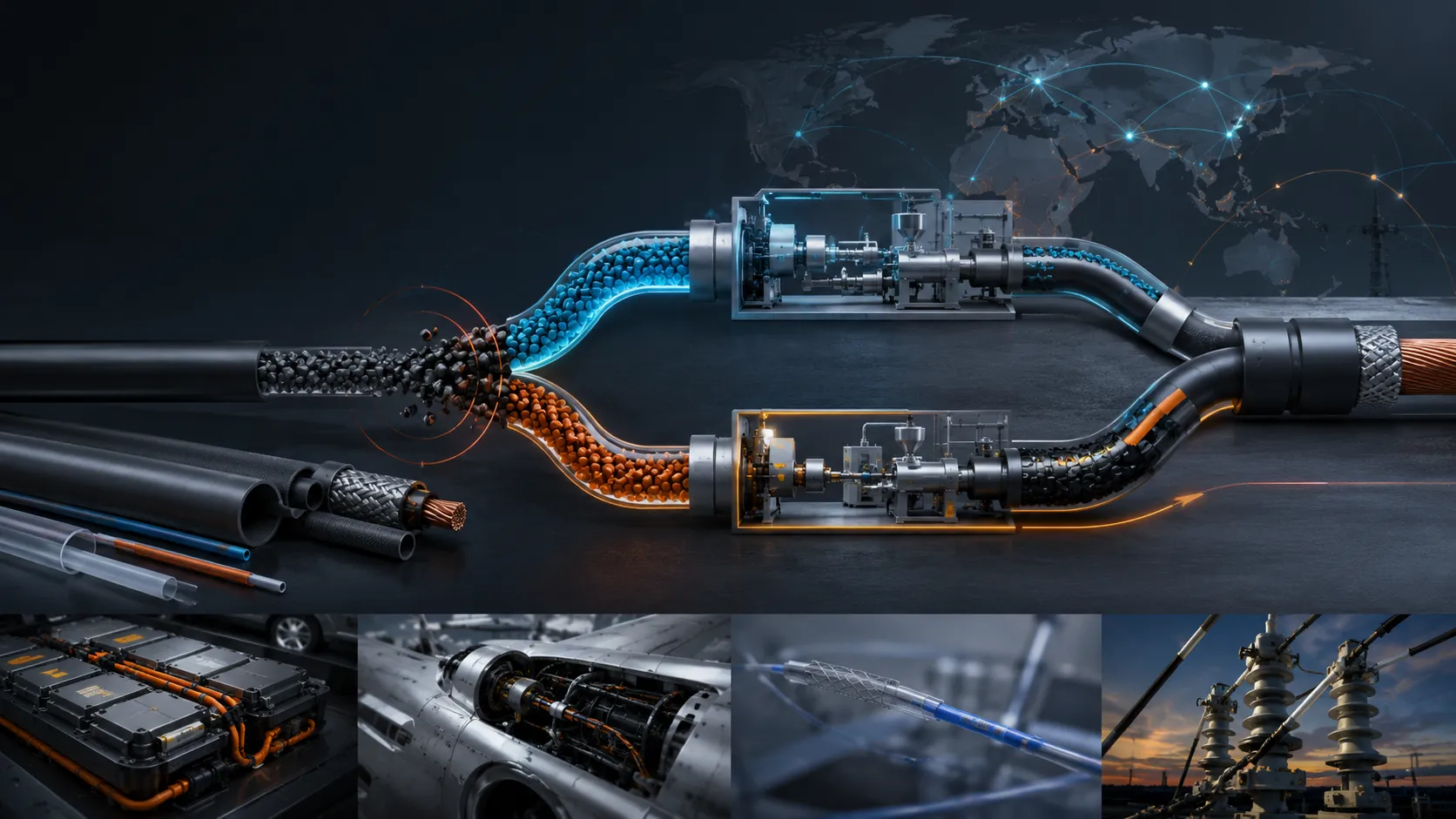
Request for Exclusive Sample: https://www.datamintelligence.com/download-sample/heat-shrink-tubing-market
Why Heat Shrink Tubing Is No Longer a Commodity Component
General-purpose polyolefin tubing will remain a high-volume product. But some of the market’s most attractive opportunities now sit at the opposite end of the spectrum: tightly controlled applications where the polymer formulation, wall construction, recovery behavior, and approvals determine whether the tube can be used at all.
In electric vehicles, tubing protects high-voltage terminations, busbars, battery interconnects, motor leads, sensors and charging-system wiring. Aerospace and defense platforms require products that can tolerate extreme temperatures, fuels, hydraulic fluids, vibration, flame exposure and long service lives. Telecommunications and data infrastructure need compact insulation, identification and environmental protection in dense cable systems. Renewable-energy and grid applications demand durable sealing and electrical insulation for exposed or high-load connections.
Medical devices create an even more specialized use case. FEP and related fluoropolymer heat shrink products can act as processing aids during catheter reflow, consolidating layers and helping manufacturers produce smooth, dimensionally controlled shafts. The tubing may then be peeled away rather than remaining in the implanted or patient-contacting device. In these applications, optical clarity, wall uniformity, release behavior and tight tolerances can matter as much as conventional shrink performance.
The result is a two-speed market. Commodity products compete heavily on price, availability, and distribution. Engineered products compete on material science, validated performance, traceability, application engineering, and the supplier’s ability to support qualification.
The Raw-Material Problem Behind Product Discontinuation
Heat shrink tubing performance begins upstream. A typical product may depend on a base polymer, crosslinking chemistry, flame-retardant package, color system, stabilizers, and processing additives. Specialty grades may have a narrow approved supply base, particularly when they are designed for high temperature, chemical exposure, low smoke, low outgassing, or military use.
This creates several failure points. A chemical producer may discontinue a low-volume additive, consolidate grades, move production, change a process, or exit a market. Even when an alternate material has the same chemical identity or broadly comparable properties, its manufacturing history, impurity profile or processing behavior may differ. The tubing producer therefore needs to assess extrusion, crosslinking, expansion, recovery, and long-term performance-not simply compare resin datasheets.
TE’s recent notices illustrate both substitution and requalification. In a 2025 notice covering RT555 and RT-790 tubing and related molded parts, TE said a vendor had discontinued a flame-retardant synergist and that it would use an equivalent grade from another supplier after internal testing. In July 2026, TE issued another notice describing broader reformulation work after several external vendors obsoleted materials used in RT555 and RT-790 compounds.
For procurement teams, the lesson is uncomfortable but useful: a component can be operationally single-sourced even when several distributors stock it. If every authorized channel ultimately depends on the same compound, production line, and approval, distributor diversity is not supply diversity.
Why Mil-Spec and Qualification Requirements Raise Switching Costs
Replacing a heat shrink tube is rarely a matter of matching diameter and color. Engineers may need to compare:
- Continuous operating and short-duration temperature limits
- Shrink ratio, recovery temperature and recovered-wall thickness
- Longitudinal change and dimensional tolerances
- Dielectric strength and insulation resistance
- Flame, smoke and toxicity performance
- Resistance to fuels, oils, solvents, hydraulic fluids, moisture and UV exposure
- Abrasion, tensile strength, flexibility and vibration endurance
- Sealant compatibility in dual-wall constructions
- Outgassing, biocompatibility or sterilization compatibility where applicable
- Mil-Spec, NAVAIR QPL, UL, IEC, automotive or customer-specific approvals
The June 2026 Mil-Spec hold is especially revealing because TE stated that analytical and performance testing found the alternate-facility material consistent with the previous supply. The commercial obstacle was not a claimed loss of performance; it was the need to restore the external qualification attached to particular products and configurations.
That distinction changes how buyers should evaluate continuity. A technically acceptable alternative may still be unusable on a controlled drawing, defense program, validated manufacturing process or regulated device until the appropriate authority approves the change. Switching cost therefore includes time, test capacity, documentation, and program risk-not just the new component price.
From Globalized Sourcing to Regional Production and Dual Qualification
The old sourcing model optimized unit cost and manufacturing scale. The emerging model must also optimize recoverability.
Regional production can shorten replenishment routes, reduce exposure to cross-border disruption, and place engineering support closer to customers. It does not, by itself, eliminate risk: two factories using the same single-source polymer remain exposed to the same upstream constraint. True resilience requires visibility across multiple tiers.
Leading suppliers and OEMs are therefore likely to combine several measures:
- Qualifying more than one raw-material source wherever technically feasible
- Separating manufacturing redundancy from material-source redundancy
- Maintaining regional extrusion, expansion, converting or finishing capabilities
- Monitoring product-change notifications and end-of-life signals earlier
- Preserving validated safety stock for long requalification cycles
- Designing approved alternates into bills of material before a disruption
- Standardizing test protocols and evidence packages to accelerate change control
Capacity investment is already visible in specialty segments. Junkosha reported in 2025 that it had increased production capacity across its medical-device portfolio by 300% from 2021 to 2025, including a doubling of capacity for peelable heat shrink tubing and liner ranges. The expansion reflects both rising demand and the premium customers place on reliable availability in qualification-sensitive medical manufacturing.
EVs and Electrification Change the Demand Profile
Electrification increases both the amount of protected electrical content and the consequences of insulation failure. High-voltage architectures require clear identification, robust dielectric protection, and resistance to heat, vibration, automotive fluids, and abrasion. Battery packs create dense assemblies in which tubing may protect joints, sensors, interconnects, and cable transitions. Electric motors and inverters add thermal and chemical stresses, while charging infrastructure extends demand beyond the vehicle.
This does not mean every EV application requires the most expensive polymer. It means material selection becomes more segmented. Crosslinked polyolefin may remain appropriate for many harness applications; fluoropolymers, fluoroelastomers, elastomeric materials, or specialized dual-wall products may be necessary where temperature, sealing, flexibility, or chemical exposure is more demanding.
For manufacturers, the opportunity lies in application-specific platforms: orange high-voltage identification, thin-wall products for compact packaging, adhesive-lined tubing for environmental sealing, high-shrink-ratio products for irregular geometries, and formulations validated against automotive electrical and chemical requirements.
For OEMs, the priority is to avoid locking an entire platform to an irreplaceable compound without an approved continuity plan.
Medical Devices Create a Premium Opportunity
Medical heat shrink tubing shows how far the industry has moved beyond basic cable insulation. In catheter manufacturing, FEP heat shrink can compress thermoplastic layers during reflow, support bonding around braids or coils, and help achieve a smooth outer profile. Peelable constructions are engineered for removal after processing, turning the tubing into a manufacturing tool rather than a permanent device component.
TE describes medical-grade FEP heat shrink products for catheter-jacket reflow and other assembly applications, with emphasis on controlled shrink behavior and tight tolerances. Junkosha’s 2025 portfolio expansion highlighted optically clear peelable FEP tubing intended to improve visibility and reduce assembly risk during catheter production.
This segment rewards capabilities that commodity suppliers may struggle to replicate: ultra-thin walls, precise expansion ratios, clean processing, consistent peel behavior, lot traceability, and collaborative application development. It also exposes suppliers to evolving polymer regulation and sustainability pressure, increasing interest in alternative material platforms that can deliver fluoropolymer-like performance where appropriate.
What the Supply-Chain Reset Means for Manufacturers and Buyers
For heat shrink tubing manufacturers, resilience is becoming part of the product specification. Suppliers that can document their material chain, maintain qualified alternatives, and help customers manage change will be better positioned than those competing only on catalog breadth.
The strategic agenda is clear:
- Map critical polymers and additives to the finished product families they support.
- Identify sole-source materials before they become end-of-life events.
- Develop and validate alternate formulations while the incumbent material is still available.
- Build dual-source strategies at the raw-material level, not merely at the distribution level.
- Expand regional capacity where it improves lead time, technical support, and recovery options.
- Invest in specialized tubing for EVs, aerospace, defense, power systems and medical devices.
- Provide cross-reference data, test reports, samples and qualification support when changes occur.
- Communicate product changes early enough for customers to manage last-time buys and validation.
Buyers also need to change. Approved-vendor lists should record manufacturing location, compound lineage, external approvals, and true alternates-not simply supplier names. Engineering and procurement teams should jointly rank tubing by business impact. A low-cost tube that can stop a vehicle harness, defense assembly or catheter line deserves more continuity planning than its purchase value suggests.
Outlook: From Tubing Supplier to Materials-and-Engineering Partner
The heat shrink tubing market will still grow with electrical connectivity, electrification, data infrastructure, industrial automation, and minimally invasive medicine. But volume growth alone misses the more important shift.
The next phase of competition will be shaped by qualification velocity and supply resilience. Customers will ask not only whether a tube meets the specification today, but also whether its polymer base is secure, whether another facility can make it, whether an alternate formulation has been tested, and how quickly the supplier can support a controlled change.
That moves the best manufacturers higher in the value chain. They become materials-and-engineering partners: organizations that translate polymer performance into reliable, approved, and manufacturable solutions.
Frequently Asked Questions
What raw materials are commonly used in heat shrink tubing?
Common materials include crosslinked polyolefin, fluoropolymers such as FEP and PTFE-related systems, PVDF, fluoroelastomers, silicone, and other elastomers. The right material depends on temperature, chemical exposure, flexibility, flame behavior, dielectric performance, and regulatory requirements.
Why can a raw-material change trigger product requalification?
Changing a resin, additive, or production site can affect processing history or documented material lineage. Even when testing shows equivalent performance, external approvals, customer drawings, or validated processes may require formal requalification.
Can one heat shrink tube be replaced with another of the same size?
Not automatically. Engineers must also compare shrink ratio, recovered-wall thickness, recovery temperature, longitudinal change, temperature rating, chemical resistance, dielectric strength, flammability, mechanical behavior, and required approvals.
What is Mil-Spec heat shrink tubing?
It is tubing qualified to an applicable military specification and, where required, listed through the relevant approval system. A non-Mil-Spec product may perform similarly but cannot be represented or used as a qualified item when the program requires the formal designation.
How is heat shrink tubing used in electric vehicles?
Applications include high-voltage cable and terminal protection, busbar insulation, battery interconnects, sensor wiring, motor leads, charging components, strain relief, sealing and circuit identification.
Why are FEP and peelable heat shrink products used in catheter manufacturing?
They can apply controlled pressure during reflow, consolidate catheter layers, and help form a smooth shaft. Peelable grades are removed after processing, which can simplify production and reduce secondary removal steps.
Does regional manufacturing eliminate heat shrink tubing supply risk?
No. It can improve lead time and reduce logistics exposure, but resilience also depends on having independent raw-material sources, qualified processes, appropriate approvals, and recovery capacity.
What should buyers ask heat shrink tubing manufacturers about continuity?
Buyers should ask where the product and compound are made, which materials are single-sourced, whether alternate materials and sites are qualified, how product changes are communicated, what approvals apply, and how quickly samples and test evidence can be supplied.
Which heat shrink tubing segments offer the greatest value opportunity?
Application-specific products for EV high-voltage systems, aerospace and defense, medical-device manufacturing, power infrastructure and harsh industrial environments generally offer more differentiation than general-purpose commodity tubing.
How should OEMs prepare for a heat shrink tubing discontinuation?
They should identify affected part numbers and inventory, confirm last-order and last-ship dates, evaluate approved alternates, reserve validation resources, document any deviation, coordinate with regulators or program authorities where necessary, and avoid assuming that distributor stock constitutes a long-term second source.