


Body-in-White Supply Chain Perspective | 2026
| PROCUREMENT SHIFT | European and North American OEMs are moving low-carbon steel and aluminium from pilot projects into contracted series-production supply. |
| WHY NOW | Hydrogen-routed steel, EAF steel, hydro-powered aluminium and high-recycled-content aluminium now carry measurable carbon specifications that suppliers must prove. |
| COMMERCIAL QUESTION | Which BIW suppliers can qualify the right grade, geometry, stamping performance and verified carbon footprint before the OEM sourcing window closes? |
Low-Carbon Metal Is Moving From ESG Target to BIW Purchase Specification
The body-in-white supply chain is entering a new sourcing phase. Steel and aluminium are no longer being purchased only against mechanical properties, gauge, coating, formability and price. OEMs are increasingly adding a fifth requirement: a documented carbon footprint that can survive procurement audits and vehicle-level lifecycle accounting.
This matters because BIW consumes some of the most qualification-sensitive metal in the vehicle. Crash structures, shock towers, longitudinal members, outer panels and battery enclosures cannot be switched casually between mills or alloy routes. Once an OEM reserves low-carbon feedstock and qualifies it for a stamped part, that supplier relationship becomes much harder to displace.
Request Sample: https://www.datamintelligence.com/download-sample/body-in-white-market
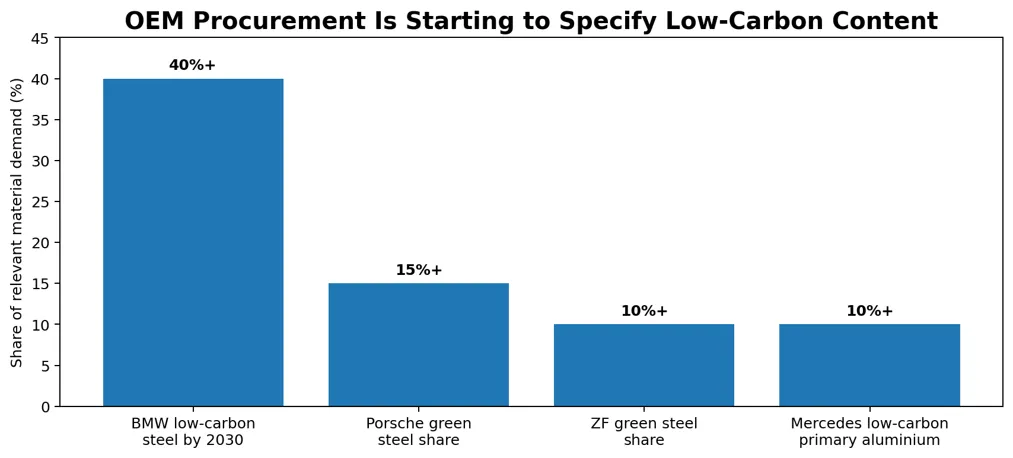
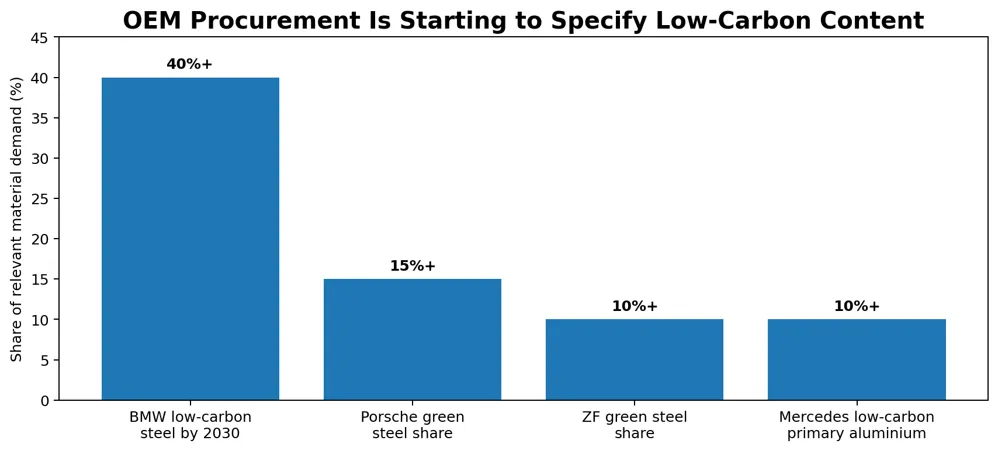
BMW plans to cover more than 40% of steel demand at its European plants with low-carbon steel by 2030. ZF has contracted green steel equal to about 10% of its current steel requirements. Porsche has arranged up to 35,000 tonnes annually, equivalent to roughly 15% of its historical steel use, while Mercedes-Benz has committed at least 10% of primary aluminium demand to qualifying low-carbon supply.
The BIW Value Pool Is Shifting Toward Verified Carbon Performance
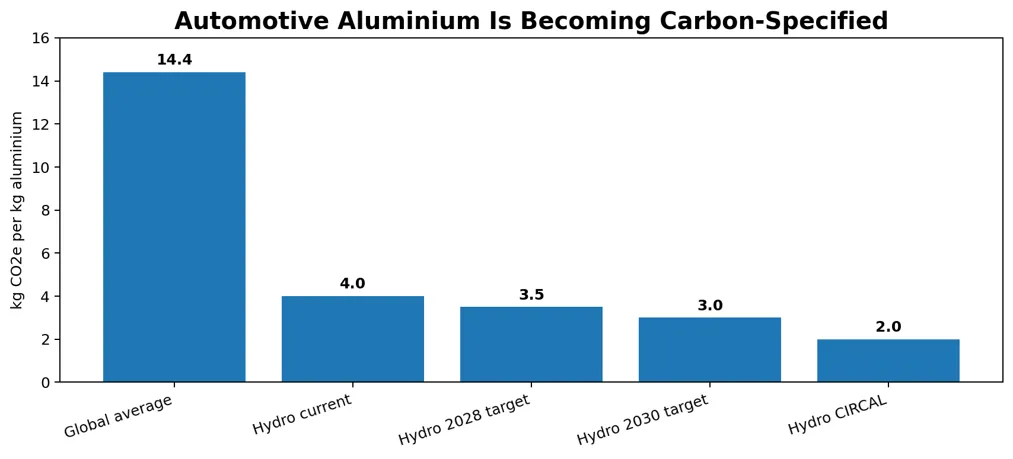
The change is particularly visible in aluminium. Mercedes-Benz currently sources Hydro aluminium at around 4.0 kg CO2e per kg, roughly 72% below the cited global average of 14.4 kg. Its new long-term agreement pushes the contracted footprint to 3.5 kg by 2028 and 3.0 kg from 2030. Hydro CIRCAL, planned for Mercedes series production from 2027, contains at least 75% post-consumer scrap and carries a footprint of no more than about 2.0 kg CO2e per kg.
Nordic Aluminium Is Already Inside Safety-Critical BIW Structures
The rush for Nordic hydro-powered aluminium is not hypothetical. Hydro has supplied renewable-power aluminium to Mercedes-Benz since 2023 for structural BIW applications including shock towers and longitudinal members across models such as the EQS, EQE, S-Class, E-Class, GLC and C-Class. Hydro also markets aluminium for complete BIW structures, crash boxes, impact beams, frames and subframes.
For stampers and structural-part suppliers, this changes the competitive question. A supplier that can offer equivalent forming performance with verified low-carbon metal can become strategically more valuable than a lower-priced supplier that cannot document origin, recycled content or embodied emissions.
72% lower Hydro aluminium currently sourced by Mercedes versus cited global average | 75%+ Post-consumer recycled content in Hydro CIRCAL |
30% Potential BIW/chassis weight reduction from aluminium versus steel | 5% Energy needed for secondary aluminium versus primary production, per Mercedes |
Green Steel Offtake Is Moving Into Hundreds of Thousands of Tonnes
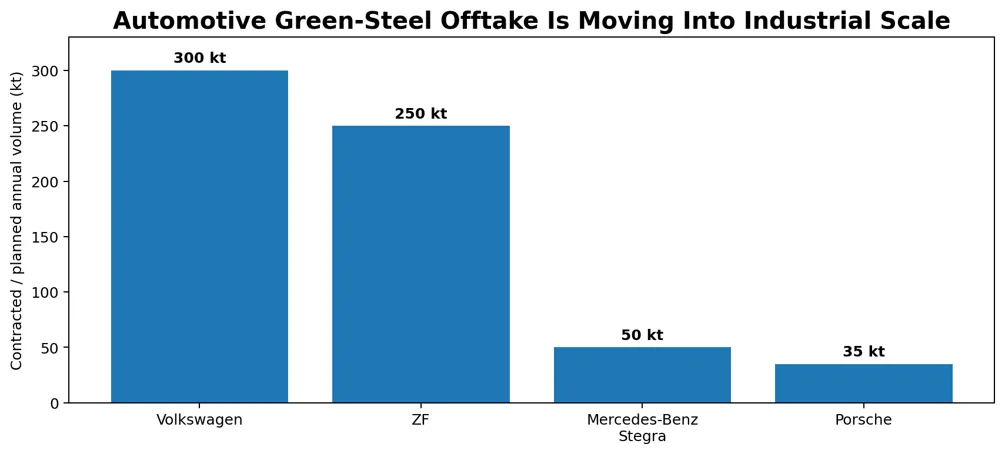
Steel is following the same path. Volkswagen has outlined up to 300,000 tonnes per year of low-carbon steel from Vulcan Green Steel from 2027. ZF has contracted 250,000 tonnes per year from Stegra. Mercedes-Benz has around 50,000 tonnes per year contracted from Stegra for European press shops, alongside more than 50,000 tonnes per year from Steel Dynamics for Alabama. Porsche plans up to 35,000 tonnes annually from Stegra for series production.
Request a Customized Report According to Your Business Strategy: https://www.datamintelligence.com/customize/body-in-white-market
These are not token demonstration volumes. They are large enough to influence mill allocation, grade qualification schedules and the availability of low-carbon flat steel for Tier 1 stampers that do not have direct offtake relationships.
The Supply Constraint Is Qualification, Not Just Tonnes
Low-carbon feedstock is not interchangeable simply because the carbon number is lower. BIW programs require tight consistency in tensile strength, elongation, surface quality, coating behavior, springback, weldability and crash performance. The commercial bottleneck therefore sits between upstream metal availability and downstream part approval.
Hydrogen-Routed and Recycled Steel Create a New Premium Tier
The reason OEMs are willing to restructure contracts is the size of the emissions opportunity. BMW says steel produced using natural gas or hydrogen and green power can cut production emissions by up to 95% versus conventional routes. Mercedes-Benz cites Stegra steel at around 0.4 t CO2 per tonne compared with more than 2 t for conventional blast-furnace steel. ZF says its Stegra material can reduce carbon footprint by up to 80%.
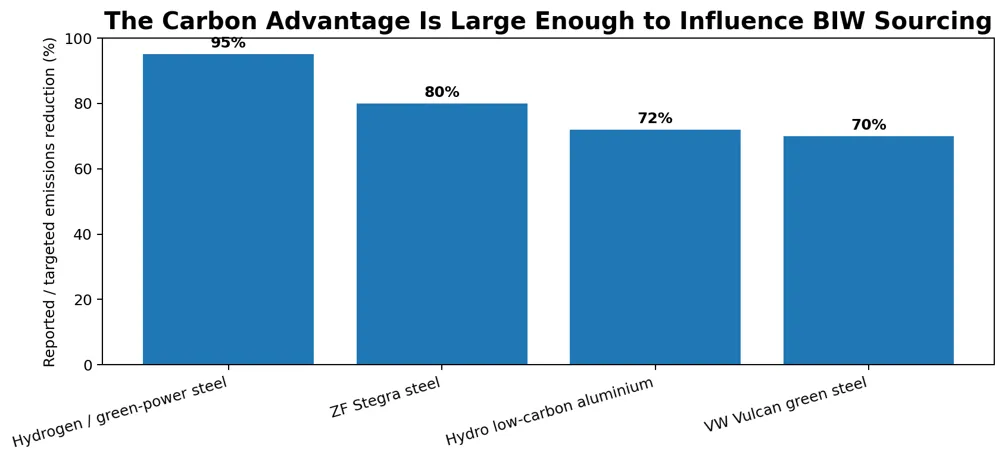
For BIW suppliers, that magnitude is commercially meaningful because purchased steel and aluminium can dominate the embedded emissions of stamped structures. Mercedes-Benz notes that steel can account for up to 20% of total CO2 emissions when manufacturing an electric vehicle, while aluminium can represent more than 20% of the material-related footprint depending on model and production route.
Five Commercial Signals BIW Suppliers Should Track
| Signal | What it reveals | BIW impact | Commercial action |
| OEM carbon threshold added | Material is becoming specification-controlled | New mill / alloy qualification | Engage before sourcing freeze |
| Long-term green-steel offtake | Prime low-carbon flat steel is being reserved | Less spot availability for Tier 1s | Secure back-to-back feedstock |
| Hydro / recycled Al mandate | BIW aluminium carbon intensity is falling | Shock towers, rails, housings affected | Qualify low-carbon alloy route |
| New vehicle platform | Material mix can be redesigned | Stamping dies and joining routes reset | Target platform launch window |
| Supplier carbon audit | Origin data enters sourcing scorecard | Traceability becomes bid requirement | Build auditable product carbon data |
The New BIW Contract Is Material + Carbon + Traceability
The commercial shift is not simply toward 'green metal.' It is toward metal that meets the same automotive performance envelope while carrying verified origin, carbon intensity and recycled-content data. That pushes BIW suppliers deeper into upstream sourcing decisions that were once largely handled by mills and purchasing teams.
Why the Rush Can Create Localised Feedstock Tightness
The physical steel and aluminium markets are large, but the pool that meets automotive-grade, low-carbon and traceability requirements is much smaller. The same tonne must satisfy chemistry, surface quality, forming behavior, certification and carbon thresholds. That is why a global metal surplus can coexist with local scarcity in a specific qualified feedstock.
This also explains the strategic value of regional sourcing. Hydro's Norwegian renewable-power base gives European OEMs access to low-carbon primary aluminium. Stegra and other Nordic projects are building hydrogen-based steel around renewable electricity. In North America, Mercedes-Benz already uses more than 50,000 tonnes per year of EAF steel from Steel Dynamics with at least 70% scrap content. The sourcing race is increasingly regional because carbon intensity depends on the local energy and production route.
What This Means for the BIW Competitive Landscape
The winners will not necessarily be the stampers with the lowest conversion cost. They will be the suppliers that can secure qualified low-carbon coil or billet, maintain consistent forming performance, provide product-level carbon documentation and commit capacity against the OEM's launch schedule.
That changes how BIW opportunity needs to be tracked. A sourcing team must know which vehicle platforms are moving to new steel or aluminium routes, which mills have already reserved low-carbon capacity, which stampers are qualified for those grades and where carbon requirements are entering the RFQ before competitors see the same shift.
DataM’s BIW report will answer: • Which OEMs have active low-carbon steel and aluminium mandates? • Which BIW components are first to shift feedstock? • Which mills and Tier 1 stampers are already qualified? • Where are premium low-carbon feedstock shortages likely to appear? | Map low-carbon material mandates, OEM contracts, qualified suppliers, regional capacity and sourcing windows before the next BIW award cycle. |