


Body-in-White Manufacturing Intelligence | 2026
| STRUCTURAL SHIFT | Mega-casting replaces dozens - and in some cases more than 100 - stamped and welded BIW parts with one large aluminium structural casting. |
| CAPITAL SHIFT | Investment moves away from press shops, fixtures, robotic joining and material handling toward 5,600-9,200 ton die-casting cells, giant dies, melt systems, trimming and machining. |
| COMMERCIAL QUESTION | Which OEM platforms are moving to mega-cast front or rear structures - and which stamping, welding, aluminium, die-tooling and machining suppliers gain or lose content? |
BIW Is Not Disappearing - Its Manufacturing Architecture Is Being Rewritten
Traditional body-in-white manufacturing builds structural sections by stamping multiple sheet-metal parts, transporting them through fixtures and joining them through spot welding, adhesives, riveting and other processes. Mega-casting attacks that architecture directly by integrating a large share of the structure into one high-pressure aluminium casting.
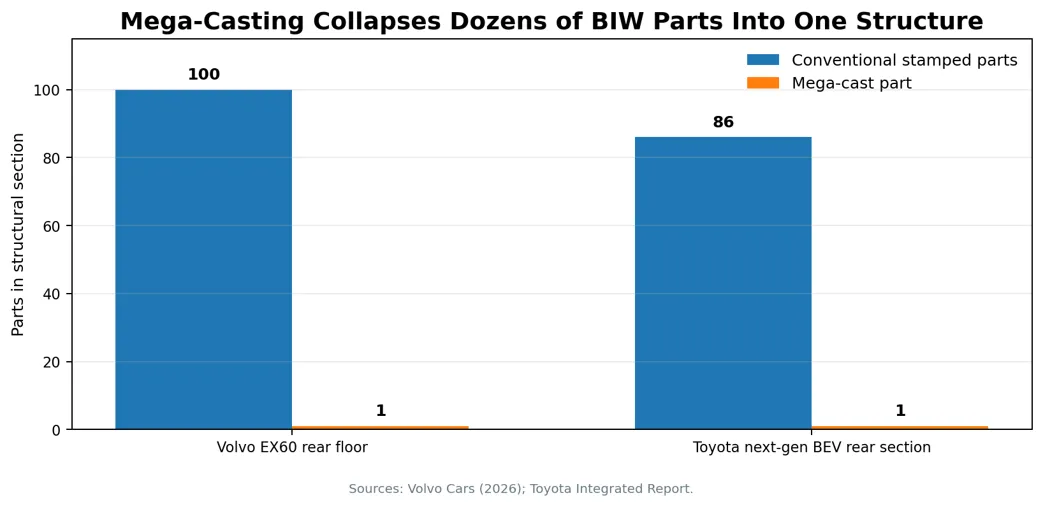
Volvo Cars says the EX60 rear floor replaces around 100 sheet-metal parts with one large casting. Toyota has separately documented a rear body section that currently uses 86 sheet-metal parts and 33 press processes, with its next-generation BEV architecture designed to collapse both the part count and the process count to one casting. These are not styling changes. They alter the physical content of the BIW factory.
Request Executive Sample: https://www.datamintelligence.com/download-sample/body-in-white-market
The result is a redistribution of manufacturing value. Fewer stamped parts mean fewer dies, fixtures, weld locations and handling steps for the affected module. At the same time, the value of aluminium metallurgy, casting simulation, giant die design, melt quality, trimming, machining, thermal control and in-line inspection rises sharply.
The Weld Shop Is Where the BIW Disruption Becomes Visible
A gigacast does not eliminate the entire BIW line. Roofs, side structures, closures, crash reinforcements and many sheet-metal panels remain. But for the structural zones that migrate to casting, the joining burden can collapse. A 2026 technical assessment of Tesla Model Y production describes 171 sheet-metal components replaced by a single rear-floor casting, alongside the elimination of about 1,600 welds and 300 robots from the affected manufacturing architecture.
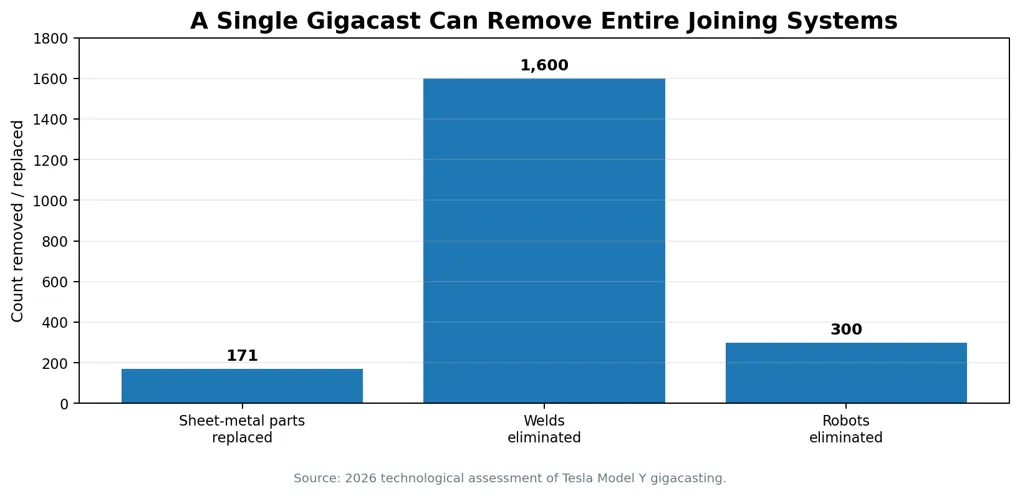
That is the key commercial disruption. The addressable opportunity is not simply "more die casting." A single structural integration decision can simultaneously reduce demand for stamping dies, transfer systems, welding robots, clamps, fixtures and body-shop floor space while increasing demand for giga presses, furnaces, vacuum systems, die-temperature control, release agents, X-ray or CT inspection, trimming and high-precision machining.
The Press Itself Is Becoming a Strategic Asset
The equipment scale required for structural megacasting is materially different from conventional die casting. Bühler offers Carat megacasting systems with 5,600, 6,100, 8,400 and 9,200 tons of locking force, while IDRA markets Giga Press systems up to 9,000 tons. These machines are large enough to create front or rear underbody sections that previously moved through multiple stamping and joining stations.
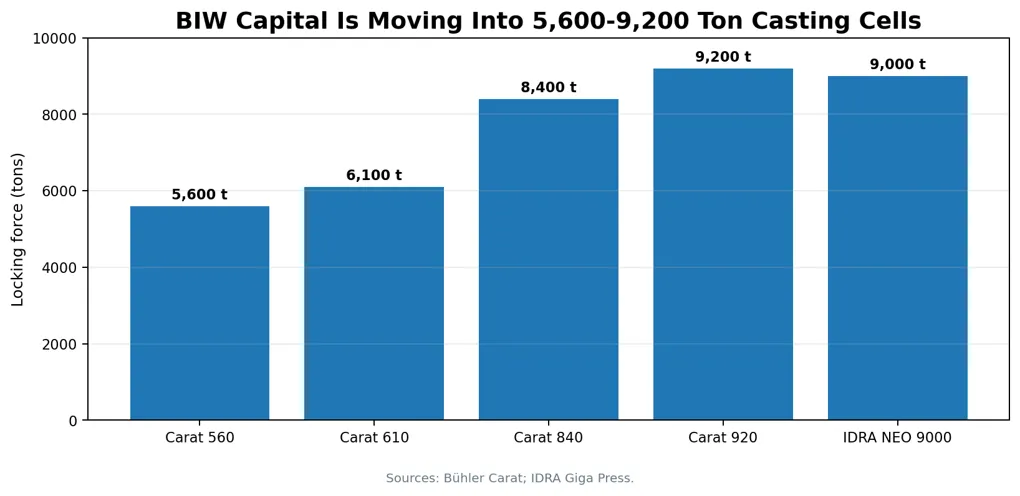
The capital shift also raises the cost of execution failure. A conventional BIW can spread defects and downtime across multiple presses or joining stations. A mega-cast cell concentrates more structural output in one machine, one die and one process window. Availability, die life, melt quality and cycle-time stability therefore become much more valuable.
Mega-Casting Has Crossed From Experiment Into Industrial Adoption
The technology is no longer confined to one manufacturer. Bühler says eight of the world’s ten largest vehicle manufacturers use megacasting and five have placed orders with Bühler. By 2025, the company had reached its 50th Carat megacasting order. In Vietnam, two Carat 920 systems installed for Seojin System can each produce up to 200,000 large structural components per year, including battery trays and rear underbodies.
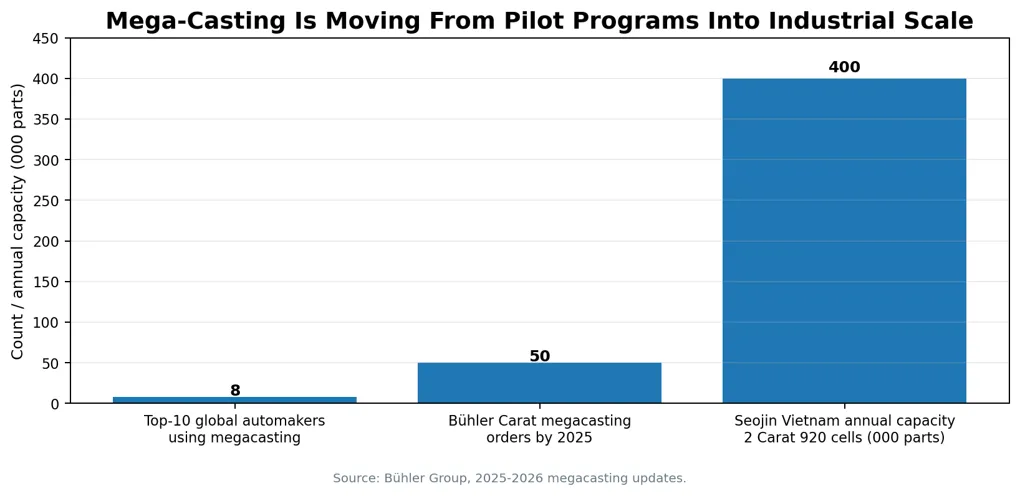
Volvo is now producing its EX60 mega-cast rear floor in-house at Torslanda, Sweden. Toyota has tied gigacasting to its next-generation BEV modular architecture. Tesla’s one-piece cast rear underbody is already documented in its repair procedures. The strategic question for the BIW supply chain has therefore moved from "will OEMs test it?" to "which vehicle modules, regions and platforms will convert next?"
The BIW Value Pool Is Splitting Into Winners, Losers and Hybrid Systems
| Design signal | Content at risk | Content gaining value |
Rear/front floor moves to one-piece casting | Lower demand for multi-part stamping dies, weld fixtures and joining content | Giga press, die, furnace, trimming, machining, inspection |
OEM retains castings in-house | Tier 1 loses assembly content but OEM gains process control | Casting-cell integration, melt systems, service and automation |
Supplier receives mega-cast award | Large capex and qualification burden moves to supplier | Press capacity, alloy sourcing, tooling engineering, NDT |
Hybrid BIW architecture persists | Stamped safety/side structures remain alongside cast floor modules | Mixed joining, dimensional control and interface engineering |
Request a Customized Report According to Your Business Strategy: https://www.datamintelligence.com/customize/body-in-white-market
Why the Shift Matters Beyond the Casting Machine
Volvo says landed cost for a mega-cast structure can be up to 35% below a mixed steel-aluminium structure and that the time from raw material to a ready product can fall from months to days. The EX60 process also uses 50% recycled aluminium. These economics explain why mega-casting can remain attractive even when OEMs do not replace the entire body architecture.
Five Signals BIW Suppliers Should Track
| Signal | What it reveals | Commercial action |
OEM announces new EV platform architecture | Module design may shift before formal sourcing begins | Map front/rear floor architecture and target design teams |
6,000+ ton press order or installation | Structural casting program is moving toward industrialization | Track press supplier, site, commissioning date and die source |
New aluminium alloy / recycled-content specification | Casting metallurgy is becoming platform-specific | Qualify alloy, melt treatment and process-window capabilities |
Weld-shop or stamping- footprint redesign | Traditional BIW content may be removed from the module | Identify displaced dies, robots, fixtures and joining systems |
Mega-cast machining / inspection award | Casting has moved from concept into production tooling | Target trimming, machining, metrology, NDT and service packages |
The Next BIW Battle Is Over Module Architecture, Not Just Material Share
Mega-casting will not replace the entire BIW. Crash performance, repairability, plant economics and model volume will keep hybrid architectures relevant. But front and rear underbodies are strategic battlegrounds because each conversion can remove dozens of stamped parts and hundreds of joining operations. Suppliers therefore need platform-level intelligence on module design, press orders, die ownership, aluminium qualification and SOP timing.
Why This Creates a BIW Intelligence Requirement
Vehicle production forecasts alone miss the disruption because a platform can hold the same volume while its BIW bill of materials changes radically. Suppliers need module architecture, casting adoption, press capacity, tooling awards, aluminium specification, localization and SOP timing to see where stamped and welded content is disappearing - and who controls the new casting value pool.
Use the BIW Market Report to map giga-casting adoption by OEM, platform, region and supplier - including the stamping, welding, casting, tooling and material opportunities created by each architecture shift.