


Grid Equipment Perspective | High-Voltage Components, HVDC and Transmission Infrastructure
| KEY TREND | GE Vernova is moving deeper into high-voltage components by acquiring an existing supplier that already sits inside its grid-equipment supply chain. |
| MARKET OUTLOOK | The transaction strengthens GE Vernova across HVDC, transmission and substations at a time when utilities and hyperscalers are competing for scarce high-voltage equipment capacity. |
| RECOMMENDED FOR | Grid OEMs, switchgear and transformer suppliers, utilities, EPCs, cable companies, data-center infrastructure teams and electrical-equipment investors. |
Explore ElectroIQ Intelligence
Discover how ElectroIQ helps you track electrical equipment demand, monitor lead times and identify emerging market opportunities: https://www.datamintelligence.com/electroiq#demo
Executive Summary
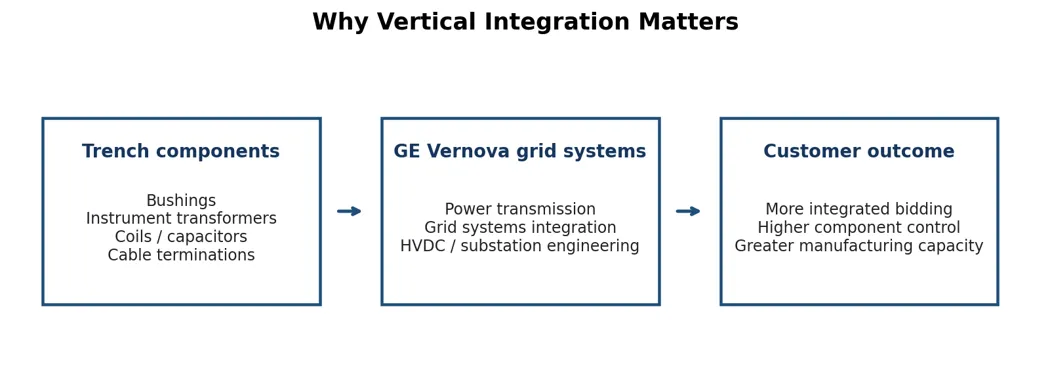
GE Vernova’s agreement to acquire Trench Group for $9.0 billion is one of the clearest signs yet that the electricity equipment cycle is shifting from product expansion toward control of strategic manufacturing capacity. Trench is not an adjacent software or services asset. It is an existing GE Vernova supplier of high-voltage components used inside the transmission systems that utilities are now struggling to procure quickly enough.
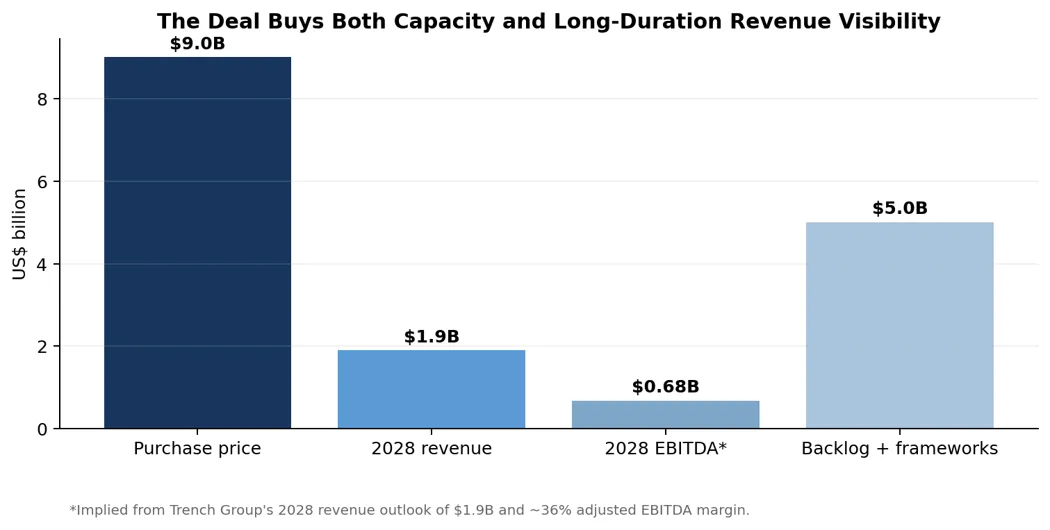
The transaction gives GE Vernova a portfolio spanning bushings, cable terminations, instrument transformers, coils and capacitors, backed by more than 3,000 employees and 11 manufacturing sites across Europe, North America and Asia. Trench serves more than 800 utilities and hyperscalers and brings approximately $5 billion of backlog and framework agreements, some extending into the next decade. The company also says its components are present in the majority of high-voltage direct-current lines built globally.
Financially, GE Vernova is paying 13x Trench Group’s expected 2028 adjusted EBITDA before synergies. Trench is expected to generate $1.9 billion of revenue at an approximately 36% adjusted EBITDA margin in 2028. The deal is expected to close in late 2027 and is currently planned to be funded roughly half with cash and half with debt.
Source: GE Vernova
The Strategic Logic Is Vertical Integration
The most important sentence in GE Vernova’s announcement is that Trench is an existing supplier. That changes the acquisition thesis. GE Vernova is effectively internalizing a component platform that already feeds its two largest Electrification businesses, Grid Systems Integration and Power Transmission. In a market where lead times, qualification cycles and factory capacity increasingly determine who can deliver a substation or HVDC project on schedule, supplier ownership can become a commercial advantage.
This matters because high-voltage systems are assembled from several specialized product layers. A transmission project can be delayed even when the headline transformer or switchgear package is available if bushings, instrument transformers, cable terminations or other qualified components are not. Bringing more of those technologies inside the group can reduce dependency on external sourcing, improve coordination across engineering packages and provide greater visibility over capacity allocation.
Source: GE Vernova, DataM Intelligences.
Trench Gives GE Vernova a Global High-Voltage Component Footprint
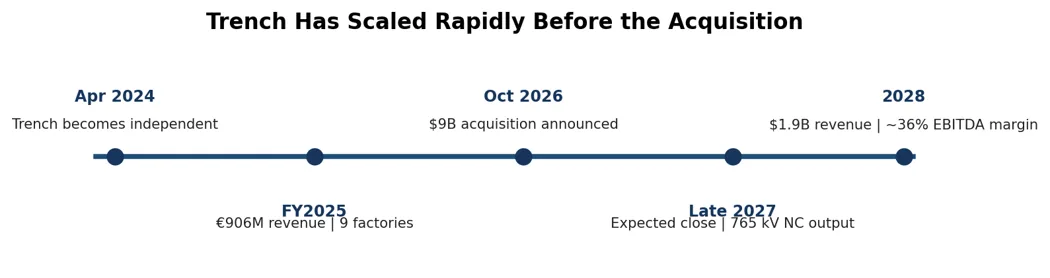
Trench Group entered the transaction from a position of rapid expansion. Its 2025 sustainability report recorded €906 million of revenue, nine factories, roughly 2,800 employees and more than 1.2 million products delivered. GE Vernova’s October 2026 announcement says the business now has more than 3,000 employees and 11 manufacturing sites, showing that capacity has continued to expand ahead of the deal.
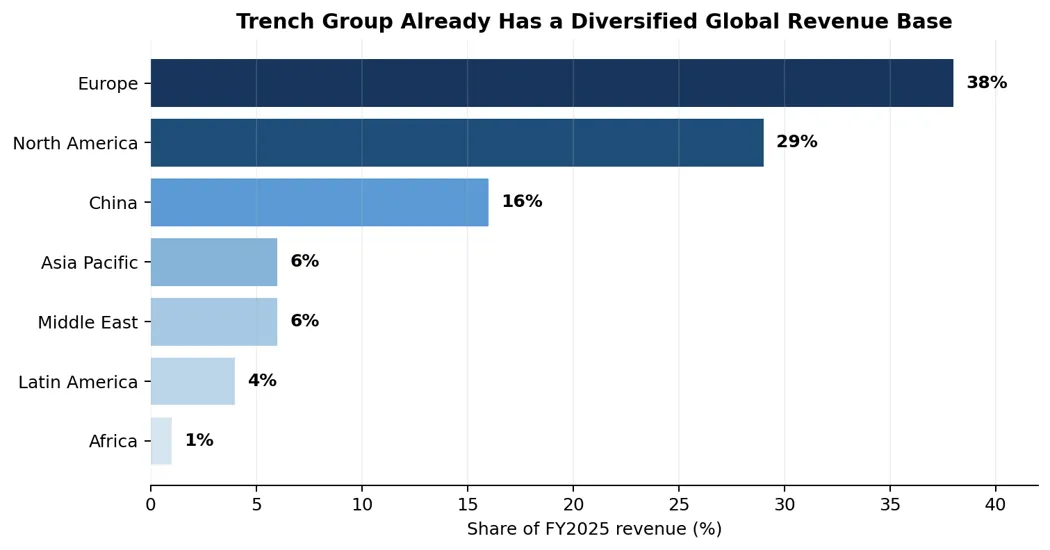
The geographic mix is also strategically useful. In FY2025, Europe represented 38% of Trench revenue and North America 29%, followed by China at 16%. The Middle East and Asia Pacific each represented 6%. That gives GE Vernova an acquired component footprint that already spans the regions where grid expansion, data centers, HVDC and renewable integration are accelerating.
Source: Trench Group Sustainability Report 2025.
Request Demo: https://www.datamintelligence.com/electroiq#demo
The Acquisition Strengthens GE Vernova’s Position in HVDC and Ultra-High-Voltage Projects
Trench says its components are present in the majority of HVDC lines built globally. That is strategically important because HVDC projects are unusually component-intensive and qualification-sensitive. Converter stations, cable interfaces and transmission substations require high-voltage bushings, measurement equipment and other specialized components that must operate reliably at extreme electrical stresses.
GE Vernova already competes across grid systems integration and transmission. Trench adds a deeper component layer underneath those system businesses. The combination can therefore improve GE Vernova’s ability to package engineering, high-voltage equipment and critical components in the same customer relationship, particularly where utilities want fewer interfaces across a complex project.
The U.S. manufacturing angle is especially important. Trench has opened a facility in Charlotte, North Carolina, where production of 765 kV equipment is expected to begin in late 2027. As North American utilities reconsider higher-voltage transmission corridors to move more electricity over constrained rights-of-way, domestic availability of 765 kV components can become a meaningful differentiator.
The Deal Is a Capacity Acquisition During an Electric Equipment Supercycle
The timing of the transaction is as important as the portfolio. Utilities are simultaneously replacing aging grid assets, connecting renewables, expanding transmission for data centers and supporting new industrial loads. That is stretching the manufacturing base for high-voltage equipment, where qualification and factory expansion take years rather than quarters.
GE Vernova’s own 2026 results show the scale of demand across electricity infrastructure. Third-quarter orders reached $29 billion, up 96% organically, while total backlog increased by $20 billion sequentially to $197 billion. The company raised its 2026 revenue guidance again as Power and Electrification demand accelerated. Trench adds another approximately $5 billion of backlog and framework agreements to that broader demand environment.
This is why the $9 billion price should be viewed partly as payment for time-to-capacity. Building a comparable global component footprint organically would require factory construction, workforce development, customer qualification and years of field performance. The acquisition buys an installed manufacturing network, an existing customer base and a qualified product portfolio at once.
Understand how the Electrical Equipment industry is currently facing supply chain issues through DataM’s new ElectroIQ platform
Trench Has Doubled Revenue Since Becoming Independent
Triton Partners says Trench surpassed $2.4 billion in order intake and $1.2 billion in revenue after becoming independent in April 2024. GE Vernova now expects the business to reach $1.9 billion in revenue in 2028. That trajectory implies the acquisition is being made into a growth platform rather than a mature component business.
Source: Triton Partners; Trench Group; GE Vernova.
Where the Competitive Pressure Increases
| Area | What the Deal Changes | Competitive Implication |
| HVDC systems | More component control inside GE Vernova could support tighter integration across converter-station and transmission packages. | Hitachi Energy, Siemens Energy and other HVDC/grid-system suppliers face a larger integrated competitor. |
| High-voltage substations | Bushings, instrument transformers, coils and terminations can be bundled more closely with transmission equipment. | OEMs may need to strengthen component partnerships or internal sourcing to protect delivery schedules. |
| 765 kV North America | Charlotte production scheduled from late 2027 expands domestic high-voltage component capacity. | U.S. suppliers compete increasingly on delivery capacity and localization, not only technology. |
| SF6-free / lower-impact equipment | Trench has SF6-free and mineral-oil-free technologies across parts of its portfolio. | Environmental specifications become another point of differentiation in grid tenders. |
| Hyperscaler grid infrastructure | Trench already serves utilities and hyperscalers. | Data-center customers gain another integrated supplier path for transmission-scale equipment. |
Source: DataM Intelligence analysis based on GE Vernova and Trench Group disclosures.
Turn Market Signals into Business Opportunities
Explore equipment-level intelligence to support procurement planning, supplier evaluation and strategic market expansion: https://www.datamintelligence.com/electroiq#demo
The $9 Billion Valuation Shows How Scarce Qualified Grid Capacity Has Become
At $9.0 billion, GE Vernova is paying approximately 13x Trench’s expected 2028 adjusted EBITDA before synergies. The headline multiple is supported by an unusually strong projected profitability profile: approximately 36% adjusted EBITDA margin in 2028. GE Vernova also expects the acquisition to be margin-accretive and has highlighted potential synergies from manufacturing, geography, customers and product complementarity.
The more important market signal is that qualified high-voltage manufacturing capacity is attracting strategic valuations. Grid OEMs are increasingly choosing between building factories, expanding existing sites, securing long-term supplier agreements or acquiring capacity outright. GE Vernova has chosen the fastest route for a component portfolio that is already embedded in its own systems.
What Electrical Equipment Companies Should Watch Through 2028
- Supplier consolidation: Large grid OEMs may continue to internalize critical components where lead times or qualification create delivery risk.
- 765 kV localization: The Charlotte ramp will be an important indicator of how quickly North American ultra-high-voltage supply can expand.
- HVDC component bottlenecks: Project pipelines should be tracked beyond converter valves and transformers to include bushings, instrument transformers, terminations and coils.
- Long-duration framework agreements: Trench’s roughly $5 billion backlog and framework book shows that customers are locking in capacity years ahead.
- Environmental specifications: SF6-free and mineral-oil-free technologies could become more important as utilities tighten equipment specifications.
ElectroIQ Can Track the Capacity Shifts Behind High-Voltage Equipment Competition
DataM Intelligence’s ElectroIQ platform can help electrical-equipment companies monitor the project and manufacturing signals behind deals like GE Vernova-Trench. The Project Tracker can identify transmission, HVDC, substation and hyperscaler projects moving toward procurement, while the Lead-Time Tracker can monitor whether high-voltage components, transformers, switchgear and cable systems are becoming schedule constraints.
The commercial value is in linking capacity additions to demand. A new 765 kV factory, a multi-year framework agreement or an acquisition of a component supplier becomes more actionable when it is mapped against the projects, regions and equipment packages that will need those products next.
The Acquisition Moves GE Vernova Further Toward an Integrated Grid Platform
The Trench transaction is a strategic response to a grid market where capacity, qualification and component availability increasingly matter as much as product design. GE Vernova is buying technology, factories, backlog, customer relationships and supply-chain control in one transaction.
If the deal closes as planned in late 2027, GE Vernova will enter the next phase of the transmission investment cycle with deeper ownership of the components underneath its HVDC and power-transmission systems. That should increase its ability to compete for complex projects where utilities are looking for fewer interfaces, stronger delivery certainty and equipment platforms that can scale across regions.