


Is the European Supply Chain Ready for the Death of the World’s Most Powerful Greenhouse Gas?
Enlit Europe 2026 Perspective | Switchgear, Grid Modernisation & Supply Chain
| KEY TREND | Europe’s SF6 phase-out is now a procurement deadline, not a future sustainability ambition. |
| MARKET OUTLOOK | The risk is a dual-track transition: scale SF6-free GIS fast enough for new projects while keeping legacy SF6 fleets safe, serviceable and compliant. |
| RECOMMENDED FOR | DSOs, TSOs, switchgear OEMs, EPCs, procurement leaders, compliance teams and grid-modernisation executives attending Enlit Europe 2026. |
Request Demo: https://www.datamintelligence.com/electroiq#demo
The regulatory clock is already running
For Europe’s network operators, one of the most immediate hardware questions on the show floor is no longer whether SF6-free switchgear works. It is whether enough compliant equipment can be manufactured, qualified and delivered quickly enough to replace the next wave of projects without creating a modernisation logjam.
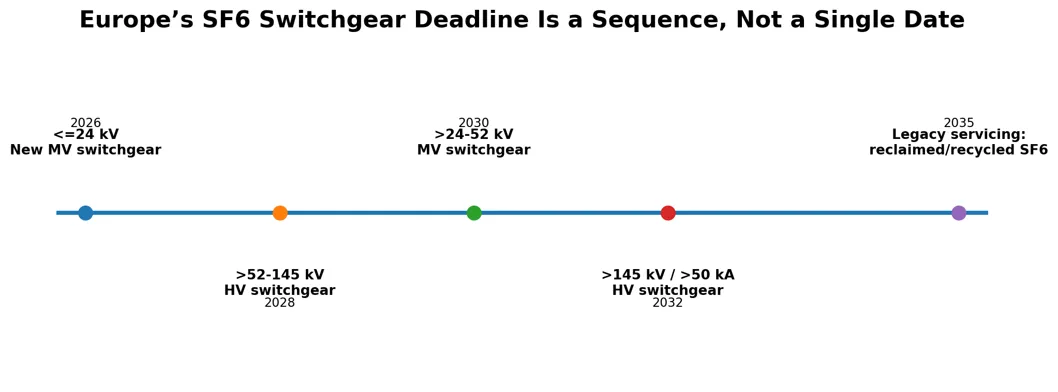
The reason is simple. SF6 has a global warming potential of roughly 24,300 times CO2. The EU F-gas Regulation now prohibits putting into operation new switchgear using fluorinated gases with GWP of 1 or more in successive voltage bands: up to 24 kV from 1 January 2026, more than 52 kV up to 145 kV from 2028, more than 24 kV up to 52 kV from 2030 and above 145 kV from 2032, subject to defined derogations.
Explore ElectroIQ Intelligence
Discover how ElectroIQ helps you track electrical equipment demand, monitor lead times and identify emerging market opportunities: https://www.datamintelligence.com/electroiq#demo
The first deadline is not theoretical anymore
For medium-voltage equipment up to 24 kV, the transition started on 1 January 2026. That makes SF6-free switchgear a live procurement requirement across secondary distribution, commercial and industrial networks, renewable plants and many new data-center electrical systems.
The supply chain is responding. Schneider Electric says its AirSeT platform is manufactured at scale in Europe, using pure air and vacuum technology. Siemens Energy’s Blue GIS combines clean-air insulation with vacuum switching and is already available across multiple high-voltage classes, while Hitachi Energy and TenneT Germany completed on-site testing of the world’s first SF6-free 420 kV GIS in June 2026.
Traditional SF6 vs. clean-air / vacuum GIS: the operational difference
| Dimension | Traditional SF6 GIS | Clean-air / vacuum GIS | Operational implication |
| Insulation / interruption | SF6 used for insulation and, depending on design, interruption | Natural-origin air / clean air for insulation plus vacuum interrupters | Removes F-gas exposure from new equipment |
| Climate impact | Very high GWP if gas leaks or is released | GWP near zero for the insulating medium in clean-air systems | Lower lifecycle greenhouse-gas risk |
| Maintenance / gas handling | Gas inventory, leak management, recovery and certified handling remain relevant | No SF6 inventory in the primary insulation system | Simplifies environmental compliance but does not eliminate normal switchgear maintenance |
| Footprint | Mature compact GIS architecture | Clean air can require more insulation distance; LPIT/digital design can offset part of the footprint | Retrofits may require bay-by-bay layout checks |
| Qualification | Long-established utility specifications | Newer approved-vendor lists, type-test references and utility standards | Specification and qualification timing can become as important as manufacturing capacity |
Siemens notes that clean-air GIS can require more space, while LPITs can help compensate: Siemens Energy Blue GIS FAQ
The supply-chain question is no longer “does the technology exist?”
The more difficult question is whether manufacturing capacity, approved configurations and utility qualification can scale at the same pace as regulation. ENTSO-E’s November 2026 supply-chain assessment says European TSOs plan to add 4,238 SF6-free GIS bays by 2035. But the same TSOs still expect 10,819 SF6 AIS circuit breakers and 2,884 SF6 GIS bays through the transition, which means manufacturers must support old and new technologies at the same time.
That dual-production requirement matters because the transition is happening during a wider grid build-out. ENTSO-E expects additions across most equipment categories to peak between 2028 and 2032 - the same period in which the regulation tightens across higher voltage bands.
Turn Market Signals into Business Opportunities
Explore equipment-level intelligence to support procurement planning, supplier evaluation and strategic market expansion: https://www.datamintelligence.com/electroiq#demo
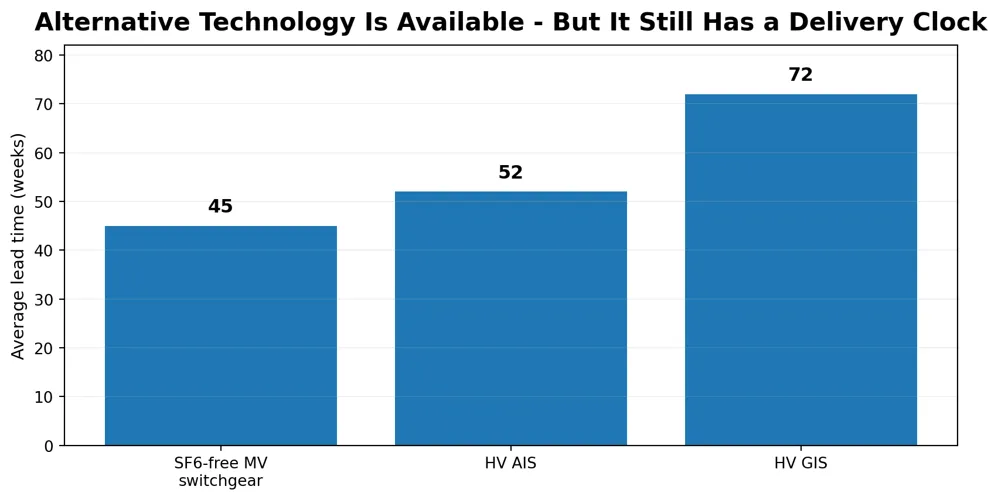
ElectroIQ’s current 2026 tracker shows average lead times of about 45 weeks for SF6-free MV switchgear, 52 weeks for HV AIS and 72 weeks for HV GIS. These averages are not directly interchangeable because voltage, utility specification, short-circuit rating and approved-vendor status differ, but they show that regulatory compliance still carries a material delivery clock.
The harder problem: Europe cannot simply abandon the legacy SF6 fleet
Existing SF6 equipment can remain in service. That creates a long transition period in which DSOs and TSOs have to operate two asset regimes simultaneously: maintain and repair legacy gas-insulated assets while procuring new F-gas-free equipment for expansion and replacement.
The legacy obligations are real. Operators must prevent emissions, repair detected leaks without undue delay, use certified personnel for relevant activities and ensure gas recovery at end of life. From 1 January 2035, only reclaimed or recycled SF6 may generally be used for servicing existing electrical switchgear, except defined emergency situations.
What DSOs should be asking suppliers at Enlit
1. Which voltage classes are genuinely available now? A roadmap slide is not the same as a qualified product. Ask for installed references, type-test status and first available factory slot.
2. What is the real footprint of the alternative? Clean-air insulation can change clearances and bay dimensions. Brownfield substations need layout confirmation before the procurement decision is locked.
3. Which components are still supply constrained? Vacuum interrupters, mechanisms, instrument transformers, copper busbars, enclosures and test capacity can still gate delivery even when the insulation technology is compliant.
4. Can the OEM support both fleets? The winning supplier will need new SF6-free products and a credible service, recovery and spare-parts strategy for installed SF6 assets.
5. Where does digitalisation come with the transition? New switchgear procurement is an opportunity to add sensors, LPITs, condition monitoring and IEC 61850-ready protection rather than replacing like for like.
This is why the SF6 deadline is likely to create winners and losers across the OEM landscape. The winning manufacturers will not simply have a compliant gas-free product. They will have enough manufacturing capacity, utility approvals, installed references, service capability and digital integration to move customers through the transition without extending project schedules.
Where ElectroIQ fits
For switchgear OEMs and suppliers, ElectroIQ can connect three signals that are usually monitored separately: the project or substation creating demand, the lead-time and factory-slot pressure on the required voltage class and the DSO, EPC or specification owner making the procurement decision. That helps commercial teams identify projects where the incumbent technology or delivery schedule is becoming incompatible with the regulatory deadline.
For DSOs and procurement teams, the same intelligence can be used to compare supplier expansions, product availability, regional project demand and lead-time shifts before a framework agreement or replacement program is locked. The practical opportunity is to move from reactive compliance to a forward procurement plan.
The question for Enlit Europe 2026: is Europe’s SF6-free transition now constrained more by technology - or by qualification, factory capacity and the ability to manage two switchgear fleets at once.