


| WHY NOW | 40% of Europe's distribution grids are more than 40 years old, while the EU estimates €584 billion of grid investment is required this decade. |
| WHAT IS CHANGING | Utilities are increasingly choosing between replacement, repair, refurbishment, retrofill, repurposing and material recovery rather than treating end-of-life as a single disposal decision. |
| COMMERCIAL SIGNAL | Every life-extension decision creates demand for diagnostics, service, spare parts, retrofit engineering, digital monitoring, recycled materials and eventual replacement planning. |
Europe’s Grid Has an Age Problem - and a Replacement Problem
Europe’s grid modernization challenge is often framed as a need to build more substations, transformers and switchgear. But a second challenge is just as important: how to keep existing assets productive while replacement queues, capital budgets and carbon targets are all under pressure.
The European Commission says 40% of distribution grids are already more than 40 years old and estimates €584 billion of investment is needed to modernize Europe’s electricity grids. Eurelectric warns that, without sufficient renewal, the share of low-voltage assets over 40 years old could rise further by 2030. The result is a portfolio problem for utilities: some assets must be replaced, while others can be repaired, upgraded or repurposed.
Request Free Demo: https://www.datamintelligence.com/electroiq#demo
Circularity Changes the Asset Decision
For heavy electrical equipment, circularity is not simply recycling metal at end of life. The higher-value sequence is usually to preserve the asset first, preserve major subassemblies second and recover materials only when continued service no longer makes technical or economic sense.
| ASSESS | REPAIR | RETROFIT | REPURPOSE | RECOVER |
| Condition, loading, failure risk | Restore failed or degraded components | Upgrade breakers, relays, bushings, controls | Move usable equipment to a new duty | Recycle oil, SF6, copper, steel and insulation |
| → | → | → | → | ↺ |
| ElectroIQ Lens | Asset age becomes more valuable when it is connected with project schedules, replacement lead times, supplier capacity and new substation investment. ElectroIQ can help teams track where aging installed bases are likely to create retrofit demand before a full replacement tender appears. |
What Does Circular Power Look Like in Practice
| Case | Asset | Circular action | Measured / stated impact | Why it matters |
Norway - Hitachi Energy Drammen | 12 transformers, 38 years old | Health assessment + refurbishment + sensors/controls | Targeting another 20-30 years of service | Life extension can defer replacement while improving reliability |
| Finland - Helen | Power transformers from retired Hanasaari coal plant | Refurbishment and repurposing for four 50 MW electric boilers | Existing transformers redeployed into a decarbonization project | Retired generation assets can become inputs to electrification projects |
Belgium - ENGIE / ABB | Aging switchgear at Doel 4 and CHP assets | Retrofit obsolete breakers, relays and selected equipment | More than half of existing cabinets, plates and busbars retained in the Doel 4 strategy | Selective retrofit can preserve embodied material and reduce outage exposure |
Sweden - E.ON / Hitachi Energy | Decommissioned distribution transformers | Recover and re-refine mineral oil for new transformers | Recycled insulation fluid delivered about 90% lower embedded carbon vs virgin mineral oil | Circularity can extend beyond equipment into transformer material loops |
Source: Hitachi Energy - Drammen transformer service center, Norway, Hitachi Energy - Helen transformer modernization, Finland, ABB - ENGIE / Doel 4 circular retrofit, Belgium, Hitachi Energy - E.ON circular transformer value chain, Sweden
Repair Versus Replace Is Becoming a Lead-Time Decision
The circular-economy case becomes stronger when replacement equipment is difficult to obtain. A transformer that can be safely refurbished for another decade or two is not only avoiding embodied carbon. It may also avoid a multi-year replacement wait, reduce outage exposure and release capital for other grid reinforcements.
The same logic applies to switchgear. Vacuum-breaker retrofits, protection upgrades, digital monitoring and targeted component replacement can extend useful life while leaving high-embedded-carbon cabinets, busbars and structures in service. This is especially relevant when a utility needs reliability improvements faster than a complete substation replacement can be engineered, permitted and delivered.
| Equipment | 2026 average lead time | Circularity implication |
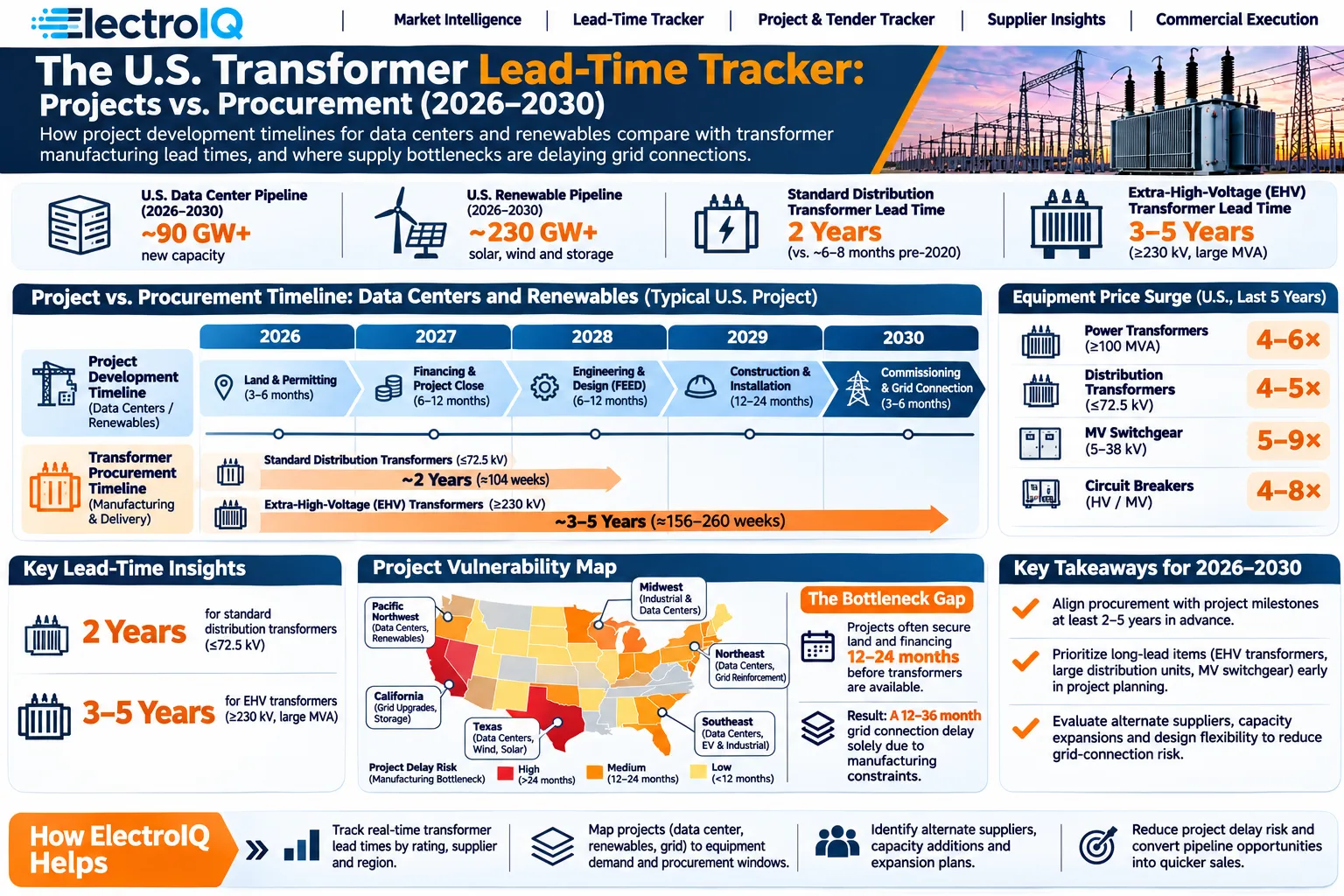
| Large power transformers | 160 weeks | A repair or life-extension program can bridge a replacement window measured in years |
Generator step-up transformers | 144 weeks | Repurpose or refurbish where duty and condition permit |
Medium power transformers | 66 weeks | Condition-based overhaul can reduce emergency replacement risk |
| MV switchgear | 130 weeks | Breaker and relay retrofits may extend the serviceable installed base |
| HV GIS | 72 weeks | Retrofill and gas-management strategies can reduce lifecycle emissions |
Source: ElectroIQ Lead-Time Intelligence - 2026 averages
| ElectroIQ Lens | A long replacement lead time changes the repair-versus-replace threshold. ElectroIQ combines lead-time movement with manufacturer expansions, project timing and regional market demand so asset owners and suppliers can see where life-extension decisions are becoming urgent. |
Explore ElectroIQ Intelligence
Discover how ElectroIQ helps you track electrical equipment demand, monitor lead times and identify emerging market opportunities: https://www.datamintelligence.com/electroiq#demo
SF6 Rules Make Circular Switchgear Strategies More Important
Europe’s F-gas regulation adds another dimension. From 1 January 2035, SF6 used for maintenance or servicing of electrical switchgear must generally be reclaimed or recycled, subject to limited exceptions. The regulation also requires recovery of F-gases from decommissioned equipment for recycling, reclamation or destruction.
That makes legacy switchgear management a portfolio problem: some assets will remain in service, some can be retrofilled, some will need targeted component upgrades and others will be retired. Hitachi Energy, for example, offers an EconiQ retrofill concept that replaces SF6 in installed high-voltage gas-insulated lines while reusing the passive gas components. The commercial opportunity therefore expands beyond new SF6-free switchgear into service, gas recovery, retrofill engineering and lifecycle management.
Recycling Is Moving Upstream Into Transformer Manufacturing
Material circularity is also becoming more sophisticated. In March 2026, Hitachi Energy said it successfully tested a large power transformer filled with re-refined mineral oil at its Córdoba factory in Spain. That follows the earlier E.ON collaboration in Sweden, where mineral oil from decommissioned transformers was recovered, re-refined and returned to the supply chain for ten new distribution transformers.
For utilities, this means end-of-life transformers can increasingly be viewed as material banks. For manufacturers and service companies, it creates new value pools around oil recovery, testing, re-refining, dismantling, component reuse and traceable low-carbon material supply.
Where the Commercial Opportunities Are Emerging
| Signal to monitor | Likely need | Who can win | ElectroIQ connection |
Transformer > 30 years + rising load | Health assessment, overhaul, sensors, bushing/tap-changer work | OEM service teams, specialists, condition-monitoring vendors | Installed-base signals + project load growth + lead-time risk |
Substation capacity upgrade before full rebuild | Breaker/relay retrofit, busbar retention, protection modernization | Switchgear OEMs, EPCs, retrofit specialists | Project/tender tracking + equipment package timing |
| Coal/gas asset retirement | Repurpose transformers or auxiliaries into electrification projects | Utilities, EPCs, refurbishment providers | Project transitions + buyer mapping |
| SF6-heavy installed base | Gas recovery, retrofill, replacement planning | HV/MV OEMs, certified service providers | Regulatory deadlines + installed-base exposure |
Decommissioned transformer fleet | Oil recovery, material recycling, component reuse | Recyclers, oil processors, OEM circular programs | Retirement pipeline + partner identification |
Replacement lead time exceeds project window | Life extension as bridge strategy | Asset owners, service companies, alternate suppliers | Lead-time intelligence + project COD mismatch |
Turn Market Signals into Business Opportunities
Explore equipment-level intelligence to support procurement planning, supplier evaluation and strategic market expansion: https://www.datamintelligence.com/electroiq#demo
Circularity Is Becoming a Grid-Resilience Strategy
Europe cannot replace every aging transformer and switchgear lineup at once. Nor should it. The emerging model is more selective: diagnose first, repair where viable, retrofit where it improves reliability or compliance, repurpose assets that still have useful life and recover materials when the equipment truly reaches end of service.
For utilities, that approach can reduce outage risk, embodied carbon and exposure to constrained supply chains. For equipment suppliers, service providers and EPCs, it expands the addressable market beyond new equipment. The opportunity now includes lifecycle services, modernization packages, digital asset health, retrofill, refurbishment and circular material partnerships.
The strategic question for 2027 is therefore not simply which European substations need replacement. It is which assets can be kept productive, which ones will become urgent before replacement capacity is available and who can identify those decisions early enough to act.
SEE THE ASSET OPPORTUNITY BEFORE THE TENDER | ElectroIQ connects lead-time intelligence, project and tender tracking, market demand, company capacity and customer/partner identification to help teams find where aging grid assets are creating repair, retrofit and replacement opportunities. |
Explore ElectroIQ: www.datamintelligence.com/electroiq