


| KEY TREND | Europe is adding generation faster than it can reinforce, digitise and equip the grid that must absorb it. |
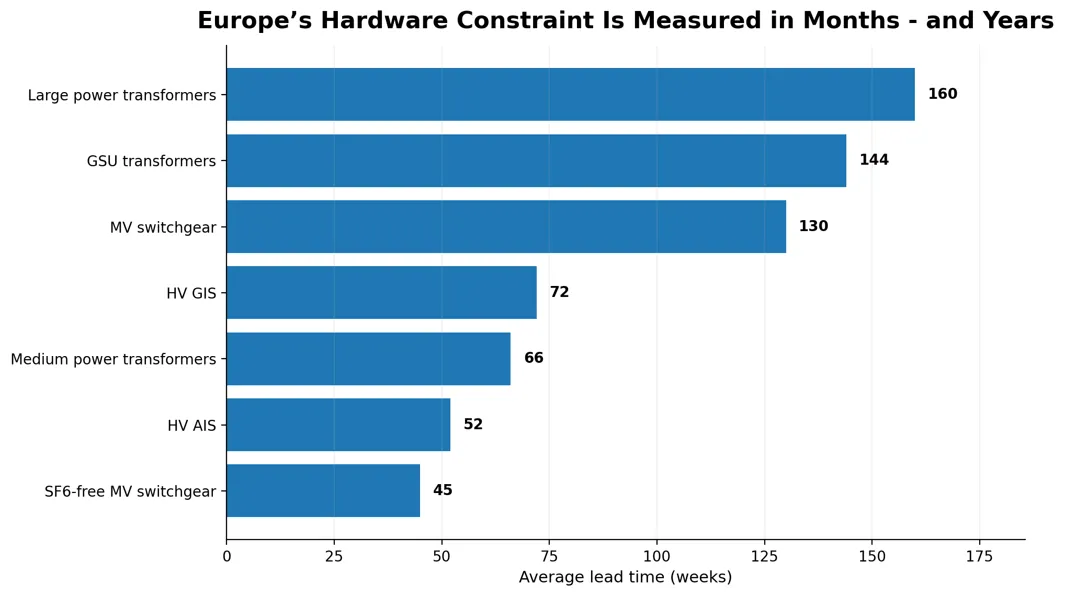
| HARDWARE RISK | ElectroIQ averages put large power transformers at 160 weeks and MV switchgear at 130 weeks, while IEA reports up to four years for large transformers. |
| ENLIT QUESTION | Can Europe convert integration, resilience and competitiveness into equipment capacity, digital visibility and faster grid delivery? |
Request Demo: https://www.datamintelligence.com/electroiq#demo
Europe Has a Generation Ambition - and a Distribution Reality
Europe has a massive generation ambition, paired with a 1980s distribution reality. As 15,000+ energy leaders head to Enlit Europe in Vienna this month, the elephant in the hall is not generation - it is hardware lead times.
That distinction matters because the transition is becoming physical. The European Commission says 40% of Europe’s distribution grids are already more than 40 years old and estimates €584 billion of grid investment is needed this decade. Germany’s 2026 network development scenarios alone point to as much as €392 billion of grid investment through 2045. At the same time, ENTSO-E now expects European TSOs to add 2,820 power transformers and 4,238 SF6-free GIS bays by 2035.
The Bottleneck Is Already Measured in Years
The most dangerous assumption in Europe’s transition plan is that equipment will be available when projects need it. It often will not be. ElectroIQ’s 2026 tracker puts large power transformers at an average 160 weeks, GSUs at 144 weeks and MV switchgear at 130 weeks. Medium-power transformers are materially better at 66 weeks, which is why it is important not to treat every transformer class as a four-year problem.
The broader supply-chain signal is still severe. The IEA says procurement can take two to three years for cables and up to four years for large power transformers, with transformer prices around 75% higher than in 2019. In other words, a project can secure the renewable generation, land and financing and still miss its connection date because the substation package is not available.
Explore ElectroIQ Intelligence
Discover how ElectroIQ helps you track electrical equipment demand, monitor lead times and identify emerging market opportunities: https://www.datamintelligence.com/electroiq#demo
AI Is Colliding with EVs, Heat Pumps and Distributed Generation
The grid is not only absorbing more renewable generation. It is also being asked to serve faster-growing, more volatile loads. The European Commission says EU data-centre capacity could rise from roughly 12 GW in 2025 to around 28 GW by 2030. Eurelectric expects Europe to reach around 50-60 million heat pumps and 65-70 million EVs by 2030, alongside more than 620 GW of additional renewable capacity.
That is why low-voltage visibility matters. Transmission systems are comparatively data-rich. Distribution networks contain millions of dispersed assets and many older feeders still depend on manual switching and legacy protection. The IEA’s 2026 grid-digitalisation work identifies distribution as the area where the largest data gaps remain, while Eurelectric explicitly flags lack of visibility as a barrier to integrating EVs, heat pumps and distributed resources.
Three Shifts Enlit Europe 2026 Attendees Should Watch
1. From Copper and Iron to Intelligence
The next generation of transformers and switchgear will increasingly be bought as monitored grid assets rather than passive hardware. Embedded sensors, digital condition monitoring, intelligent electronic devices and interoperable protection data can turn a substation from a maintenance liability into an observable node. IEC 61850 matters here because it standardises communication and data models across utility automation systems, extending well beyond basic substation messaging.
For DSOs, the commercial value is knowing which transformer is overheating, which feeder is approaching its voltage limit and which local network can absorb another heat pump cluster, EV charging depot or data-centre connection without premature reinforcement.
2. The Eco-Switchgear Transition Is Now a Procurement Deadline
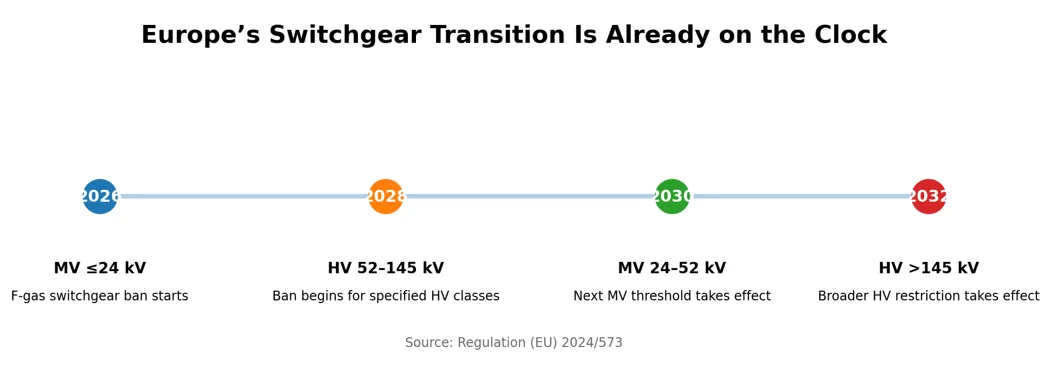
Europe’s SF6 transition is no longer a future sustainability target. Regulation (EU) 2024/573 prohibits putting new F-gas MV switchgear up to and including 24 kV into operation from 1 January 2026, with additional voltage classes following in 2028, 2030 and 2032. ENTSO-E’s 2026 outlook shows TSOs planning thousands of SF6-free GIS bays while still needing legacy SF6 equipment during the transition.
Technology is catching up. Siemens Energy’s Blue GIS portfolio uses vacuum switching with clean-air insulation and already extends to 145 kV products. The competitive question is shifting from whether SF6 alternatives work to whether utilities can qualify them fast enough and whether manufacturers can supply them at the required scale.
3. LV Grid Digitalisation Becomes the Hidden Capacity Upgrade
Europe cannot reinforce every low-voltage feeder at once. That makes visibility and control a form of capacity. Digital twins, feeder monitoring, smart secondary substations and better state estimation can help DSOs identify where flexibility, phase balancing, voltage control or targeted reinforcement can defer a larger capital project.
This is the least visible part of the transition because there is no dramatic wind turbine or solar park to photograph. Yet it is where millions of consumer-level devices connect. If DSOs remain blind at the LV layer, electrification can create local congestion long before the transmission system appears constrained.
What This Means on the Enlit Europe Floor
| Stakeholder | 2026 bottleneck | Practical response |
| DSOs | LV visibility, transformer loading, feeder automation | Digital twins, sensors, secondary-substation monitoring, IEC 61850-enabled protection |
| TSOs | Transformer and GIS supply, replacement cycles | Long-term framework procurement, supplier capacity reservation, SF6-free qualification |
| OEMs | Factory-slot scarcity and specification change | Capacity expansion, modular platforms, component localisation, digital service bundles |
Data centres / industrial loads | Connection timing and grid reinforcement | Earlier utility engagement, dedicated substations, flexible load and staged energisation |
The implication is straightforward: Europe’s energy transition will be won by approving more generation but itt will also be dependent on coordinating generation with transformer slots, switchgear availability, protection architecture, digital visibility and the physical ability of the distribution network to absorb new load.
Turn Market Signals into Business Opportunities
Explore equipment-level intelligence to support procurement planning, supplier evaluation and strategic market expansion: https://www.datamintelligence.com/electroiq#demo
What ElectroIQ Is Watching
For electrical OEMs, utilities and commercial strategy teams, the opportunity is to connect these signals before they appear in a formal tender. ElectroIQ combines project tracking, equipment lead-time intelligence, manufacturer capacity expansions and customer/partner identification so teams can see where a grid project is moving, which equipment package is exposed and where a supplier or alternate technology can intervene.
At Enlit Europe 2026, the most valuable conversation may therefore be less about how many gigawatts Europe can build and more about a simpler question: can the grid hardware arrive before the generation, data centre, EV depot or heat-pump cluster needs it?
For DSOs and OEMs attending Enlit: are you seeing transformer lead times stabilising - or stretching further into 2027?