


Manufacturers are missing commercial opportunities even when electrification investments, data center construction and grid expansion are accelerating.
There's an uncomfortable question facing electrical equipment manufacturers.
If demand for transformers, switchgear, cables and industrial electrical systems is increasing, why are so many manufacturers still struggling to identify their next customer?
The conventional explanation is competition: too many suppliers, aggressive pricing, established customer relationships and lengthy qualification processes. All valid. But there is another problem that receives far less attention.
Manufacturers often know where the market is growing. They don't necessarily know where their next order will come from.
And that distinction is becoming increasingly important.
Request Demo: https://www.datamintelligence.com/electroiq#demo
1. A Growing Market Doesn't Automatically Mean a Growing Order Book
Consider a medium-voltage switchgear manufacturer targeting data centers. The company knows that investment is expanding and has identified the sector as a strategic priority. But several questions remain unanswered:
- Which projects will enter electrical procurement over the next 6 to 12 months?
- Which projects have finalized electrical designs?
- Which engineering consultants define switchgear specifications?
- Which EPC contractors manage electrical procurement?
- Which opportunities are still open to new suppliers?
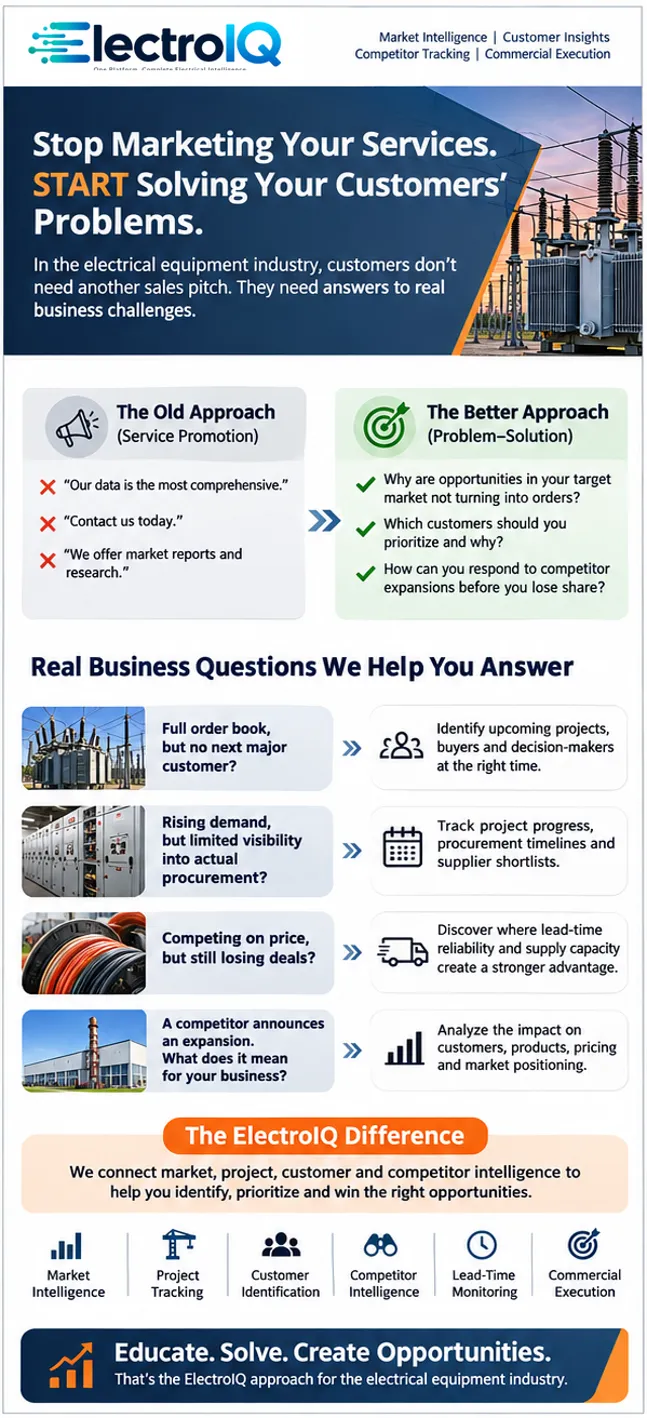
A market forecast can demonstrate the opportunity. It cannot, by itself, tell the sales team which buyer to approach next week. That is where ElectroIQ steps in.
The problem isn't always insufficient demand. It's insufficient visibility into when and how demand becomes a purchase order.
2. Your Competitor May Be Winning the Order Before You Even Know It Exists
Electrical equipment procurement does not begin when a purchase order is issued. Technical consultants influence specifications. EPC contractors shortlist manufacturers. Project owners establish approved vendor lists. Procurement teams evaluate lead times, compliance and delivery capabilities.
Imagine two transformer manufacturers competing for the same utility expansion. Manufacturer A finds the opportunity when a tender is published. Manufacturer B identifies the project during early planning, understands the requirements and has already engaged the relevant stakeholders.
Both manufacture suitable equipment, but they are not competing from the same starting position. Understand when new projects enter the planning stage, the timeline for their tender process and history of tender approvals before you begin your sales pitch with ElectroIQ’s project tracker solution.
Are your sales teams tracking project announcements, or the people and decisions that turn projects into orders?
3. A Shorter Lead Time Can Be Worth More Than a Lower Price
Electrical equipment buyers balance procurement cost against project execution risk. A late transformer or switchgear package can affect commissioning schedules, contractor productivity and downstream milestones, especially with lead times reaching as high as 4 years for certain transformers.
Suppose one technically compliant supplier offers a lower price but a longer delivery time. Another offers a shorter, more reliable commitment at a premium. The stronger proposition depends on the project schedule and the consequences of delay.
Many manufacturers still compete primarily on specifications and price, overlooking when delivery reliability can become a purchasing priority.
Which customers have delivery constraints severe enough that lead-time reliability becomes a decisive advantage?
4. Your Next Major Customer May Not Be on Your Sales Team's Target List
Established channels - distributors, utility accounts, industrial customers and EPC relationships, provide continuity. They can also create blind spots.
A manufacturer expanding in India usually targets major projects and national EPC firms while overlooking regional system integrators, panel builders, electrical contractors and OEMs that influence product selection. A cable supplier targeting data centers may know the owner but not the electrical contractor responsible for the package.
An effective customer identification strategy separates three roles:
- Who operates or consumes the equipment?
- Who specifies, recommends or approves it?
- Who actually places the purchase order?
Often, these are different organizations that require different commercial approaches.
5. Market Share Doesn't Tell You Where You Can Win Next
Revenue, market share and geographic footprint are useful competitor benchmarks. They do not fully explain where a competitor is vulnerable.
When a manufacturer expands switchgear production, ask: Which voltage classes gain capacity? Which customers benefit? Will delivery times improve? Could pricing change? Will distributors reconsider their relationships? What does the expansion mean for component suppliers?
A factory investment is a news event. Understanding the customers, products and supply relationships it may affect is the business opportunity.
6. The Biggest Intelligence Gap Is Between Knowing and Acting
Most electrical equipment companies already have market reports, CRM records, tenders, distributor feedback and competitor updates. The challenge is that these sources remain disconnected.
Market signal: Data center construction increases in a region.
Project intelligence: Developments need medium-voltage distribution equipment.
Customer intelligence: Specific EPCs, consultants and distributors are involved.
Competitive intelligence: Incumbent suppliers face possible capacity or delivery constraints.
Commercial action: A manufacturer prioritizes qualified accounts and engages stakeholders.
The value comes from connecting information to an actionable decision, rather than collecting one more data point. That’s where ElectroIQ excels. We connect all these individual signals into a single streamlined platform where you can understand your next opportunity before it comes up on your radar.
Turn Market Signals into Business Opportunities
Explore equipment-level intelligence to support procurement planning, supplier evaluation and strategic market expansion: https://www.datamintelligence.com/electroiq#demo
The Real Competitive Advantage
Electrical equipment manufacturers do not necessarily need more industry news. They need answers to the questions that determine their next order: which market to enter, which project to pursue, which buyer to approach, where to invest capacity and when to act.
That is the thinking behind ElectroIQ: connecting electrical equipment market intelligence, project opportunities, competitor developments, customer ecosystems and lead-time signals with expert-led commercial execution.
Knowing that a market is growing is useful. Knowing where you can win, who you need to reach and when to act makes that knowledge commercially valuable.
What is your biggest challenge: identifying qualified opportunities, reaching decision-makers or converting market demand into orders?