


How electrical equipment sales teams can turn prolonged delivery queues into new customers, second-source positions and long-term account growth
| KEY TREND | Long lead times at incumbent transformer and switchgear suppliers are forcing utilities, data centers, EPCs and industrial buyers to qualify alternate sources earlier. |
| COMMERCIAL OPENING | The strongest opportunity is not simply selling available equipment. It is identifying projects where incumbent delivery dates no longer fit energization, COD or expansion schedules. |
| RECOMMENDED FOR | Electrical OEM sales teams, component manufacturers, distributors, panel builders, system integrators and commercial strategy teams |
Request Demo: https://www.datamintelligence.com/electroiq#demo
The Shortage Is Also a Sales Opportunity
Long electrical equipment lead times are usually discussed as a procurement problem. For manufacturers and suppliers with available capacity, alternative designs, regional production or faster qualification pathways, they are also one of the largest customer-acquisition openings in the market.
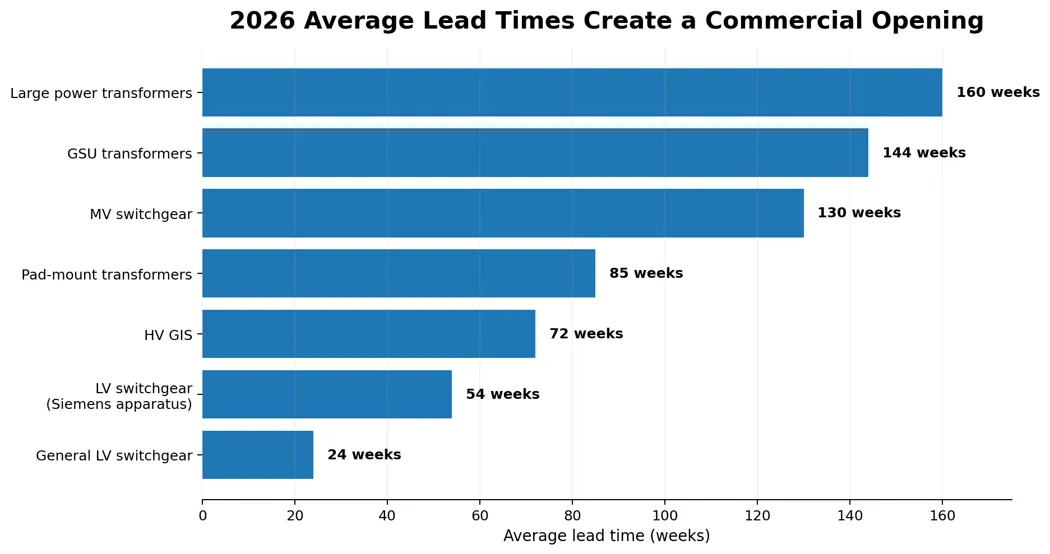
The IEA says cables now take two to three years to procure and large power transformers can take up to four years. Its industry survey found average lead times for large power transformers and cables have almost doubled since 2021. The U.S. Department of Energy separately describes a severe transformer bottleneck driven by rising electricity demand, aging assets and insufficient manufacturing capacity.
That changes buyer behavior. A utility that historically bought from two approved OEMs may suddenly need a third. A data-center developer with an energization target cannot wait for an incumbent factory slot. An EPC may redesign around a qualified alternative if the original package threatens the project schedule.
The commercial question is therefore now about which customers have a delivery problem that makes them willing to reconsider who they buy from.
Why the Customer-Acquisition Window Will Stay Open
Capacity is being added, but relief is staggered. Eaton is opening a 370,000 sq. ft. Nebraska facility for medium-voltage switchgear with production expected in the first half of 2027. Hitachi Energy’s $528 million Mississippi transformer factory is scheduled to start production in 2029. Siemens announced more than $200 million of U.S. electrical manufacturing investments in 2026, including a new Georgia low-voltage manufacturing hub and additional Texas capacity.
These investments matter, but they also show why the commercial opening does not disappear next quarter. Buyers placing orders today are still competing for current factory slots while new plants are built, qualified and ramped. Suppliers that can solve a schedule problem during this transition can enter accounts that were previously difficult to penetrate.
10 Growth Plays for Electrical Equipment Sales Teams
| 1 Win Second-Source Status | 2 Target Schedule-Mismatch Projects |
Get approved before the next shortage emergency. | Prioritize projects where incumbent delivery no longer fits COD. |
| 3 Enter Through EPCs & Specifiers | 4 Use Regional Availability |
Influence the vendor list before the RFQ is locked. | Turn usable local capacity into a sales wedge. |
| 5 Convert Urgent Orders | 6 Cross-Sell Adjacent Equipment |
Use one shortage-driven win to enter a framework account. | Expand from one constrained package into the wider electrical BOM. |
| 7 Track Competitor Capacity Timing | 8 Monetize the Installed Base |
Target customers before new incumbent output arrives. | Use replacement, retrofit and service needs to enter accounts. |
| 9 Expand Through Local Partners | 10 Run Lead-Time Trigger Campaigns |
Use qualified channels where direct qualification is slow. | Prospect when a delivery gap creates a reason to switch. |
Explore ElectroIQ Intelligence
Discover how ElectroIQ helps you track electrical equipment demand, monitor lead times and identify emerging market opportunities: https://www.datamintelligence.com/electroiq#demo
1. Win Second-Source Status Before the Next Emergency
Many large buyers are revisiting approved vendor lists because one-source or two-source strategies no longer provide sufficient schedule resilience. The immediate objective does not have to be replacing the incumbent. Winning approved second-source status can open the door to emergency orders, regional projects and future framework agreements.
Commercial move: Target accounts where the incumbent lead time exceeds the customer’s normal replacement or expansion cycle. Lead with qualification readiness, tested configurations, standards compliance and actual available production windows.
2. Target Projects Where the Incumbent Delivery Date No Longer Fits COD
The best displacement opportunity is a live project whose electrical package has become the critical path. Data centers, renewable projects, industrial expansions and substations all have dates that can be more valuable than a modest equipment-price difference.
Commercial move: Map project energization, construction and commissioning milestones against current transformer and switchgear delivery windows. Prioritize projects where schedule mismatch is already visible.
Where ElectroIQ helps: its Project & Tender Tracker can surface live projects whose energization or commissioning dates are at risk, while Lead-Time Intelligence shows whether the incumbent equipment window still fits the project schedule.
3. Enter Through EPCs and Specification Owners Before the RFQ Is Locked
By the time a formal RFQ is issued, the approved equipment list may already be defined. Long lead times make earlier design-stage engagement more valuable because engineers are more willing to consider alternatives when they understand availability risk.
Commercial move: Identify the EPC, electrical consultant, utility engineer or specification owner at planning and FEED stages. Position the conversation around schedule protection, approved alternatives and configuration flexibility.
4. Use Regional Availability as a Sales Wedge
A supplier may not be the global market leader but can still win if it has a usable regional production slot, local assembly, a qualified channel partner or shorter logistics path. In a constrained market, availability itself becomes part of the value proposition.
Commercial move: Compare country-level and supplier-level availability. Use regional capacity to target customers whose incumbent source is constrained in another geography.
5. Convert One Urgent Order Into a Framework Account
The first order may be triggered by a shortage. The larger opportunity comes after successful delivery. A supplier that solves an urgent problem can move from emergency vendor to repeat supplier if performance, documentation and service are strong.
Commercial move: Treat the first order as an account-entry program. Build a post-delivery plan covering additional plants, business units, upcoming capital projects, spare equipment and framework procurement.
6. Cross-Sell Adjacent Electrical Equipment Into the Same Project
Lead-time disruption often affects multiple packages at once. A customer searching for an alternative MV switchgear supplier may also be facing transformer, protection, cable, UPS or distribution-panel constraints.
Commercial move: Once an account is opened through one constrained product, map the complete electrical bill of materials and identify adjacent categories where your portfolio or partners can solve another schedule problem.
ElectroIQ connection: Market & Demand Intelligence can show which adjacent equipment categories are expanding in the same geography, helping sales teams move from a one-product opportunity to a wider account-growth plan.
7. Target Customers Around Competitor Capacity-Expansion Timing
Factory announcements reveal both opportunity and risk. If a competitor’s meaningful new capacity does not arrive until 2027-2029, the period before ramp-up is a customer-acquisition window. If capacity is coming sooner, it may change which regions or segments remain attractive.
Commercial move: Track announced plants, expansions, commissioning dates and product scope. Prioritize markets where incumbent supply remains structurally tight before new output becomes available.
8. Use the Installed Base to Create Service and Replacement Opportunities
Long lead times do not only affect new projects. They change how utilities and industrial customers think about aging equipment, spare strategy, refurbishment and lifecycle support. DOE notes refurbishment can cut transformer lead time from months to weeks in suitable cases.
Commercial move: Identify installed fleets approaching replacement age, customers with limited spares and sites with reliability exposure. Offer condition assessment, refurbishment, retrofit, spare strategies or planned replacement before failure creates an emergency.
9. Expand Through Local Partners Where Direct Qualification Is Too Slow
Some markets require local approvals, utility relationships, installation capability or after-sales support. A qualified distributor, panel builder, system integrator or EPC partner can reduce the time needed to become commercially credible.
Commercial move: Map partners by voltage class, end-use sector, customer access, service capability and existing approved-vendor relationships. Prioritize partners that already sell into the accounts facing the largest delivery gaps.
ElectroIQ connection: Customer & Partner Identification can help map distributors, panel builders, EPCs, system integrators and end users by product fit, project access and commercial relevance instead of relying on broad company directories.
10. Build Lead-Time Trigger Campaigns Instead of Generic Prospecting
The strongest outreach message is not “we manufacture switchgear” or “we supply transformers.” It is a specific reason why the customer may need another option now. Lead-time movements, project awards, factory delays and capacity announcements create natural commercial triggers.
Commercial move: Connect lead-time intelligence with live projects, named accounts and decision-makers. When a delivery gap appears, outreach can reference the customer’s likely timing problem rather than sending a generic product introduction.
Which Opportunities Should Be Prioritized First?
| Signal | Why It Matters | Best Target | Commercial Response |
| Lead time > project window | Buyer must find another path to protect COD | Project owner / EPC | Offer qualified alternative and confirmed slot |
Incumbent factory expansion is years away | Shortage likely persists through current buying cycle | Utility / data center / industrial buyer | Pursue second-source approval now |
New project enters tender/award stage | Equipment specification is still commercially active | EPC / engineer / procurement | Engage before vendor list closes |
Customer has repeated multi-site capex | One urgent win can scale across portfolio | Corporate procurement / engineering | Convert first order into framework discussion |
Regional supplier availability improves | Local delivery advantage becomes credible | Buyers importing constrained equipment | Lead with regional capacity and service |
Turn Market Signals into Business Opportunities
Explore equipment-level intelligence to support procurement planning, supplier evaluation and strategic market expansion: https://www.datamintelligence.com/electroiq#demo
How ElectroIQ Turns Lead-Time Pressure Into a Sales Opportunity Map
Lead-time information becomes commercially powerful when it is connected to market demand, projects and the buying ecosystem. A 130-week MV switchgear lead time is a useful signal. Knowing which data center, utility or industrial project is exposed to that lead time, which EPC controls the specification and which buyer is still able to qualify an alternative turns the signal into an opportunity.
ElectroIQ brings those layers together across electrical equipment markets. Its Project & Tender Tracker follows end-user projects and manufacturing investments. Lead-Time Intelligence monitors product-specific delivery windows and sourcing risks. Customer & Partner Identification maps OEMs, EPCs, specifiers, distributors and end users. Market & Demand Intelligence adds the geographic and product context needed to decide where sales resources should be concentrated. Together, these modules help commercial teams move from a generic target list to accounts where timing, demand and supplier availability create a credible reason to engage.
For manufacturers trying to grow while the supply chain remains constrained, the objective is straightforward: identify where demand is real, where incumbent supply is late and where your company has a credible path to win.
Source: ElectroIQ - Electrical Equipment Growth Intelligence
The Window Will Not Stay Open Forever
New factories will eventually add capacity. Lead times may stabilize in some equipment categories and incumbent suppliers will defend their accounts. That is exactly why the next few years matter.
When buyers are under schedule pressure, they are more willing to reconsider approved vendors, qualify alternatives and build redundancy into their supply base. Suppliers that use this period only to raise prices may capture short-term margin. Suppliers that use it to enter new accounts can build a much larger customer base that remains after the shortage eases.
The strategic question for electrical equipment companies is therefore simple: while your competitors are protecting their backlogs, how many of their customers are actively looking for another qualified option?