


Why transformers and switchgear are deciding which projects energize first - and how to identify the opportunities before the RFQ arrives.
| KEY TREND | Long equipment queues have moved transformers and switchgear onto the critical path for data centers, grid projects, renewables and industrial expansion. |
| COMMERCIAL IMPLICATION | The winning question is no longer only “Who can supply?” It is “Which projects are exposed, which suppliers have capacity and who should we approach before specifications lock?” |
| RECOMMENDED FOR | Electrical OEMs, component suppliers, EPCs, distributors, utilities, project developers and commercial strategy teams. |
Request Demo: https://www.datamintelligence.com/electroiq#demo
The Bottleneck Has Moved Into the Electrical Path
AI campuses, grid reinforcement, renewable generation and industrial electrification are all accelerating at the same time. The hardware that connects those investments to power is not scaling at the same speed.
The International Energy Agency says large power transformers can take up to four years to procure, while cable and transformer lead times have almost doubled since 2021. The U.S. Department of Energy says multi-year equipment queues are now being driven by rising electricity demand, aging assets, material constraints and limited manufacturing capacity.
DOE supply-chain analysis also notes that the United States still imports around 80% of power transformers and 50% of distribution transformers. This means the lead-time problem is not just a factory scheduling issue. It is also a capacity, materials, geography and sourcing-risk problem.
For commercial teams, that changes the question. A shortage is only useful intelligence when you can see where it intersects with an actual project, a procurement milestone and a buyer that still has room to change the specification or supplier.
Explore ElectroIQ Intelligence
Discover how ElectroIQ helps you track electrical equipment demand, monitor lead times and identify emerging market opportunities: https://www.datamintelligence.com/electroiq#demo
A Lead-Time Number by Itself Is Not Enough
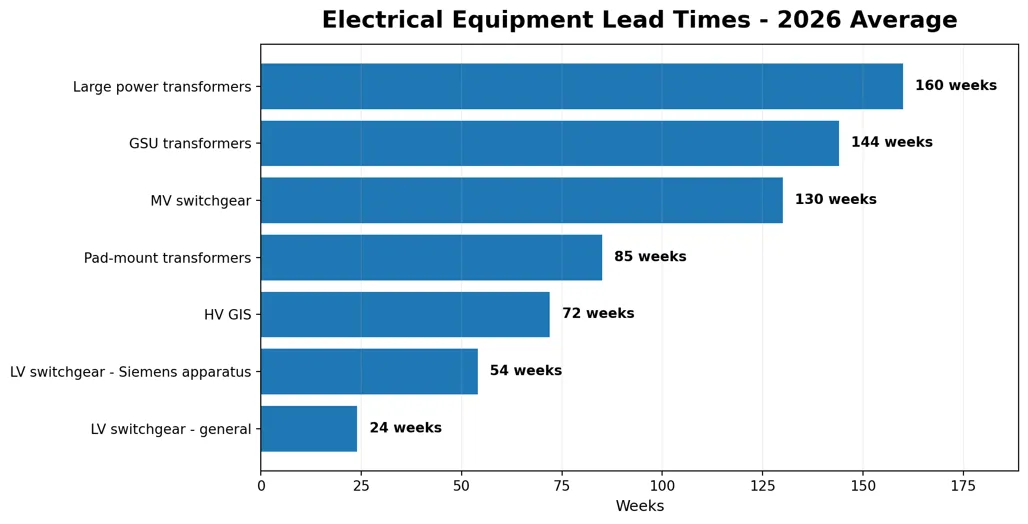
A 160-week transformer benchmark is important. But it does not tell a sales team whether the delay is creating an addressable opportunity. The commercial value appears when four layers are connected:
| Intelligence layer | Question it answers | Commercial use |
| Lead-time intelligence | Which equipment is tight, where and why? | Spot delivery gaps before they become project delays. |
| Project intelligence | Which projects will buy that equipment and when? | Prioritize active demand rather than generic accounts. |
| Market intelligence | Which regions and end uses are structurally expanding? | Allocate sales coverage to the highest-value markets. |
| Company intelligence | Who is adding capacity, winning packages or influencing specifications? | Map competitors, alternative suppliers, EPCs and decision-makers. |
The Real Opportunity Is Where a Project Clock and a Factory Clock Diverge
Consider a data center, utility substation or industrial project with an energization date 18 to 24 months away. If the required MV switchgear is averaging 130 weeks or the large power transformer is averaging 160 weeks, the project has a timing gap before construction even starts.
That gap is already visible in the market. Eaton announced a new 370,000-square-foot Nebraska switchgear facility in April 2026, specifically citing surging demand from nearly 3,000 planned U.S. data centers. Production is expected to begin in 2027. Hitachi Energy announced a $528 million Mississippi transformer factory in September, but production is scheduled to start in 2029.
Siemens is also investing €300 million in Germany to expand production of power-distribution systems for data centers, e-mobility and industrial automation. The investment signals where suppliers see demand, but it does not eliminate the near-term queue.
This is why capacity announcements and project announcements have to be read together. One tells you where supply may improve. The other tells you where demand is becoming procurement. The commercial opportunity sits between the two.
Turn Market Signals into Business Opportunities
Explore equipment-level intelligence to support procurement planning, supplier evaluation and strategic market expansion: https://www.datamintelligence.com/electroiq#demo
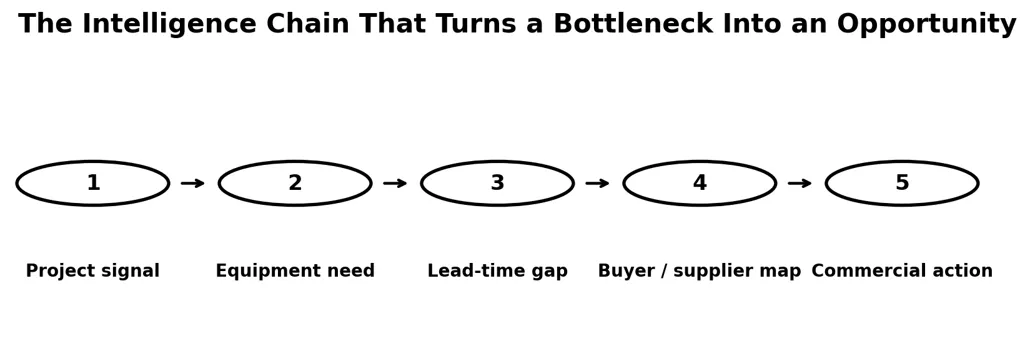
Five Signals That Should Trigger Commercial Action
| Signal | What it means | Next action |
Project announced before electrical package award | Specification influence may still be open. | Map owner, EPC, engineering consultant and likely equipment package. |
COD is shorter than current lead time | Incumbent supply path may no longer fit the project. | Identify qualified alternates with earlier slots or modular options. |
Manufacturer announces new capacity | Future regional availability or competitive intensity may change. | Track ramp timing, products, target customers and nearby projects. |
Lead time starts lengthening by product or geography | Backlog pressure is moving before the market sees a shortage. | Prioritize affected accounts and protect committed delivery windows. |
Market growth accelerates in one end use | Sales resources should move before competitor coverage does. | Combine market demand, project pipeline and customer mapping. |
How ElectroIQ Connects the Signals
ElectroIQ is designed to connect these signals in one commercial view. The platform combines market and demand intelligence, project tracking, lead-time intelligence, customer and partner identification, company intelligence and execution support across electrical equipment markets.
Its Project Tracker connects end-user projects with likely equipment requirements, procurement milestones, owners, EPCs and specification influence. Its Lead-Time Intelligence links delivery windows with bottlenecks, upstream dependencies, regional supply conditions and factory expansion projects.
The practical difference is simple. Instead of seeing “MV switchgear is at 130 weeks,” your team can ask: Which projects need MV switchgear? Which ones are scheduled to energize inside that window? Who controls the specification? Which suppliers are expanding capacity? Where can an alternate vendor, partner or sourcing route realistically win?
Four Questions Better Intelligence Should Answer
For commercial and sourcing teams, better intelligence should reduce uncertainty around four decisions: where demand is emerging, where delivery risk is creating an opening, who needs to be engaged and what milestone should trigger action.
| 1. Where is demand emerging? | Projects, tenders, market growth and end-use signals relevant to the product portfolio. |
2. Where is delivery risk creating an opening? | Lead-time gaps, order-book pressure, component bottlenecks and supplier availability. |
| 3. Who needs to be engaged? | Project owners, EPCs, engineering specifiers, OEMs, distributors and qualified partners. |
4. What milestone should trigger action? | Specification freeze, tender release, supplier qualification, factory-slot allocation or project energization. |
The Question for 2027 Is No Longer “Is There a Bottleneck?”
The bottleneck is visible. The harder question is whether your commercial and sourcing teams can see it early enough to act.
In a market where a transformer slot can outlast a project’s design cycle, intelligence has to move ahead of procurement. The companies that identify the exposed project, the alternative supplier and the real buyer first will be in a stronger position than those reacting after the RFQ is already locked.
For manufacturers, EPCs, distributors, utilities and project developers, the advantage comes from connecting market demand, live project activity and equipment availability before procurement decisions are locked. ElectroIQ brings those signals together so teams can identify exposed projects, prioritize the right accounts and act earlier on emerging opportunities. See ElectroIQ in action