


How shielding, warmer CCT, curfews and networked controls are changing the lighting market
| KEY TREND | Dark-sky rules are moving outdoor lighting specifications away from maximum lumen output toward controlled distribution, lower uplight, warmer color temperature and time-based operation. |
| MARKET OUTLOOK | State law remains fragmented, but local codes and public procurement are creating a de facto national design direction for street, area, parking and architectural lighting. |
| RECOMMENDED FOR | Lighting OEMs, LED module suppliers, controls companies, municipalities, utilities, EPCs, distributors and outdoor-lighting procurement teams |
Request FREE Demo Access: https://www.datamintelligence.com/electroiq
DMI Analyst View
Dark Sky regulation is becoming a product-specification issue for the U.S. lighting industry rather than a niche environmental topic. The legal landscape is still fragmented: the National Conference of State Legislatures says at least 19 states, the District of Columbia and Puerto Rico have laws that reduce light pollution, while municipalities have added hundreds of local lighting provisions. Most state statutes are narrower than a full private-sector ban, often applying to state-funded facilities, public roads or specific environmental concerns. The commercial effect is broader because municipal codes, utility specifications and public tenders increasingly borrow the same design principles.
The common direction is clear. New outdoor lighting is being pushed toward full shielding or full cutoff optics, lower unnecessary lumen output, limits on light trespass, warmer correlated color temperature and controls that dim or switch off non-essential lighting. DarkSky International’s municipal-code framework uses 3000 K as a key baseline and incorporates curfews, trespass limits and controls. In 2026, communities such as Avon, Colorado updated local standards to require full-cutoff shielding plus 2700 K-3000 K exterior lighting for new installations after September 24, showing how local rules can move faster than state statutes.
For lighting manufacturers, this does not simply shrink demand. It changes where value sits inside the fixture. Commodity high-output luminaires face pressure while optical design, warm-CCT LED engines, shielding, dimming, sensors, controls, photometric compliance and field-configurable products gain importance. The addressable opportunity is particularly significant in street and roadway lighting, which accounted for about 42.35% of the U.S. outdoor LED lighting market in 2025, while luminaires represented 69.84% of the market and new installations 52.78%.
Almost 20 U.S States Already Have Laws Addressing Light Pollution
There is no single federal Dark Sky law governing outdoor lighting. State-level policy has developed through a mix of broad night-sky statutes, state-procurement rules, roadway-lighting restrictions, wildlife protections and utility requirements. The NCSL inventory identifies at least 19 states with laws in place to reduce light pollution. The map below highlights those states, but the scope of each law is not equivalent.
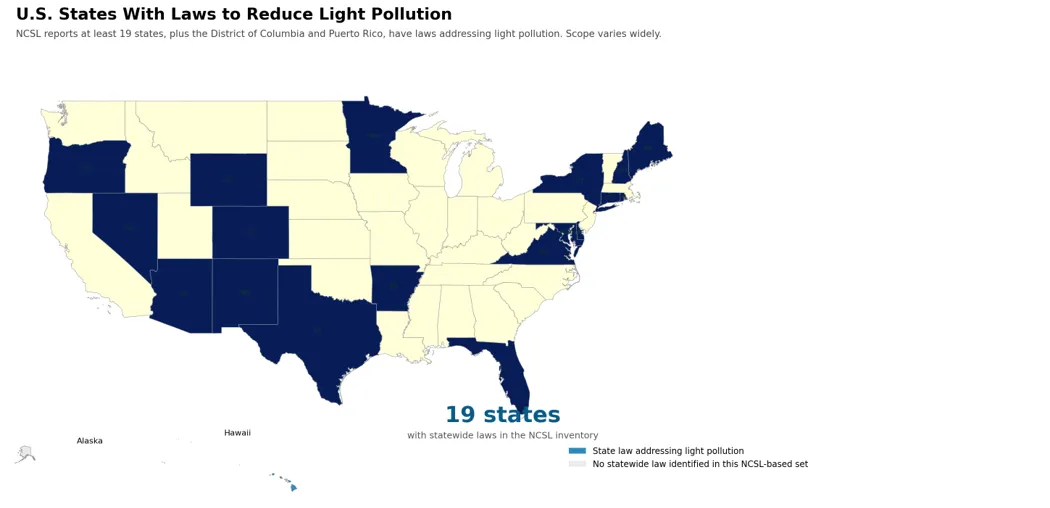
Source: National Conference of State Legislatures; DarkSky policy database
Request FREE Demo Access: https://www.datamintelligence.com/electroiq
| State group | Representative requirements | Commercial impact |
Broad shielding / night-sky rules | Arizona and New Mexico require shielding across significant categories of outdoor fixtures, with exceptions. | Strong demand for compliant optics, shields, lower uplight and retrofit replacement. |
State-funded / roadway rules | Colorado, Connecticut, Delaware, New Hampshire, New York, Oregon, Texas and Virginia apply requirements to state-funded lighting, roads or public facilities. | Public procurement becomes a specification-setting market for compliant luminaires. |
Environmental / special-purpose rules | Florida includes lighting provisions tied to marine-turtle protection; other states use wildlife or astronomy objectives. | Creates specialized demand for spectral control, cutoff optics and site-specific design. |
Utility / customer-option requirements | Arkansas and Wyoming include utility-related requirements or customer options for shielded outdoor lighting. | Utilities and distributors need compliant SKUs plus retrofit/service offerings. |
The Regulation Is Shifting the Product Specification, Not Just the Fixture
The largest market impact comes from a change in how outdoor lighting quality is defined. Historically, projects could be optimized around illuminance, wattage, fixture count and acquisition cost. Dark-sky policies add a second set of constraints around where light travels, when it operates and the spectrum it emits.
| Specification lever | Typical dark-sky direction | Lighting-sector implication |
| Uplight / shielding | Fully shielded or full-cutoff luminaires; minimize light above the horizontal plane. | Higher value for precision optics, shielding accessories and zero-uplight product families. |
| Lumens | Use only the light necessary for the intended task. | Reduces over-lighting; shifts competition toward optical efficiency rather than raw lumen output. |
| CCT / spectrum | 3000 K maximum is increasingly used in DarkSky-oriented local codes; some communities target 2700 K-3000 K. | Expands warm-white outdoor LED offerings and requires efficacy/color-rendering optimization at lower CCT. |
| Curfew / timing | Non-essential lighting dimmed or switched off during defined nighttime hours. | Increases value of clocks, schedules, occupancy sensing and networked control nodes. |
| Light trespass | Limits at residential, habitat and boundary conditions. | Raises demand for photometric modeling, house-side shields and tighter beam control. |
| Adaptive operation | Dim when full output is unnecessary and restore output when needed. | Moves more value into control platforms and connected infrastructure. |
Source: NCSL; DarkSky municipal-code guidance; DOE outdoor-lighting controls guidance
Request FREE Demo Access: https://www.datamintelligence.com/electroiq
3000 K Is Becoming a Commercial Design Threshold
Color temperature is one of the most visible changes. DarkSky has required approved lighting to remain at or below 3000 K since 2014 and its municipal-code template uses 3000 K as the maximum baseline for outdoor luminaires unless a documented safety exception applies. The logic is that higher short-wavelength content contributes more strongly to sky glow and can have greater ecological effects.
The 2026 market shows this moving from voluntary guidance into local code language. Avon, Colorado now requires exterior fixtures installed after September 24, 2026 to direct light downward, use full-cutoff shielding and operate within a 2700 K-3000 K range. New York City also introduced legislation in January 2026 proposing a 3000 K cap for new and replacement streetlights. The New York measure is a proposal rather than an enacted requirement, but it illustrates the direction of specification debates in major municipal markets.
The commercial impact is nuanced. A shift from 4000 K or 5000 K outdoor products toward 3000 K and below can reduce efficacy at the same technology generation, so manufacturers must recover performance through better LEDs, optics and driver design. It also expands the number of SKU and certification combinations required for national suppliers because local requirements are not synchronized.
Street and Roadway Lighting Is the First Large Market to Feel the Change
Street and roadway lighting represented about 42.35% of U.S. outdoor LED lighting revenue in 2025, making public infrastructure the largest single exposure point for dark-sky specifications. This matters because public agencies can embed requirements directly into tenders, creating immediate demand for compliant products without waiting for private-building codes to change.
2025 U.S. outdoor LED market signal | Share / metric | Why it matters for Dark Sky transition |
Luminaires share of product mix | 69.84% | Regulation affects the core value-bearing product category rather than a small accessory segment. |
New installations share | 52.78% | A large portion of demand can be specified correctly at design stage rather than retrofitted later. |
Street & roadway share | 42.35% | Municipal and utility procurement can materially redirect product design and qualification. |
Retrofit growth outlook, 2026-2035 | 5.07% CAGR | Existing high-uplight or high-CCT stock creates a multi-year conversion opportunity. |
Source: DataM Intelligence
Request FREE Demo Access: https://www.datamintelligence.com/electroiq
Controls Can Turn Regulation Into a Higher-Value System Sale
Dark-sky rules also favor controls because reducing operating hours and output can meet environmental goals without removing lighting needed for safety. DOE guidance has long identified networked outdoor-lighting controls as a path to lower energy and maintenance cost. DOE pathway analysis indicates that controls and sensors can add roughly 20%-40% savings beyond LED conversion depending on dimming strategy and hours of operation.
This changes the sales mix. A basic LED replacement may reduce watts, but a dark-sky-oriented system can combine a luminaire, occupancy or traffic sensing, a dimmable driver, remote monitoring, scheduling and asset-management software. The hardware may deliver fewer lumens at certain hours while generating more revenue per controlled point because intelligence and optical performance replace over-lighting as the value proposition.
The Market Impact Will Differ Sharply by Application
| Application | Regulatory pressure | Likely product shift | Commercial opportunity |
| Street & roadway | High in state/public procurement and municipalities | Full cutoff, warm CCT, adaptive dimming, network controls | Fleet conversion, smart-city controls, fixture replacement |
Parking lots & garages | High where trespass and lumen limits apply | Area optics, house-side shielding, schedules, occupancy dimming | Retrofit packages and sensor-integrated luminaires |
| Commercial exterior | Moderate to high at local-code level | Lower lumen density, shielding, curfews, 3000 K options | Compliant SKU families and site redesign |
Architectural / facade | Rising because uplight is visible and non-essential | Tighter aiming, downward lighting, reduced hours | Precision optics and control-led redesign |
| Sports lighting | Specialized; often exempted or separately regulated | Tighter beam control, spill-light limits, curfews | High-specification LED systems and controls |
Residential / hospitality | Highly local and community-driven | Warm CCT, low lumen, zero uplight, timers | Premium dark-sky fixtures and retrofit demand |
Request FREE Demo Access: https://www.datamintelligence.com/electroiq
The Biggest Winner May Be Optical Control Rather Than LED Conversion Itself
The U.S. outdoor market is already substantially LED-based, so the next regulatory cycle is less about replacing sodium lamps with LEDs and more about correcting the design weaknesses of early LED conversions. High-output white LED streetlights can still create glare, trespass and sky glow if optics, tilt and spectrum are poorly controlled. Dark-sky regulation therefore creates a second-generation retrofit cycle focused on quality of light rather than only energy efficiency.
Manufacturers with strong photometric engineering can gain share because a compliant luminaire must put usable light on the target plane while minimizing near-horizontal emission. Better optics can maintain roadway or site performance with fewer lumens. This creates differentiation for companies able to document BUG ratings, uplight performance, boundary illuminance and application-specific photometry rather than compete only on lumens per watt.
Fragmented Local Codes Will Increase Compliance Complexity
The absence of a single national standard is both a challenge and an opportunity. State statutes may cover only public assets while cities and counties impose stricter rules on private development. DarkSky’s policy database contains more than a thousand statutory and local provisions related to outdoor lighting, glare, shielding, light trespass and similar topics. Manufacturers selling nationally therefore need a compliance architecture that can accommodate different CCT limits, shielding requirements, lumen thresholds, curfews and exemptions.
This fragmentation favors configurable platforms. Field-selectable output, interchangeable shields, programmable dimming profiles and multiple CCT variants can reduce the number of fully distinct fixtures needed. Distributors can also gain by stocking code-ready products by region and helping contractors avoid specification failures late in the permitting process.
Request FREE Demo Access: https://www.datamintelligence.com/electroiq
What U.S. Lighting Companies Should Prepare for Through 2030
Lighting companies should treat dark-sky regulation as a specification migration rather than a niche compliance issue. The first priority is to build 3000 K and lower-CCT options across all major outdoor platforms while preserving efficacy, thermal performance and lumen maintenance. The second is to design shielding, zero-uplight optics and house-side control into standard product families rather than sell them only as custom accessories.
The third priority is controls. Curfews and adaptive operation create a practical reason to embed dimming and connectivity even where energy codes do not require them. The fourth is regulatory intelligence. Because most commercial change will occur city by city, sales teams need visibility into local codes, municipal retrofit programs, utility tenders and planned public-infrastructure projects before the specification is locked.
The companies best positioned to gain share will be those that can prove compliance while still meeting the buyer’s safety, photometric and lifecycle-cost requirements. Dark-sky policy is therefore likely to accelerate a move from selling fixtures as commodity hardware toward selling engineered outdoor-lighting systems.
ElectroIQ Can Help Track the Regulatory and Project Transition
DataM Intelligence's ElectroIQ platform can support lighting manufacturers and component suppliers by tracking regulatory changes alongside municipal, utility, commercial and infrastructure projects. Combining country/state-level market intelligence with project visibility can help commercial teams identify where dark-sky requirements, streetlight conversions or outdoor-lighting upgrades are creating new specification opportunities before procurement closes.