


Critical Minerals & Energy Storage Contracting Intelligence
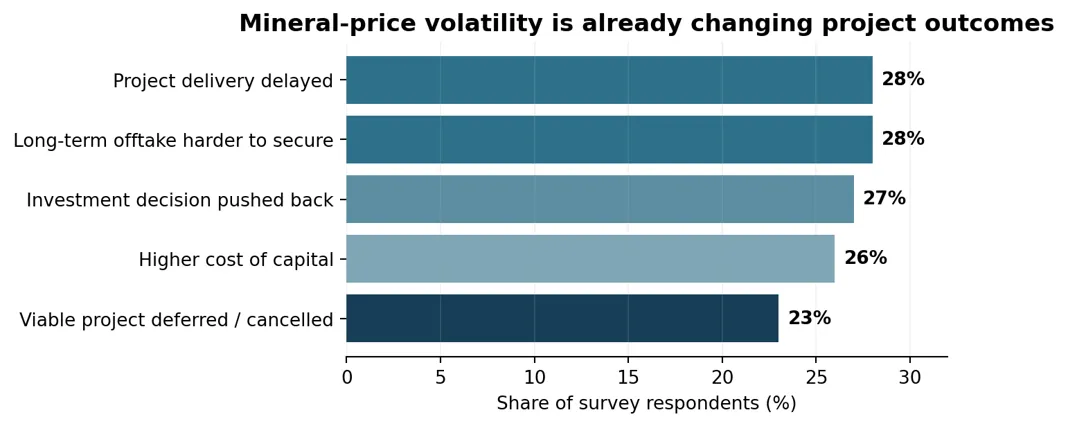
| THE PROJECT SHOCK | 23% of energy-storage participants say otherwise viable projects have been deferred or cancelled because unpredictable critical-mineral pricing made the economics unworkable. |
| THE BANKABILITY PROBLEM | 52% describe mineral-price volatility as a major constraint or dealbreaker. Another 28% report difficulty securing bankable long-term offtake and 26% report a higher cost of capital. |
| THE CONTRACT RESET | Pricing risk is being redistributed across the chain. Component-linked pricing, price floors, hybrid structures and long-term fixed contracts with periodic resets are replacing one-size-fits-all commodity exposure. |
The Commodity Price Is Becoming a Project-Finance Variable
Energy-storage procurement used to treat mineral prices as an upstream purchasing issue. Lithium, nickel, cobalt, graphite and other inputs moved, buyers negotiated around the movement and the downstream project continued to be financed against expected battery-system costs.
That separation is breaking down. DLA Piper surveyed 550 participants across investors, lenders, developers, OEMs, utilities, miners and other energy-storage stakeholders. Almost one in four reported that viable projects had already been deferred or cancelled because critical-mineral prices were too unpredictable. The effect is flowing through delivery schedules, offtake negotiations, investment committees and financing costs.
The commercial consequence is bigger than a volatile spot quote. The contract itself is becoming part of the risk-control system. Buyers are changing what price is referenced, miners are changing how long prices stay fixed and lenders are pushing for structures that prevent a raw-material shock from destroying project bankability.
Request Executive Sample: https://www.datamintelligence.com/download-sample/critical-minerals-market
The Two 37% Figures Tell Different Stories
The most important distinction in the DLA Piper research is easy to miss. Two separate 37% figures describe two different responses to volatility. First, 37% of developers are pursuing vertical integration to gain greater control over supply. Second, 37% of respondents overall support component-linked pricing as an alternative to raw-mineral spot pricing. Those strategies solve different problems.
37% - DEVELOPERS refinery-to-cell chain and reduce dependence on external supply shocks. | 37% - ALL RESPONDENTS Component-linked pricing Reference a battery or cell index rather than passing raw-mineral spot volatility directly through the contract. |
46% - DEVELOPERS so neither buyer nor seller carries the full commodity-price risk. | 48% - MINERS Fixed pricing + periodic resets Preserve revenue visibility for long-duration supply while allowing prices to reset at defined intervals. |
There Is No Single “New Contract”
Every layer is trying to move risk toward the counterparty best able to absorb or hedge it. Battery and technology manufacturers show the strongest support for component-linked pricing at 46%. Lenders favour guaranteed price floors at 43%. Developers prefer hybrid structures at 46%. Mining and raw-material producers lean most strongly toward long-term fixed pricing with periodic resets at 48%.
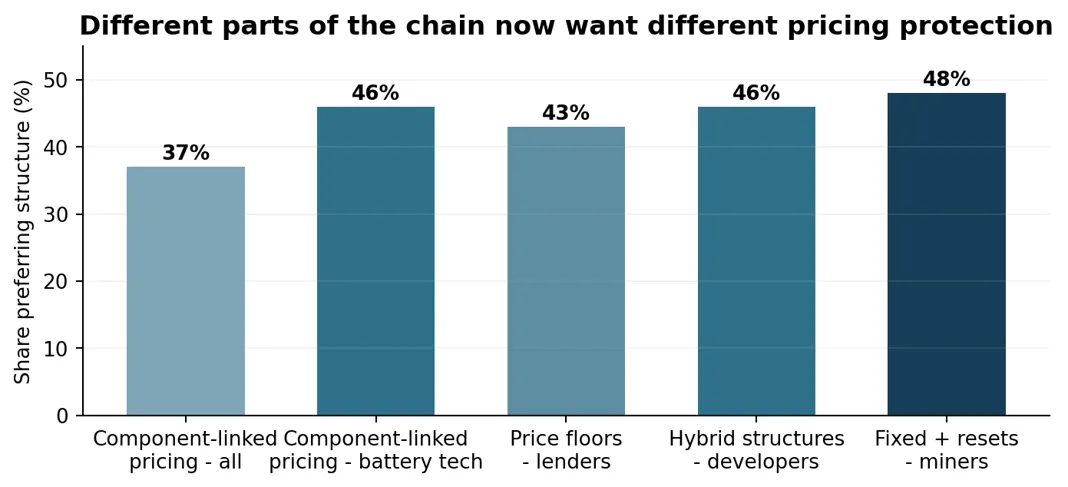
This is contractual fracturing in practice. The upstream seller wants revenue certainty without being trapped in a fixed price for an entire cycle. The downstream developer wants cost visibility without accepting raw-material spikes it cannot pass through. The lender wants a structure that keeps debt-service coverage intact. The resulting agreement increasingly looks like a negotiated risk-allocation formula rather than a simple commodity purchase.
The Benchmark Problem Is Driving the Fracture
The contract problem is particularly acute in smaller or more opaque mineral markets. DLA Piper notes that some niche critical minerals do not have a robust index at all, while indices that do exist can be heavily influenced by Chinese market conditions. That matters because a benchmark only helps if buyers, sellers and lenders believe it reflects the price risk they actually face.
The IEA makes a similar point at policy level. Many mineral markets are concentrated and opaque, and price discovery often relies on bilateral contracts or price-reporting agencies rather than deep, liquid exchanges. The 2026 market has added another complication: export controls have created sharp geographic price divergences. IEA reports European prices for gallium and heavy rare earths at roughly five times Chinese domestic levels and germanium at almost three times Chinese prices.
HOW PRICE RISK NOW MOVES THROUGH THE CHAIN
| MINE Ore / concentrate | REFINER Battery-grade material | CELL Cathode / anode / cell | BESS System integrator | PROJECT Developer / lender |
A mineral benchmark can now affect more than the mine-to-refinery contract. It can change cell pricing, EPC bids, warranty economics, project returns and ultimately the financing package. The more volatile or less representative the benchmark, the more value there is in contractual mechanisms that smooth, cap or redistribute the movement.
Volatility Is Not Being Felt Equally
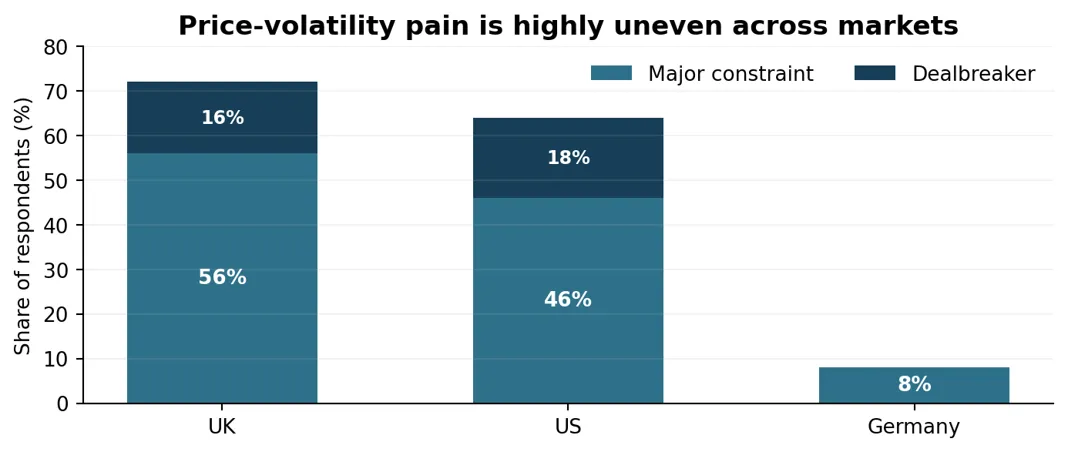
The regional split is commercially important. In the UK, 56% call volatility a major constraint and another 16% call it a dealbreaker. In the U.S., the equivalent figures are 46% and 18%. Germany is far less alarmed, with only 8% calling volatility a major issue and no respondent describing it as a dealbreaker. Contract structure therefore cannot be designed in isolation from local revenue models, domestic supply chains, financing conditions and regulatory support.
The Paradox: Prices Rebounded While Investment Retreated
The upstream side faces a different version of the same problem. The IEA says critical-mineral prices rebounded in 2025 and early 2026. Lithium more than doubled, cobalt rose around 130% and strategic minor minerals more than doubled, with tungsten surging sixfold. Yet investment did not respond with a broad expansion cycle.
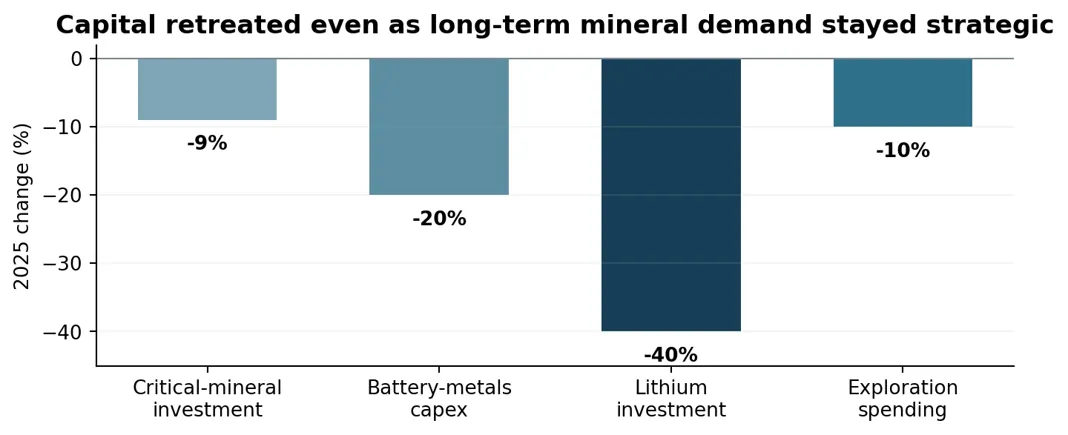
Total critical-mineral investment fell 9% in 2025. Battery-metals capital spending fell by more than 20%, lithium companies cut investment by around 40% and exploration spending declined by more than 10%. That is the capital-market consequence of unstable pricing: high prices can arrive too late to justify new supply, while low prices can destroy the economics before a project reaches financing.
This is why miners increasingly favour long-term fixed pricing with periodic resets. A mine or refinery needs enough revenue visibility to finance multi-year capital expenditure. A developer needs enough flexibility to avoid being locked into a high commodity cycle. Periodic resets, floors, caps and component-linked formulas are attempts to create an investable middle ground.
The Contract Has Become a Competitive Advantage
WHAT EACH PARTY IS TRYING TO PROTECT
| Party | Preferred direction | Primary risk | Commercial objective |
| Miners / processors | Fixed + periodic reset | Revenue collapse | Finance capacity |
| Battery manufacturers | Component-linked | Raw-material pass-through | Protect conversion margin |
| Developers / OEMs | Hybrid pricing | Budget volatility | Keep projects bankable |
| Lenders | Price floors / protections | Downside cash-flow risk | Protect debt service |
Companies that understand this shift can negotiate around risk before volatility reaches the final project. That can mean different mineral-index exposure, more frequent resets, a floor-and-cap corridor, a component-level benchmark, volume commitments, regional supply clauses or strategic equity participation upstream. Procurement, treasury and project-finance teams increasingly need the same market intelligence.
Five Signals That the Next Contract Reset Is Coming
| Benchmark divergence widens | Regional prices stop moving together | Reopen index and location basis before renewal |
| Mineral price spike hits cell quotes | Raw-material volatility reaches downstream equipment | Test component-linked or hybrid pricing |
| Offtake negotiation extends | Counterparties cannot agree on future price risk | Model floors, caps and reset intervals |
| Mining capex is deferred | Future supply response weakens | Secure longer-duration volume before shortage |
| Developer financing cost rises | Lender sees commodity exposure as project risk | Bring pricing protection into financing package |
Why the Critical Minerals Report Matters Now
The next competitive advantage in critical minerals will not come from knowing that lithium, cobalt, nickel, graphite, copper or rare earths are strategic. Buyers already know that. The advantage comes from understanding which mineral is exposed to which pricing mechanism, where processing concentration creates benchmark distortion, which regions are adding or losing capacity and how those shifts change procurement leverage.
A contract can only allocate risks that the parties can see. That makes supply-demand balance, regional processing concentration, mineral-specific price drivers, policy changes, recycling economics and supplier strategy essential inputs into commercial negotiations.
| WHAT THE DATAM CRITICAL MINERALS MARKET REPORT HELPS ANSWER • Which minerals carry the highest supply, processing and price-concentration risk? • How are lithium, cobalt, nickel, graphite, copper, manganese and rare earth supply chains changing by region? • Where does China retain the strongest processing and pricing influence? • Which end-use sectors are most exposed to commodity-price shocks? • How are recycling, localization and long-term offtake changing future supply security? • Which producers, processors and downstream buyers are best positioned as contracting structures change? |
Use the report to move from a broad “critical minerals are volatile” thesis to mineral-by-mineral decisions on sourcing, investment, contract structure and regional exposure: View the DataM Intelligence Critical Minerals Market Report