


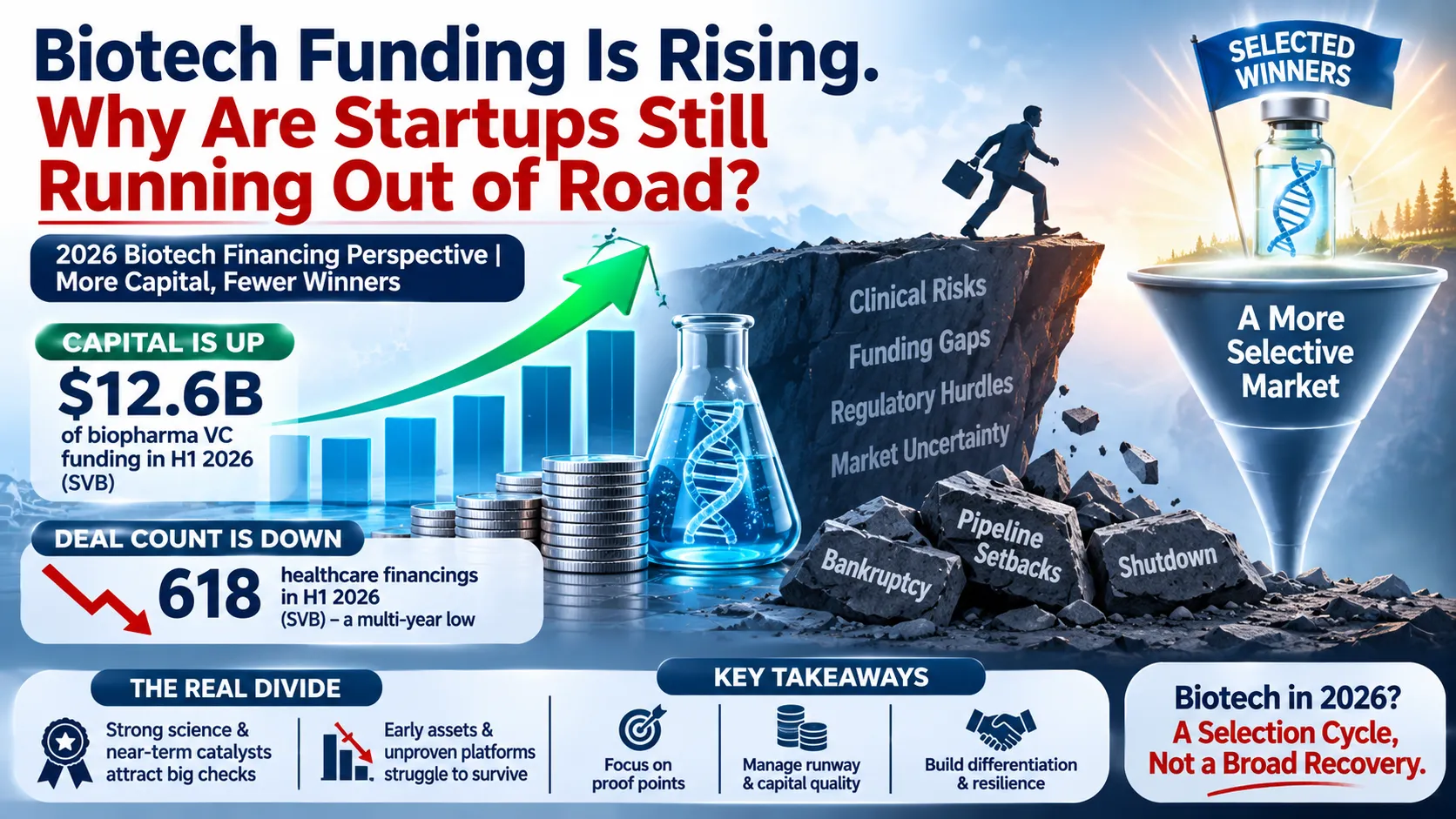
2026 Biotech Financing Perspective | More Capital, Fewer Winners
| CAPITAL IS UP | $12.6B of biopharma VC funding in H1 2026 according to SVB. J.P. Morgan data indicate 2026 global biopharma funding is on track to exceed 2025. |
| DEAL COUNT IS DOWN | SVB recorded 618 healthcare financings in H1 2026 - a multi-year low - showing that more dollars are concentrating in fewer companies. |
| THE REAL DIVIDE | Clinical proof, credible management teams and near-term catalysts are attracting large checks. Early platforms and unproven assets are still struggling to survive. |
The 2026 Paradox: Biotech Is Raising More Money While More Companies Hit the Wall
The financing market looks healthier from 30,000 feet. Silicon Valley Bank reports $12.6 billion of biopharma venture funding in the first half of 2026 and says overall healthcare investment dollars remain on an upward trend. J.P. Morgan data show global biopharma companies raised $54.5 billion across 959 rounds from the start of 2025 through Q3 2026, with full-year 2026 funding projected at about $33 billion versus $30.5 billion in 2025.
But the improvement is highly concentrated. SVB counted only 618 healthcare financings in H1 2026, a multi-year low. BioPharma Dive separately tracked more than $9.1 billion raised by 68 biotechs in the first half, the strongest first-half total since 2022 within its dataset, yet 76% of that capital came from rounds of $100 million or more. Forty-two of the 68 companies already had a drug in human testing.
That is the core story of 2026. Capital has returned, but it is behaving like a filter. The market is rewarding evidence and optionality while allowing weaker balance sheets, failed programs and hard-to-finance modalities to fall away faster.
Request for Partner/ Customer Identification Service: https://www.datamintelligence.com/capabilities/partnership-identification
Five Different Biotechs Show Why Funding Growth Does Not Equal Startup Survival
The companies below are different from the Caribou Biosciences, Arpeggio Bio and Adecto examples often used to illustrate the current shakeout. Each demonstrates a different route from scientific ambition to financial distress.
| Company | 2026 status | What went wrong | What it shows |
| Karyopharm Therapeutics | Chapter 11 filed Nov. 2 | Debt and liquidity pressure forced a court-supervised restructuring despite an operating commercial business. | Commercial revenue does not protect a biotech if capital structure and cash needs become unsustainable. |
| BioXcel Therapeutics | Chapter 11 filed Aug. 27 | The company entered bankruptcy and later completed asset dispositions after years of commercial and development pressure. | An approved product does not eliminate financing risk when adoption and operating costs miss expectations. |
| Sangamo Therapeutics | Chapter 11 filed Jun. 23 | The genomic medicine company entered bankruptcy and sold assets through a court-supervised process. | Platform value can survive while the corporate entity does not. |
| IO Biotech | Bankruptcy / shutdown in March | After FDA advised against an approval filing for its cancer vaccine, the company closed operations and moved into liquidation. | A single regulatory setback can erase financing options when the pipeline lacks backup assets. |
| Nido Biosciences | Wound down in early 2026 | Its lead rare-neurology program disappointed in Phase 2 after the company had previously raised substantial venture capital. | Past fundraising does not matter if the next clinical catalyst does not support another round. |
Why the Same Market is Producing $300M Rounds and Bankruptcy Filings at the Same Time
| LATER-STAGE WINS | MEGAROUNDS DISTORT TOTALS | MODALITY RISK MATTERS |
Capital increasingly favors companies with human data, advanced assets or near-term catalysts. | Large financings make aggregate funding look broad even when deal counts are falling. | Cell, gene and platform technologies can become hard to finance quickly after safety or efficacy setbacks. |
| ONE-ASSET RISK IS HIGH | CASH RUNWAY IS A CATALYST | M&A DOES NOT RESCUE EVERYONE |
A failed lead program can remove the financing case for the entire company. | Companies with 12-18 months of cash can lose negotiating leverage before the next clinical readout. | Big Pharma is buying assets aggressively, but only programs that fit strategic priorities receive a lifeline. |
This is why biotech funding being up can be true at the same time as a steady flow of restructurings and shutdowns. The industry has moved from a broad risk-on model to a concentrated proof-based model. Investors are still willing to deploy large amounts of capital, but the bar for receiving it has risen.
The New Funding Hierarchy Is Becoming Clear
| Funding position | What investors increasingly want | Why it matters |
| Strongest | Positive human efficacy data + clear differentiation | Can still support $100M+ rounds and premium valuations |
| Strong | Validated target + credible clinical path + experienced team | Fundable if the next catalyst is visible and capital-efficient |
| Mixed | Preclinical platform with strong pharma validation | Strategic partnerships may matter more than standalone VC |
| Weak | Single early asset with uncertain differentiation | Harder to finance without a near-term data event |
| Highest risk | Clinical setback + short runway + limited pipeline breadth | Strategic alternatives, asset sale or shutdown can become the default outcome |
What Founders and Investors Should Watch in 2027
- Runway before data. The financing decision is increasingly made months before the catalyst. Companies that wait until cash is tight lose negotiating leverage.
- Pipeline breadth. A second credible asset can determine whether a clinical setback becomes a delay or a corporate endpoint.
- Financing quality, not financing size. A large round can extend runway, but milestone structure, investor syndicate strength and follow-on capacity matter just as much.
- Strategic fit. With M&A activity elevated, assets that fill specific patent-cliff or modality gaps may have financing options that standalone platforms do not.
- Capital concentration. The headline funding recovery will continue to hide a widening gap between companies that can repeatedly access capital and those that cannot.
The Takeaway: Biotech Is Not in a Broad Recovery. It Is in a Selection Cycle
The most important signal from 2026 is not that biotech capital has returned. It is that capital has become more selective. Investors are writing larger checks into fewer companies, rewarding clinical proof, experienced teams and near-term optionality while allowing weaker stories to fail faster.
That makes company survival less dependent on whether biotech as a sector is “hot” and more dependent on whether each individual company can cross the next proof point before its runway expires. For founders, the strategy is increasingly about sequencing capital and catalysts. For investors, it is about distinguishing a temporary financing gap from a broken scientific or commercial thesis.
The question heading into 2027 is therefore straightforward: if aggregate biotech funding rises again, will that create a broader recovery - or simply produce even larger rounds for an even smaller group of winners?