


Industrial filtration has become a mission-critical investment for large manufacturing facilities. From controlling airborne contaminants and protecting worker health to ensuring product quality and meeting environmental regulations, advanced filtration technologies now play a direct role in operational efficiency and profitability.
As manufacturing sectors such as chemicals, pharmaceuticals, food processing, semiconductors, automotive, and energy continue to expand, the demand for high-performance filtration systems is rising. Industry analysts identify environmental compliance, wastewater treatment requirements, contamination control, and smart factory initiatives as major drivers accelerating industrial filtration adoption globally.
This article explores the most effective industrial filtration technologies helping manufacturers improve productivity, reduce maintenance costs, and achieve sustainability goals.
Need More Market Intelligence?
Discover exclusive forecasts, technology trends, competitive benchmarking, and growth opportunities in the global industrial filtration industry.
Download Your Free Sample of the Industrial Filtration Market Report
What Are the Best Industrial Filtration Technologies?
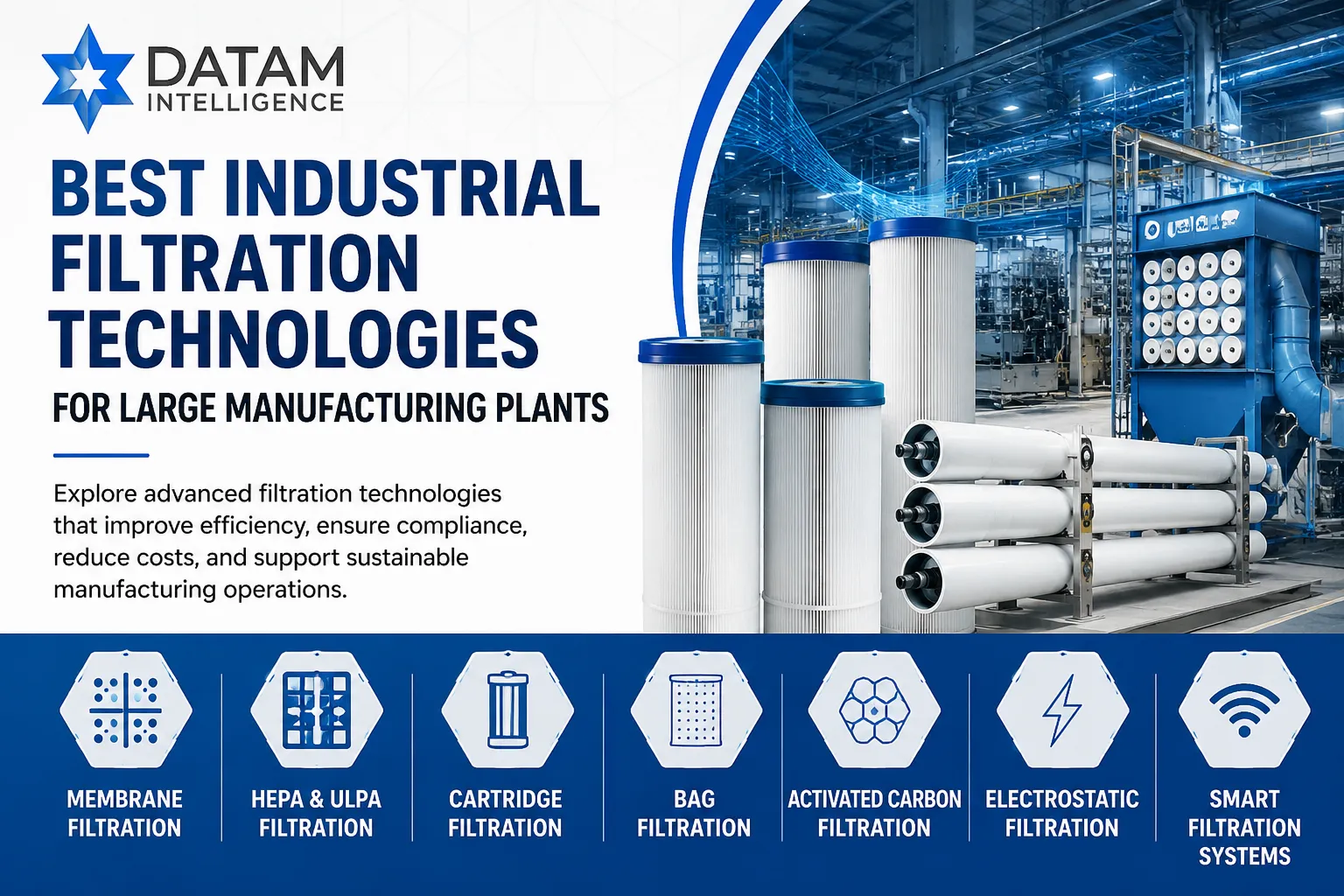
For large manufacturing plants, the most effective industrial filtration technologies include:
- Membrane Filtration Systems
- HEPA and ULPA Air Filtration
- Nanofiber Filtration Media
- Cartridge Filtration Systems
- Bag Filtration Systems
- Activated Carbon Filtration
- Electrostatic Filtration Technologies
- Smart IoT-Enabled Filtration Systems
The best choice depends on process requirements, contamination risks, regulatory standards, and operational goals.
Why Industrial Filtration Matters More Than Ever
Manufacturers face increasing pressure to:
- Reduce emissions and wastewater discharge
- Improve workplace air quality
- Maintain strict product purity standards
- Prevent equipment failures
- Lower operational costs
- Achieve ESG and sustainability targets
Stricter environmental regulations and growing investments in advanced manufacturing are driving companies toward next-generation filtration technologies. Industries are increasingly integrating intelligent monitoring, predictive maintenance, and energy-efficient filtration solutions into production operations.
1. Membrane Filtration Systems
Best For:
- Wastewater treatment
- Chemical processing
- Pharmaceutical manufacturing
- Food and beverage production
- Semiconductor manufacturing
Membrane filtration remains one of the fastest-growing industrial filtration technologies due to its ability to remove microscopic contaminants while supporting water reuse initiatives.
Common membrane technologies include:
Microfiltration (MF)
Microfiltration (MF) is one of the most widely used membrane filtration technologies in industrial water treatment. It typically operates with pore sizes ranging from 0.1 to 10 microns, making it highly effective for removing suspended solids, sediment, algae, and bacteria from process water.
MF is commonly deployed as a pre-treatment step before more advanced filtration technologies such as ultrafiltration, nanofiltration, or reverse osmosis. By reducing the concentration of larger contaminants, microfiltration helps extend membrane lifespan, lower maintenance requirements, and improve overall system efficiency.
Key Applications:
- Food and beverage processing
- Pharmaceutical manufacturing
- Municipal and industrial wastewater treatment
- Cooling tower water treatment
- Chemical processing facilities
Benefits:
- High flow rates
- Low operating pressure
- Reduced downstream membrane fouling
- Improved water quality and process reliability
Ultrafiltration (UF)
Ultrafiltration (UF) utilizes membranes with pore sizes ranging from 0.01 to 0.1 microns, enabling the removal of viruses, proteins, colloidal particles, emulsified oils, and fine suspended solids that cannot be captured through conventional filtration methods.
UF systems have become increasingly important in industries requiring stringent water purity standards and consistent process performance. They are widely used in water reuse applications, helping manufacturers reduce freshwater consumption while meeting environmental compliance requirements.
Key Applications:
- Pharmaceutical and biotechnology production
- Dairy and beverage processing
- Semiconductor manufacturing
- Industrial wastewater recycling
- Power generation facilities
Benefits:
- Superior pathogen removal
- Consistent water quality
- Reduced chemical treatment requirements
- Enhanced sustainability through water reuse
As industries move toward circular water management strategies, ultrafiltration is becoming a cornerstone technology for industrial water recovery and resource conservation.
Nanofiltration (NF)
Nanofiltration (NF) bridges the gap between ultrafiltration and reverse osmosis by selectively removing dissolved contaminants while allowing certain beneficial minerals to pass through. With pore sizes typically around 1 nanometer, NF membranes effectively remove multivalent ions, hardness minerals, organic compounds, colorants, pesticides, and heavy metals.
NF technology is particularly valuable in industries where water softening, partial desalination, or selective contaminant removal is required without the high energy consumption associated with reverse osmosis.
Key Applications:
- Water softening systems
- Chemical and petrochemical processing
- Textile manufacturing
- Mining operations
- Industrial wastewater treatment
Benefits:
- Lower energy consumption compared to RO
- Effective hardness reduction
- Improved process water quality
- Reduced scaling and equipment wear
Growing concerns around water scarcity and industrial sustainability are driving increased adoption of nanofiltration technologies across manufacturing sectors worldwide.
Reverse Osmosis (RO)
Reverse Osmosis (RO) is considered the gold standard for industrial water purification. Using semi-permeable membranes and high operating pressure, RO systems remove up to 99% of dissolved salts, organic contaminants, bacteria, viruses, and other impurities, producing ultra-pure water suitable for highly sensitive industrial processes.
RO technology is essential in industries where even trace contaminants can compromise product quality, equipment performance, or regulatory compliance.
Key Applications:
- Semiconductor fabrication
- Pharmaceutical manufacturing
- Boiler feedwater treatment
- Power generation plants
- Electronics manufacturing
- Hydrogen production facilities
Benefits:
- Exceptional water purity
- Removal of dissolved salts and contaminants
- Reduced scaling and corrosion
- Improved product quality and process consistency
As industrial sectors increasingly focus on sustainability and water conservation, reverse osmosis systems are playing a critical role in wastewater recovery, desalination, and zero-liquid-discharge (ZLD) initiatives.
2. HEPA and ULPA Air Filtration Systems
Best For:
- Pharmaceutical facilities
- Electronics manufacturing
- Semiconductor fabs
- Cleanroom environments
HEPA (High-Efficiency Particulate Air) filters remove at least 99.97% of particles measuring 0.3 microns, making them essential for contamination-sensitive manufacturing operations.
ULPA (Ultra-Low Particulate Air) filters offer even higher filtration efficiency and are commonly used in advanced semiconductor fabrication facilities.
Benefits include:
- Enhanced product quality
- Regulatory compliance
- Reduced contamination risks
- Improved worker safety
The growth of pharmaceutical manufacturing and semiconductor production continues to drive strong demand for HEPA and ULPA filtration systems.
3. Nanofiber Filtration Technology
Best For:
- Fine particulate removal
- High-efficiency air filtration
- Industrial dust collection
Nanofiber filters utilize ultra-thin fibers that create highly efficient filtration layers while maintaining lower airflow resistance.
Key advantages include:
- Higher particle capture rates
- Extended filter life
- Reduced energy consumption
- Improved airflow performance
As sustainability becomes a major operational priority, nanofiber technology is emerging as a preferred solution for manufacturers seeking lower operating costs and enhanced filtration efficiency.
4. Cartridge Filtration Systems
Best For:
- Liquid filtration
- Chemical processing
- Water treatment
- Food manufacturing
Cartridge filters offer flexible and cost-effective filtration for a wide range of industrial applications.
Advantages include:
- High filtration precision
- Easy replacement
- Compact design
- Low maintenance requirements
These systems are widely used where process reliability and contamination control are critical.
5. Bag Filtration Systems
Best For:
- High-volume industrial processes
- Dust collection
- Bulk liquid filtration
Bag filtration systems are commonly used in manufacturing plants handling large fluid volumes or airborne particulate matter.
Benefits include:
- High dirt-holding capacity
- Cost-effective operation
- Simple maintenance
- Scalability for large facilities
Bag filters remain widely adopted across chemicals, mining, and power generation industries.
6. Activated Carbon Filtration
Best For:
- VOC removal
- Odor control
- Chemical adsorption
Activated carbon systems effectively remove:
- Volatile organic compounds (VOCs)
- Chemical vapors
- Industrial odors
- Organic contaminants
Manufacturers facing stricter emissions regulations increasingly integrate activated carbon filtration into air pollution control strategies.
7. Electrostatic Filtration Systems
Best For:
- Fine particulate removal
- Industrial air quality management
- Manufacturing exhaust treatment
Electrostatic filtration uses electrical charges to capture airborne contaminants with minimal pressure drop.
Benefits include:
- Energy efficiency
- Reduced operating costs
- Enhanced particle capture
- Long-term reliability
These systems are gaining popularity in facilities focused on sustainability and energy optimization.
8. Smart IoT-Enabled Filtration Systems
Best For:
- Smart factories
- Industry 4.0 operations
- Predictive maintenance programs
The newest generation of industrial filtration systems integrates:
- IoT sensors
- Artificial intelligence
- Predictive analytics
- Remote monitoring
These technologies help manufacturers:
- Detect filter degradation early
- Reduce unplanned downtime
- Optimize maintenance schedules
- Improve filtration efficiency
Smart filtration is rapidly becoming a strategic differentiator for large-scale manufacturing facilities. Industry experts identify digital monitoring and predictive maintenance as key future growth areas within industrial filtration markets.
Why Membrane Filtration is Transforming Industrial Water Management
Membrane filtration technologies are becoming a strategic investment for large manufacturing facilities seeking to improve operational efficiency, environmental performance, and regulatory compliance. By integrating MF, UF, NF, and RO systems into a multi-stage treatment process, manufacturers can maximize contaminant removal while optimizing energy consumption and water recovery rates.
Increasingly, organizations are deploying advanced membrane solutions to support Zero Liquid Discharge (ZLD) programs, reduce dependence on freshwater resources, and meet stringent environmental regulations. Recent innovations in membrane materials including ceramic membranes, graphene-enhanced membranes, and anti-fouling coatings are further improving system efficiency, extending membrane lifespan, and lowering maintenance costs.
As global industries continue prioritizing sustainability, water reuse, and resource efficiency, membrane filtration is expected to remain one of the fastest-growing segments within the industrial filtration market.
How to Choose the Right Industrial Filtration Technology
Selecting the right industrial filtration technology requires a careful assessment of operational needs, regulatory obligations, and long-term performance goals. The ideal solution should not only remove contaminants effectively but also improve efficiency, reduce maintenance costs, and support sustainability initiatives.
Contaminant Type
The nature of the contaminants is the primary factor in choosing a filtration system. Manufacturers must determine whether they need to remove airborne particles, suspended solids, dissolved chemicals, biological contaminants, oils, or gases. Different technologies such as membrane filtration, HEPA filters, activated carbon systems, or electrostatic filters are designed to address specific filtration challenges.
Regulatory Requirements
Industries must ensure compliance with environmental, health, and product quality regulations, including EPA, OSHA, FDA, GMP, ISO, and local standards. Choosing a filtration system that meets industry-specific compliance requirements can help avoid penalties, improve workplace safety, and maintain product integrity.
Operational Scale
Filtration systems should align with production volumes and facility capacity requirements. Large manufacturing plants often require high-flow, scalable solutions capable of handling continuous operations without compromising filtration performance or causing production bottlenecks.
Energy Efficiency
Energy consumption significantly impacts the total cost of ownership. Modern filtration technologies are increasingly designed to minimize pressure drops and reduce power consumption, helping manufacturers lower operating costs while supporting corporate sustainability goals.
Maintenance Requirements
Maintenance needs vary across filtration technologies. Factors such as filter lifespan, replacement frequency, cleaning requirements, and system downtime should be evaluated to ensure reliable performance and minimize disruptions to production processes.
Digital Monitoring Capabilities
As Industry 4.0 adoption accelerates, manufacturers are increasingly investing in smart filtration systems equipped with IoT sensors and predictive maintenance capabilities. These technologies enable real-time performance monitoring, early fault detection, and optimized maintenance scheduling, helping maximize system efficiency and reduce unexpected downtime.
Future Trends Shaping Industrial Filtration
Several emerging technologies are expected to transform industrial filtration over the next decade:
- AI-driven filtration optimization
- Self-cleaning filtration systems
- Advanced membrane technologies
- Nanotechnology-based filter media
- PFAS removal solutions
- Sustainable and recyclable filter materials
Manufacturers adopting these innovations early may gain significant advantages in compliance, operational efficiency, and environmental performance.
Explore the Industrial Filtration Market in Detail
Advanced filtration technologies are transforming manufacturing operations worldwide, driven by growing sustainability initiatives, stricter environmental regulations, and increasing demand for operational efficiency.
To gain a deeper understanding of market trends, growth opportunities, competitive dynamics, and future technology developments, explore DataM Intelligence's comprehensive Industrial Filtration Market Report.
Get Exclusive Market Insights
- Market forecasts through 2032
- Technology and innovation trends
- Competitive intelligence
- Regional growth opportunities
- Strategic recommendations
Access the Full Industrial Filtration Market Report
Conclusion
Industrial filtration is no longer just an environmental compliance requirement, it is a strategic investment that directly impacts productivity, product quality, sustainability, and profitability.
For large manufacturing plants, membrane filtration, HEPA systems, nanofiber technologies, activated carbon filtration, and smart IoT-enabled solutions represent the most effective technologies available today. As regulations tighten and manufacturing processes become increasingly sophisticated, organizations that invest in advanced filtration infrastructure will be better positioned to achieve operational excellence and long-term growth.
Related Reports
Explore DataM Intelligence's in-depth market research reports for additional insights into filtration technologies, water treatment solutions, and industrial sustainability trends:
- Industrial Filtration Market - Comprehensive analysis of market trends, growth drivers, competitive landscape, and future opportunities.
- Membrane Filtration Market - Insights into advancements in microfiltration, ultrafiltration, nanofiltration, and reverse osmosis technologies.
- Industrial Water Treatment Market - Market intelligence on water purification, treatment technologies, and industrial water management solutions.
- Industrial Wastewater Treatment Market - Analysis of wastewater treatment technologies, regulatory developments, and sustainability initiatives.
- Air Filtration Market - Explore the latest developments in air filtration systems, contamination control, and industrial air quality management.