


Introduction: Flexible Packaging Printing Is Entering a Hybrid Era
The analog and digital printing flexible packaging market is changing quickly in 2026. Flexible packaging converters, food brands, pharmaceutical companies, personal care manufacturers, pet food producers, and private-label retailers are no longer choosing a printing method based only on color quality or unit cost. They are weighing speed, sustainability, personalization, SKU complexity, recyclable materials, regional supply chains, and investment activity.
Analog printing technologies such as flexography, gravure, offset, and EB offset still play a major role in high-volume flexible packaging. These methods remain highly relevant for large runs, consistent artwork, and cost-efficient mass production. At the same time, digital printing is gaining share in short-run pouches, seasonal packaging, startup brand launches, variable data printing, e-commerce packaging, and fast-turnaround rollstock.
The flexible packaging market size was valued at USD 260.6 billion in 2025 and is expected to reach USD 345.6 billion by 2033, while DataM Intelligence reports that the global digital printing market reached US$42.95 billion in 2025 and is projected to reach US$71.4 billion by 2033 at a 6.5% CAGR from 2026 to 2033.
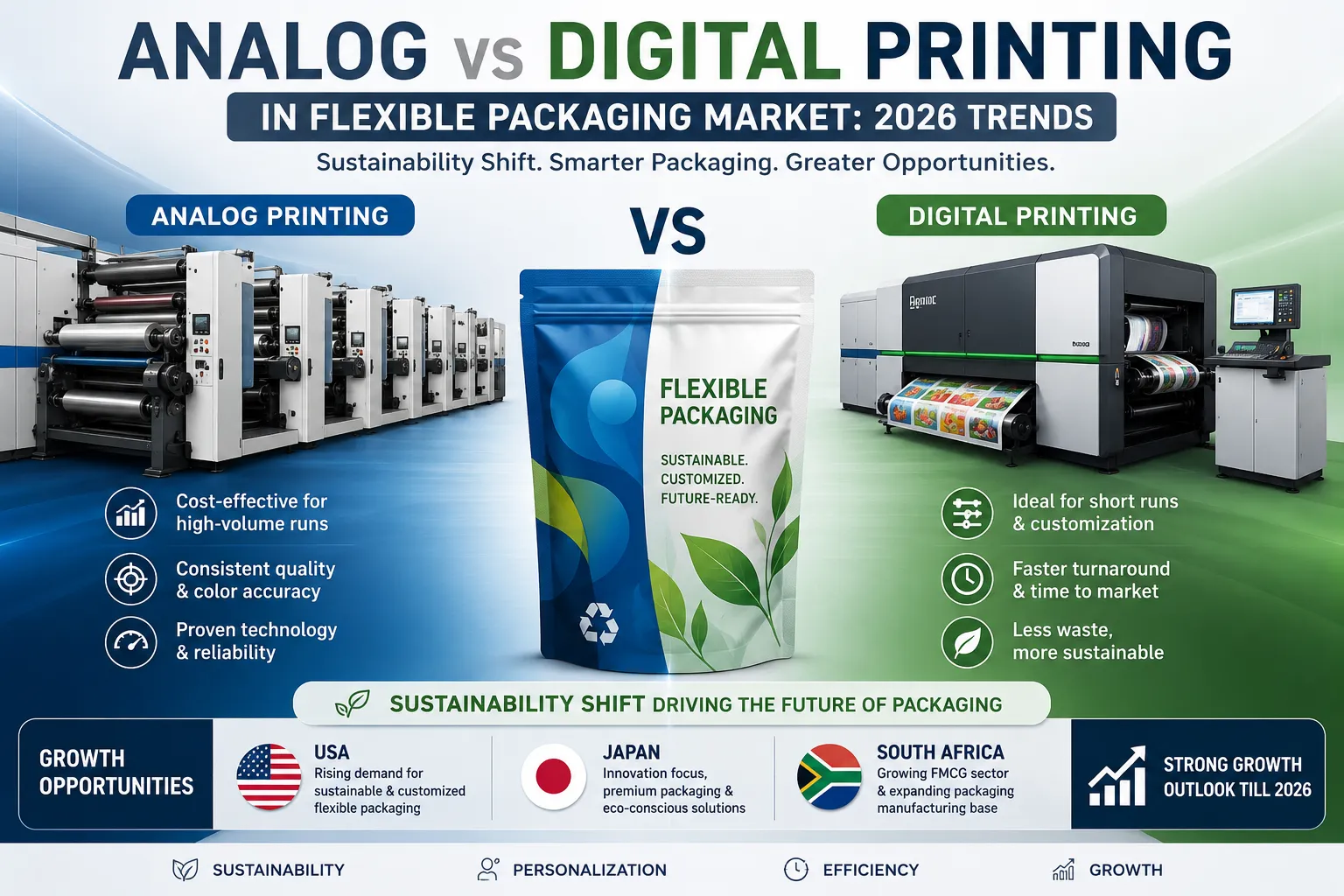
For brands and converters, the future is not simply “analog vs digital.” The stronger market story is hybrid flexible packaging production, where analog presses handle scale and digital systems support agility, personalization, waste reduction, and faster launch cycles.
What Is Flexible Packaging Printing?
Flexible packaging refers to packaging formats that bend, fold, compress, or wrap around a product rather than holding a rigid shape. Common formats include pouches, sachets, rollstock, wraps, lidding films, stick packs, bags, shrink sleeves, films, and laminated structures. These formats are widely used across food and beverages, pharmaceuticals, healthcare, cosmetics, personal care, pet food, household products, and industrial goods.
Printing is one of the most important value-adding steps in flexible packaging. It turns a plain film or laminate into a brand communication platform. A printed pouch or wrapper can display brand identity, nutrition facts, ingredients, barcodes, QR codes, recycling instructions, regulatory information, traceability codes, anti-counterfeiting elements, and promotional messages.
In the digital printing packaging market, applications already span folding cartons, metal cans, flexible packaging, labels, pharmaceuticals, food and beverages, cosmetics, electrical and electronics, and other industrial categories. Digital printing is also valued for just-in-time quantities, improved workflow, innovative marketing, faster speed, and enhanced packaging appearance.
Flexible packaging printing usually involves a combination of substrate selection, ink chemistry, press technology, lamination, curing, coating, and finishing. As sustainability expectations rise, packaging teams are also paying closer attention to whether a printing process is compatible with mono-material PE, mono-material PP, paper-based structures, water-based inks, solventless lamination, and recyclable pouch designs.
Analog Printing Flexible Packaging Market Overview
Analog printing in flexible packaging refers to conventional press-based printing methods that use plates, cylinders, blankets, or mechanical image transfer systems. The most common analog technologies include flexographic printing, rotogravure printing, offset printing, EB offset printing, and hybrid analog systems.
Flexography: The Workhorse of Flexible Packaging
Flexographic printing, often called flexo, is one of the most widely used printing technologies in flexible packaging. It uses flexible printing plates and can run at high speeds on plastic films, foils, paper, and laminates. Flexo is especially strong in food packaging, beverage packaging, household products, personal care packaging, and cost-sensitive FMCG applications.
Flexo works well when brands need large quantities, repeatable designs, and consistent color across long production runs. Modern flexographic systems are also becoming more automated, with better plate technology, faster makeready, improved color control, and expanding use of water-based and UV-curable inks.
Gravure: Premium Quality for Long Runs
Rotogravure printing is known for high-definition graphics, rich color depth, and excellent consistency over very long print runs. It uses engraved cylinders, making it a preferred choice for premium flexible packaging, high-volume snack packaging, confectionery wrappers, and markets where photographic print quality is critical.
Gravure’s main challenge is cost and preparation time. Cylinders can be expensive, setup can be slower, and the process is less flexible when brands frequently change artwork or launch limited-edition designs.
Offset and EB Offset: Sustainability-Focused Innovation
Offset printing is more common in paper and carton packaging, but EB offset is gaining relevance in flexible packaging because of its sustainability profile. Electron beam curing can reduce the need for high-temperature drying and can help lower emissions in certain flexible packaging applications.
In May 2026, TOPPAN announced mass production of flexible packaging using Japan’s first EB offset printing method. TOPPAN stated that EB offset uses electron beam curing, contains almost no organic solvents, reduces VOC emissions, and can cut CO₂ emissions by about 16% compared with gravure under its stated assumptions.
Where Analog Printing Wins
Analog printing remains the preferred choice for high-volume flexible packaging because it offers strong unit economics at scale. Once plates or cylinders are prepared, analog presses can produce large quantities quickly and consistently. This makes analog printing highly attractive for established SKUs in snacks, frozen foods, beverages, household goods, medical packaging, and personal care.
Smithers projects that flexographic and gravure printing together will reach $358.5 billion in 2026, with flexo valued at $250.7 billion and gravure at $107.8 billion. Smithers also notes that flexo remains the larger market globally, while gravure retains strength in high-quality reproduction and high-growth Asian packaging markets.
Digital Printing Flexible Packaging Overview
Digital printing in flexible packaging means printing directly from digital files without traditional plates or cylinders. The main technologies include inkjet printing, electrophotographic printing, toner-based systems, HP Indigo-type digital presses, and hybrid digital-analog systems.
The digital printing flexible packaging market is growing because brands need speed and flexibility. Product lifecycles are shorter, consumer trends change faster, and brands are launching more SKUs than ever. A snack brand may need multiple flavors, limited-edition designs, regional labels, influencer collaborations, holiday packs, and e-commerce-ready packaging-all without committing to large minimum order quantities.
Digital printing supports this environment because it allows quicker artwork changes, lower setup time, variable data printing, and smaller production runs. It is especially useful for startups, D2C brands, premium food brands, small-batch coffee and tea brands, nutraceutical companies, cosmetics, pet food companies, and seasonal promotional campaigns.
The global digital printing market is benefiting from demand for personalized printing, variable data printing, print-on-demand, cost-effective short runs, and fast turnarounds. DataM Intelligence also notes that digital printing does not require plates compared with offset printing, allowing images to be printed directly from electronic files onto different substrates.
However, digital printing is not perfect for every flexible packaging job. Some digital systems may have higher ink costs, substrate limitations, slower speeds than analog presses at very high volumes, and strict requirements around food-contact compliance, ink migration, coatings, and lamination compatibility.
Analog vs Digital Printing in Flexible Packaging: Direct Comparison
| Factor | Analog Printing | Digital Printing |
| Best for | Long runs, stable SKUs, mass production | Short runs, personalized packs, frequent design changes |
| Setup | Requires plates, cylinders, or mechanical setup | No plates or cylinders required |
| Unit cost | Lower at high volume | Better for small and medium runs |
| Turnaround | Slower setup, efficient long-run production | Faster job changeover and launch cycles |
| Personalization | Limited and costly | Strong for variable data, QR codes, versioned designs |
| Sustainability | Improving through water-based inks, EB curing, better plates, solventless systems | Can reduce excess inventory, obsolete packaging, and makeready waste |
| Common users | Large food, beverage, household, pharma, and FMCG brands | Startups, premium brands, seasonal SKUs, D2C and e-commerce brands |
| Key technologies | Flexo, gravure, offset, EB offset | Inkjet, electrophotographic, toner-based, HP Indigo-type systems |
The decision depends on the job. If a brand needs millions of identical snack packs, flexography or gravure may be the best fit. If a startup wants 5,000 custom pouches for a new protein snack, digital printing may offer faster speed and better commercial flexibility.
Sustainability: The Bridge Between Analog and Digital Printing
Sustainability is one of the strongest forces reshaping the analog and digital printing flexible packaging market. Brands are under pressure to reduce plastic use, improve recyclability, lower emissions, and design packaging that fits circular economy systems. This shift is changing both print technology selection and material selection.
The sustainable flexible packaging market reached US$20.2 billion in 2025 and is expected to reach US$41.2 billion by 2033, growing at a 9.6% CAGR during 2026–2033. DataM Intelligence identifies mono-material recyclable films, biopolymers, compostables, and circular economy adoption as defining trends in the sustainable flexible packaging market.
Mono-Material Films and Print Compatibility
Traditional flexible packaging often uses multilayer laminates to achieve strength, barrier performance, heat resistance, printability, and shelf life. The challenge is that multilayer structures can be difficult to recycle because different materials are bonded together. Mono-material PE and mono-material PP structures are gaining attention because they can improve sortability and recycling compatibility.
In April 2026, DNP launched a recyclable mono-material medical sterilization pouch composed of more than 90 wt% polyethylene-based materials. The company said the product is designed to improve sortability in recycling and compatibility in resource recovery compared with conventional composite materials.
Low-VOC and Lower-Emission Printing
Analog printing is becoming more sustainable through water-based flexo inks, UV-curable systems, EB-curable inks, solventless lamination, improved plate materials, and better makeready efficiency. TOPPAN’s EB offset development in Japan is a good example of how analog innovation is responding to sustainability expectations, especially in markets where gravure has historically been strong.
Digital printing also supports sustainability in a different way. Because digital production can handle shorter runs and just-in-time quantities, brands may reduce obsolete inventory, avoid overproduction, and print only the packaging they need. This matters for seasonal SKUs, promotional products, changing regulations, and regionalized packaging.
The key point is that neither analog nor digital is automatically “more sustainable” in every case. The sustainability result depends on run length, energy use, ink system, material structure, waste rate, transport distance, recycling compatibility, and end-of-life design.
Latest 2026 Industry Developments, M&A, Investments, and Funding Activity
The flexible packaging printing industry is also being shaped by consolidation and capacity expansion. These 2026 developments show how companies are investing in digital printing, sustainable materials, regional growth, and larger manufacturing networks.
| 2026 Development | Type | Why It Matters |
| Butterfly Equity acquired ePac Flexible Packaging | M&A | ePac is a major digitally printed flexible packaging player, and Butterfly completed the acquisition from an investor consortium including Amcor and Indevco North America. (ePac Flexible Packaging) |
| HP Indigo and ePac announced a $50 million investment | Capacity expansion | HP said ePac is integrating more than 10 HP Indigo 200K digital presses into its global network, with installations across North America and Europe. (HP) |
| ProAmpac completed its acquisition of TC Transcontinental Packaging | M&A | ProAmpac said the March 2026 acquisition expands its capabilities in material science, sustainability, barrier films, mono-material structures, and fiber-based formats. (ProAmpac) |
| TOPPAN began mass production using Japan’s first EB offset flexible packaging method | Technology development | This supports Japan-targeted analog printing innovation and lower-emission flexible packaging. (Toppan Holdings) |
| DNP launched a recyclable mono-material medical sterilization pouch | Sustainable packaging innovation | The pouch uses more than 90 wt% polyethylene-based materials and targets improved recycling sortability. (global.dnp) |
| RMB Corvest and Alito Fund 2 acquired a majority stake in Packaging World | South Africa investment | Packaging World supplies flexible packaging solutions such as reels, bags, and pouches mainly for FMCG food customers in South Africa. (RMB Corvest) |
| Amcor continued Berry Global integration with FY2026 synergy targets | M&A integration | Amcor said it is on track to deliver at least $260 million in pre-tax synergy benefits in fiscal 2026 and $650 million by the end of fiscal 2028. (PR Newswire) |
Deloitte’s Q1 2026 packaging M&A update also expects packaging M&A to remain active or rise slightly in 2026, with fewer megadeals and more smaller transactions as companies buy growth amid muted organic demand.
Region-Specific Market Opportunities
North America: Digital-First Flexible Packaging and Private Equity Consolidation
The North America flexible packaging printing market is one of the most important regions for digital pouch printing, short-run flexible packaging, and digitally printed packaging for emerging CPG brands. Startup food brands, nutraceutical companies, pet food producers, personal care brands, and e-commerce sellers need faster packaging launch cycles and lower minimum order quantities.
ePac’s model is especially relevant to the USA digital printing flexible packaging market because it focuses on order-to-demand production, fast turnaround, and digitally printed flexible packaging for CPG customers. ePac operates facilities throughout the U.S. and Canada and serves food-focused consumer packaged goods customers.
The HP Indigo and ePac investment also shows that digital flexible packaging capacity is scaling beyond niche use. More than 10 HP Indigo 200K presses are expected to support ePac’s North American and European operations, reinforcing the role of digital printing in flexible packaging growth.
Japan: EB Offset, Mono-Material Packaging, and Low-VOC Innovation
The Japan flexible packaging printing market is strongly linked to high-quality print, advanced materials, food packaging, medical packaging, cosmetics, and sustainability-driven innovation. Japan has historically used gravure widely for flexible packaging because of its high print quality, but new technologies are opening alternative routes.
TOPPAN’s EB offset flexible packaging launch is important because it offers a lower-VOC and lower-CO₂ analog printing path for flexible packaging. The company also linked the development to sustainable production methods, water-based flexo, digital print, and solventless lamination initiatives.
DNP’s mono-material medical sterilization pouch adds another Japan-specific sustainability example. It shows how recyclable flexible packaging design is moving into healthcare and medical packaging, a segment where safety, seal strength, sterilization compatibility, and environmental performance must be carefully balanced.
South Africa: FMCG Demand, Local Manufacturing, and Sustainable Packaging Investment
The South Africa flexible packaging market is influenced by FMCG demand, local manufacturing, food packaging, affordability, and sustainability requirements. The acquisition of a majority stake in Packaging World by RMB Corvest and Alito Fund 2 signals investor confidence in South African flexible plastic packaging capacity.
Packaging World supplies specialized flexible packaging solutions, including reels, bags, and pouches, primarily to the FMCG food sector. RMB Corvest said the investment supports the company’s next growth phase, including larger corporate customers, recyclable and sustainable packaging innovation, localization of supply chains, and expansion across sub-Saharan Africa.
For converters in South Africa, the opportunity is not only to add more capacity but to offer cost-sensitive, reliable, and increasingly recyclable flexible packaging for food, personal care, household, and regional FMCG customers.
Market Segmentation
A strong market research view of the analog and digital printing flexible packaging market should segment demand by technology, packaging format, material, ink type, and end user.
By printing technology: flexography, rotogravure, offset, EB offset, inkjet, electrophotographic printing, and hybrid printing.
By packaging format: pouches, bags, sachets, rollstock, films and wraps, lidding films, and stick packs.
By material: plastic films, paper-based flexible packaging, foil, laminates, mono-material PE, mono-material PP, and bio-based materials.
By ink type: water-based inks, solvent-based inks, UV-curable inks, EB-curable inks, and latex inks.
By end user: food and beverages, pharmaceuticals and healthcare, cosmetics and personal care, pet food, home care, and industrial products.
This segmentation matters because a coffee pouch, medical sterilization pouch, pet food bag, snack wrapper, and shampoo sachet may all use flexible packaging, but each one has different requirements for barrier performance, ink migration, heat sealing, print quality, shelf appeal, recyclability, and compliance.
Competitive Landscape
The competitive landscape includes both packaging converters and printing technology providers.
Leading flexible packaging converters and packaging companies include Amcor, ProAmpac, Mondi, Huhtamaki, Sealed Air, Constantia Flexibles, TOPPAN, DNP, Printpack, and Glenroy. In the sustainable flexible packaging market, DataM Intelligence lists Amcor, Mondi, Sealed Air, Huhtamaki, Constantia Flexibles, Berry Global, ProAmpac, Glenroy, Printpack, and WestRock among key players.
Digital printing and press technology players include HP Indigo, Canon, Ricoh, Xerox, Xeikon, Fujifilm, Kodak, Mimaki, and Durst. These companies support growth in inkjet, electrophotographic printing, production automation, variable data printing, digital workflow, color management, and short-run packaging.
The companies that win in 2026 and beyond will likely be those that combine print quality, speed, sustainability, regional capacity, technical support, food-contact compliance, and material innovation.
Key Growth Drivers
The market is expanding because flexible packaging is lightweight, versatile, and widely used in packaged food, beverages, healthcare, personal care, pet food, and home care. As packaged food and ready-to-eat product demand rises, brands need packaging that protects products while also standing out on shelf and online.
SKU proliferation is another major driver. Brands are creating more flavors, formats, sizes, regional versions, and promotional editions. This favors digital printing for smaller runs and faster job changes, while still supporting analog printing for proven high-volume SKUs.
Sustainability is also pushing change. Recyclable mono-material structures, water-based inks, EB offset, solventless lamination, and reduced overproduction are becoming part of the purchasing conversation. At the same time, M&A activity and private equity investment are helping companies expand capacity, acquire technology, and enter faster-growing regional markets.
Key Restraints and Challenges
The market also faces real challenges. Multilayer flexible packaging can be difficult to recycle, especially when different polymers, foils, coatings, adhesives, and inks are combined. Raw material price volatility can pressure margins for converters and brands.
Food-contact compliance is another major issue. Inks, coatings, adhesives, and films must be selected carefully to avoid migration risk and meet regulatory expectations. Digital printing must also prove compatibility with flexible films, sealant layers, lamination, and high-speed converting.
Analog printing faces challenges around plate cost, gravure cylinder cost, setup time, makeready waste, and slower artwork changes. Digital printing faces challenges around ink cost, press speed at very high volumes, substrate limitations, and color consistency across large multi-site production networks.
The best solution is often not choosing one method forever. It is matching print technology to product lifecycle, order volume, sustainability target, and speed-to-market requirement.
Buyer Decision Guide: When to Choose Analog vs Digital
| Use Case | Best-Fit Print Method |
| Large-volume snack packaging | Flexography or gravure |
| Premium high-definition packaging | Gravure or high-end flexography |
| Seasonal limited-edition packaging | Digital printing |
| Startup food brand pouches | Digital printing |
| Pharma or medical packaging | Depends on compliance, substrate, sterilization, and validation needs |
| Recyclable mono-material pouch | Flexo, EB offset, or compatible digital process |
| Personalized QR or variable data packaging | Digital printing |
| Cost-sensitive long-run FMCG packaging | Flexography |
| Frequent artwork changes | Digital printing |
| Stable high-volume national SKU | Flexography or gravure |
| Sustainability-focused premium launch | Depends on material, ink, curing, and run length |
For purchasing teams, the practical question is simple: how many units are needed, how often will artwork change, what material is required, what compliance rules apply, and how important is speed? Once those questions are clear, the choice between analog and digital becomes much easier.
Future Outlook: Hybrid Printing Will Define the Next Phase
The future of the analog and digital printing flexible packaging market will be hybrid. Analog printing will remain essential for high-volume, cost-efficient, repeatable packaging. Digital printing will continue growing in short runs, personalization, regionalization, test launches, rapid prototyping, e-commerce brands, and startup packaging.
Sustainable flexible packaging will influence both sides. Analog printing will become cleaner through water-based flexo, EB offset, improved plates, and solventless lamination. Digital printing will reduce waste through print-on-demand production, lower minimum order quantities, fewer obsolete packs, and faster artwork changes.
M&A will also remain important. Companies will continue buying regional capacity, sustainable packaging capabilities, digital press networks, and material science expertise. As Deloitte notes, packaging M&A in 2026 is expected to stay active or rise slightly, even as the market shifts toward smaller transactions rather than only megadeals.
In short, the winning converters will not ask whether analog or digital is better in every case. They will build flexible production models that use both.
Frequently Asked Questions (FAQs)
What is analog printing in flexible packaging?
Analog printing in flexible packaging uses conventional plates, cylinders, or mechanical image transfer systems. Common methods include flexography, gravure, offset, and EB offset. It is best suited for large-volume production, stable artwork, and lower unit cost at scale.
What is digital printing in flexible packaging?
Digital printing uses digital files to print directly onto packaging substrates without conventional plates or cylinders. It is commonly used for short runs, fast turnaround, variable data, personalized packaging, seasonal designs, and startup brand packaging.
Which is better for flexible packaging: analog or digital printing?
Neither is better in every situation. Analog printing is usually better for long runs and mass production, while digital printing is better for short runs, personalization, fast launches, and frequent design changes.
Is digital printing more sustainable than flexographic printing?
Digital printing can reduce waste by supporting shorter runs, just-in-time production, and lower obsolete inventory. However, flexographic printing can also be sustainable when it uses water-based inks, efficient makeready, recyclable substrates, and modern press technology. The more sustainable choice depends on the job.
Why is digital printing growing in flexible packaging?
Digital printing is growing because brands need faster speed-to-market, smaller order quantities, more SKUs, personalization, e-commerce-ready packaging, and flexible production. It also supports startups and premium brands that cannot commit to high-volume analog print runs.
What are the main analog printing technologies used in flexible packaging?
The main analog technologies are flexography, rotogravure, offset printing, EB offset printing, and hybrid analog systems.
Which industries use digitally printed flexible packaging?
Food and beverages, pet food, nutraceuticals, cosmetics, personal care, pharmaceuticals, healthcare, home care, and specialty consumer goods all use digitally printed flexible packaging.
How is sustainable flexible packaging changing printing technology?
Sustainable flexible packaging is pushing converters toward recyclable mono-material films, low-VOC inks, water-based flexo, EB-curable systems, solventless lamination, lighter structures, and print methods that reduce waste.
What are the key flexible packaging printing trends in the USA?
Key USA trends include digital pouch printing, short-run packaging, private equity investment, startup CPG packaging, food and pet food packaging, digital press expansion, and demand for recyclable flexible packaging.
What are the key flexible packaging printing trends in Japan?
Japan’s key trends include high-quality print, EB offset innovation, low-VOC packaging, mono-material medical packaging, recyclable flexible structures, and advanced sustainable packaging technology.
What are the key flexible packaging printing trends in South Africa?
South Africa’s key trends include FMCG food packaging demand, local flexible plastic packaging capacity, private equity investment, recyclable packaging innovation, localization of supply chains, and sub-Saharan Africa expansion opportunities.
- What are the latest M&A and investment developments in flexible packaging printing in 2026?
- Mjor 2026 developments include Butterfly Equity’s acquisition of ePac, HP Indigo and ePac’s $50 million digital press expansion, ProAmpac’s acquisition of TC Transcontinental Packaging, TOPPAN’s EB offset flexible packaging launch, DNP’s mono-material medical pouch, RMB Corvest and Alito Fund 2’s Packaging World investment in South Africa, and Amcor’s continued Berry Global integration.