


Aluminum Extrusion Market: How Lightweight Design, Electrification and Recycling Are Reshaping Growth
Aluminum extrusion is becoming an increasingly strategic manufacturing process as automakers, building developers and energy equipment suppliers seek lighter structures, more flexible designs and lower-carbon materials. The opportunity is shifting from supplying standard metal profiles toward delivering engineered components with tighter tolerances, specialized alloys and documented recycled content.
What Is Aluminum Extrusion?
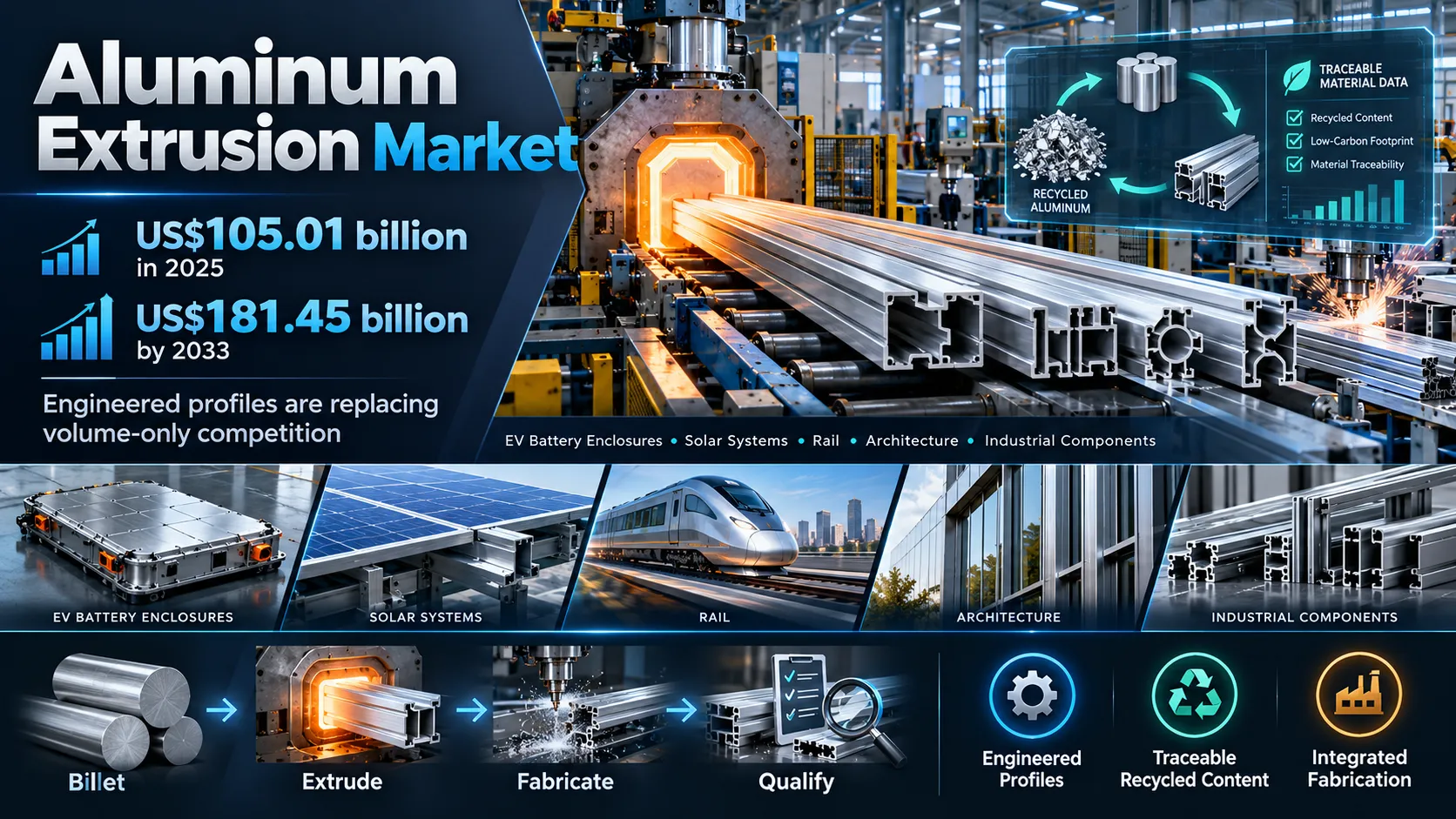
Imagine squeezing toothpaste through a shaped opening. The toothpaste takes the shape of the opening as it comes out. Aluminum extrusion works on a similar principle, except a heated solid aluminum billet is pushed through a precision steel die using a powerful hydraulic press. The result is a long profile with a consistent cross-section: a channel, tube, rail, frame or complex structural shape.
The profile is then cooled, stretched, cut and often heat-treated to improve strength. Manufacturers may also machine, weld, anodize or powder-coat it. The die determines the shape; the alloy and processing determine performance. This combination allows one continuous profile to replace assemblies made from multiple separate parts.
For example, an electric-vehicle battery enclosure may use extruded aluminum rails for impact protection, while a solar installation uses lightweight extruded frames to hold panels. Window systems, heat sinks, rail cars and industrial machinery rely on the same basic process.
Request Sample: https://www.datamintelligence.com/download-sample/aluminium-extrusion-market
Where Are the Major Growth Opportunities?
1. Electric Vehicles and Structural Lightweighting
Electric vehicles create demand for battery enclosures, crash-management systems, structural rails and thermal-management components. High-strength extrusions can reduce mass without sacrificing critical safety performance. Constellium markets extrusion-based automotive structures and battery-enclosure solutions, illustrating how supplier differentiation increasingly depends on engineering partnerships rather than commodity tonnage.
2. Solar, Electrical Infrastructure and Energy Storage
Solar module frames, mounting rails, cable-management systems, electrical housings and battery energy storage structures offer another demand channel. Manufacturers able to supply corrosion-resistant profiles with reliable dimensions, finishing and rapid delivery are well positioned as utilities and equipment manufacturers scale deployments.
3. Buildings, Facades and Modular Construction
Doors, windows, curtain walls and modular building systems remain major outlets. Future growth will increasingly favor thermally efficient facade systems, prefabricated assemblies and profiles that combine aesthetics with energy performance. Urban construction activity supports volume while renovation and efficiency upgrades support higher-value specifications.
4. Low-Carbon and Recycled Aluminum Profiles
Procurement teams are paying closer attention to the carbon footprint of aluminum rather than evaluating price alone. Recycling-based billets, traceability and verified emissions data could become decisive differentiators. In a 2026 commercial-vehicle demonstration, Hydro supplied 31 extruded components totaling 600 kg, using Hydro CIRCAL aluminum containing at least 75% post-consumer scrap.
5. Precision Profiles and Downstream Fabrication
Heat sinks, automation systems, robotics, electronics and transport equipment increasingly require intricate profiles and additional machining or assembly. Extruders that offer design assistance, tooling, coating, and fabrication can capture more value per kilogram while becoming harder to replace in customer supply chains.
Where Is the Market Headed Through 2035?
Industry forecasts vary by scope and methodology. Grand View Research estimates the global aluminum extrusion market at $98.2 billion in 2025, rising to $193.3 billion by 2033, while identifying Asia Pacific as the largest regional market. The figures indicate substantial growth potential but should not be treated as a guaranteed trajectory.
Across the coming decade, three shifts are likely to define the industry: volume to value, as tailored profiles and fabricated systems grow in importance; primary metal to circular supply, as buyers demand recycled content and emissions documentation; and standalone extrusion to integrated engineering, as manufacturers support customers from alloy and die design through finished components.
Regional strategies may also diverge. Asia Pacific will remain central to scale and manufacturing capacity, while North American and European suppliers may emphasize proximity to automotive programs, supply-chain resilience and low-carbon differentiation. Energy costs, scrap availability, tariffs and construction cycles remain important risks to profitability.
Ten Major Companies Shaping the Market
- Hydro Extrusions - global extrusion footprint, automotive engineering and recycled low-carbon profiles.
- Constellium - advanced automotive structural extrusions, crash systems and battery components.
- Press Metal Aluminium Holdings - integrated aluminum production with downstream extrusion activities.
- Hindalco Industries - integrated aluminum capabilities and value-added extrusion solutions in India.
- Jindal Aluminium - architectural and industrial extrusion manufacturing in India.
- Bonnell Aluminum (Tredegar) - custom extrusions and fabricated solutions for North American industrial customers.
- Kaiser Aluminum - specialty aluminum products including extruded applications for demanding end markets.
- Arconic - aluminum products serving aerospace and industrial supply chains, including extruded offerings.
- Gulf Extrusions - architectural and industrial profiles across Middle Eastern and export markets.
- ETEM Group - European architectural and industrial aluminum extrusion systems.
- Other participants include UACJ Corporation, YKK AP, Guangdong Xingfa Aluminium, Alumil, Alexandria Industries, Taber Extrusions, Capral Aluminium and Bahrain Aluminium Extrusion Company (BALEXCO).
Competition increasingly centers on higher-strength alloy development, precision dies, complex hollow profiles, low-carbon billet sourcing, recycling loops, fabrication capability, shorter lead times and qualification for safety-critical automotive and energy applications.
Request Sample: https://www.datamintelligence.com/download-sample/aluminium-extrusion-market
The Bigger Opportunity
The next phase of the aluminum extrusion market will reward manufacturers that sell more than metal length. Customers increasingly want finished, lightweight and reliable components with predictable performance, competitive total cost and credible environmental credentials. By 2035, capabilities in design collaboration, recycling and downstream processing could matter as much as installed press capacity.