


AI Infrastructure Has Entered a New Thermal Era
Artificial intelligence is no longer just a software revolution. It has become an infrastructure revolution. Behind every large language model, generative AI platform, autonomous system, recommendation engine, and enterprise AI application is a growing physical layer of compute: GPUs, CPUs, high-speed networking, memory, storage, power delivery, and cooling systems working together at massive scale.
In 2026, this physical layer is under intense pressure. AI workloads are expanding faster than traditional data center design assumptions can support. Training clusters are becoming larger, inference demand is becoming continuous, and hyperscale operators are building what the industry increasingly calls AI factories: facilities designed to convert electricity into intelligence at industrial scale.
This shift is creating one of the most important infrastructure questions of the decade: how can data centers remove heat fast enough to keep AI systems reliable, efficient, and economically viable?
For many years, air cooling was sufficient for enterprise servers and conventional cloud workloads. Fans, computer room air handlers, containment systems, and airflow optimization could support most rack designs. But AI data center infrastructure has changed the equation. Modern GPU clusters generate far more heat in smaller spaces, and next-generation systems such as NVIDIA GB300 and Rubin-era platforms are accelerating the transition from air-cooled data halls to liquid-cooled AI infrastructure.
Recent industry analysis indicates that liquid cooling is moving from an optional enhancement to a mainstream requirement for high-density AI servers. The reason is simple: air can no longer keep pace with the thermal intensity of AI compute.
The AI Compute Revolution Is Creating a Cooling Crisis
The rise of AI compute infrastructure is fundamentally different from previous waves of data center growth. Traditional enterprise applications were often spread across many moderate-density servers. AI workloads, by contrast, rely on dense clusters of accelerators connected through high-bandwidth networking. These systems run for long periods at high utilization, producing continuous heat loads that are difficult to manage with legacy cooling designs.
A modern AI training cluster may contain thousands or tens of thousands of GPUs. These GPUs are not lightly used. They are often pushed close to peak power for model training, fine-tuning, reasoning workloads, and large-scale inference. As AI models become more complex, the demand for compute grows, and so does the amount of heat generated per rack.
This is why AI data center design now looks very different from conventional cloud infrastructure. Operators must plan for higher rack densities, larger power feeds, more complex coolant distribution, stronger floors, advanced monitoring, and tighter integration between IT hardware and facility systems. Cooling is no longer a back-end facility concern. It is now a strategic design constraint that determines how much AI capacity can be deployed.
The term AI factory infrastructure captures this new reality. In an AI factory, GPUs, networking, storage, power, and cooling are engineered as one system. Performance is measured not only in FLOPS but also in tokens per watt, thermal stability, uptime, and deployable capacity per megawatt. If cooling fails to scale, the entire AI factory model becomes inefficient.
This is where AI data center liquid cooling becomes essential. Liquid cooling allows operators to remove heat closer to the source, reduce dependence on high-volume airflow, and support rack densities that would be difficult or impossible with air alone.
Requset For Exclusive Sample on AI Data Center Liquid Cooling Market
Why Traditional Air Cooling Is Reaching Its Limits
Air cooling works by moving large volumes of air across hot components and transferring heat away from servers into the data hall cooling system. For conventional workloads, this method has been reliable and widely understood. But air has a major limitation: it is not very efficient at carrying heat compared with liquid.
As GPU power densities rise, air cooling faces four major challenges.
First, heat generation is increasing faster than airflow efficiency. AI accelerators consume significant power, and nearly all of that electrical energy becomes heat. When dozens of high-power GPUs are packed into a single rack-scale system, the heat load can exceed what traditional airflow strategies can remove safely.
Second, fan power consumption becomes a hidden efficiency penalty. As servers run hotter, fans must spin faster. High fan speeds consume more electricity, increase noise, create mechanical stress, and reduce the net efficiency gains that operators expect from newer hardware.
Third, space constraints become more severe. Air-cooled systems require room for airflow pathways, containment, raised-floor or overhead distribution, and sufficient spacing to prevent hot spots. In high-density AI environments, operators want more compute per square foot, not more space devoted to air movement.
Fourth, air cooling can create uneven thermal conditions. AI servers include dense GPU packages, memory, networking components, and power electronics. These components do not always heat evenly. Hot spots can form inside servers or across racks, causing throttling, failure risk, or reduced hardware lifespan.
AI workloads are therefore forcing operators to upgrade cooling infrastructure. Many facilities built for general-purpose cloud or enterprise computing were never designed for today’s AI rack densities. Retrofitting them can be expensive and technically challenging. New AI-focused data centers, meanwhile, are increasingly being designed with liquid cooling from the beginning.
Air cooling will not disappear. It will still support lower-density workloads, storage systems, networking equipment, and hybrid environments. But for the most demanding AI server thermal management requirements, liquid cooling is becoming the new baseline.
Direct-to-Chip Cooling: The Fastest Growing Technology
Direct-to-chip cooling is currently one of the most important technologies in AI infrastructure cooling. It is also one of the fastest-growing approaches because it offers a practical bridge between traditional data center operations and next-generation liquid-cooled AI servers.
In a direct-to-chip cooling system, liquid coolant is delivered to cold plates attached directly to heat-generating components such as GPUs, CPUs, or high-bandwidth memory modules. The cold plate acts as a heat exchanger. Heat moves from the chip into the metal cold plate and then into the circulating coolant. The warmed coolant is carried away to a coolant distribution unit, heat exchanger, dry cooler, chiller, or facility water loop.
The advantage is thermal proximity. Instead of waiting for heat to move from chip to server air to room air to cooling coils, direct-to-chip cooling captures heat at the source. This improves thermal efficiency and allows higher component power levels without relying entirely on airflow.
For engineers, the design considerations include cold plate geometry, coolant flow rate, pressure drop, leak detection, water chemistry, pump redundancy, quick-disconnect reliability, and serviceability. A well-designed direct-to-chip system must remove heat efficiently while remaining safe, maintainable, and compatible with data center uptime requirements.
Direct-to-chip cooling can also help reduce power usage effectiveness, commonly known as PUE. Because liquids carry heat more efficiently than air, data centers can reduce fan energy, improve heat rejection, and potentially use more free cooling depending on climate and design. The result is not just better thermal performance but improved energy efficiency across the facility.
This is especially important for liquid cooling for AI servers because AI economics are heavily tied to utilization. A GPU that throttles due to heat is not just a technical problem. It is a financial problem. Every watt of cooling overhead affects operating cost, and every thermal bottleneck reduces infrastructure productivity.
Direct-to-chip cooling is therefore becoming a preferred solution for high-density GPU clusters, hyperscale data center cooling, and AI factory infrastructure where reliability and efficiency must scale together.
Immersion Cooling: The Next Frontier for AI Factories
While direct-to-chip cooling is gaining mainstream momentum, immersion cooling data centers represent the next frontier for extreme-density AI infrastructure.
In immersion cooling, servers or components are submerged in a dielectric fluid that does not conduct electricity. Heat transfers directly from electronic components into the fluid, which then carries the heat away. There are two main types of immersion cooling: single-phase immersion and two-phase immersion.
In single-phase immersion cooling, the liquid remains in liquid form as it absorbs heat. Pumps or natural convection circulate the warmed fluid to a heat exchanger, where the heat is removed before the fluid returns to the tank.
In two-phase immersion cooling, the fluid boils at a relatively low temperature. As components heat the fluid, it changes from liquid to vapor. The vapor then condenses on a cooling coil or condenser surface and returns to liquid form. This phase-change process can remove large amounts of heat efficiently, but it introduces additional complexity in fluid management, sealing, maintenance, and environmental controls.
The benefits of immersion cooling are significant. It can support very high power densities, reduce or eliminate server fans, improve temperature uniformity, and make it possible to design compact high-performance AI clusters. It may also allow facilities to reduce dependence on traditional room-level cooling systems.
However, immersion cooling faces challenges. These include hardware compatibility, fluid cost, long-term material interaction, maintenance workflows, technician training, warranty alignment, and standardization. Many operators are also cautious about changing service models because immersion systems require different handling procedures than conventional rack-mounted equipment.
For AI factories, immersion cooling may become more attractive as rack densities continue to climb. It is not the default option for every deployment, but it is an important part of the future cooling roadmap for extreme AI workloads.
NVIDIA, Hyperscalers, and the Shift Toward Liquid-Cooled AI Infrastructure
The move toward liquid-cooled AI infrastructure is being accelerated by GPU platform evolution. NVIDIA GB300 cooling requirements are a clear example of how AI hardware is reshaping data center design.
The GB300 generation reflects a broader shift toward rack-scale AI systems. Instead of treating each server as an isolated unit, these platforms integrate GPUs, CPUs, memory, networking, and cooling into a unified architecture. This improves performance for large-scale AI reasoning and training, but it also concentrates power and heat into dense racks.
Hyperscalers are responding by building liquid-cooled clusters, redesigning data halls, and working closely with infrastructure partners on power and cooling blueprints. The industry is moving from server-by-server deployment to system-level infrastructure engineering.
Rubin-era platforms are expected to push this trend even further. As AI models require more memory, faster interconnects, and higher sustained compute performance, cooling must be co-designed with the accelerator platform. Future AI factories will not simply add liquid cooling as an accessory. They will be planned around liquid cooling from the earliest design stage.
TrendForce reports that liquid cooling is becoming mainstream for AI servers as new GPU platforms ramp globally. This matters because market adoption is no longer limited to experimental high-performance computing environments. It is expanding into hyperscale cloud, AI model providers, enterprise AI platforms, sovereign AI infrastructure, and colocation facilities serving high-density customers.
For buyers and investors, this creates a growing market around cold plates, coolant distribution units, pumps, manifolds, quick connectors, leak detection, heat exchangers, immersion fluids, modular cooling systems, and integration services.
Water Usage, Sustainability, and Regulatory Challenges
Liquid cooling improves thermal efficiency, but it also raises important sustainability and regulatory questions. As AI infrastructure expands, communities, regulators, utilities, and investors are paying closer attention to water consumption, power availability, grid pressure, and environmental impact.
Not all liquid cooling systems consume large amounts of water. Some use closed-loop designs with minimal makeup water. Others depend more heavily on evaporative cooling or facility water systems. The environmental impact depends on the full system design, local climate, electricity mix, and water source.
This distinction is important because public concern around AI data centers is growing, especially in drought-prone regions. A data center that looks efficient from an energy perspective may still face opposition if it increases local water stress. Similarly, a design that minimizes water use may require more electricity if it relies heavily on mechanical cooling.
Operators must therefore balance energy efficiency, water stewardship, carbon goals, and local permitting requirements. ESG pressure is no longer a marketing issue. It is becoming a deployment constraint. Hyperscale data center cooling strategies must now consider community acceptance, utility coordination, and transparent resource reporting.
Energy efficiency mandates may also become stricter as governments respond to rising data center power demand. AI infrastructure operators will need to prove that they are using power and water responsibly. Liquid cooling can support this goal, but only when it is implemented with thoughtful system design.
The future of AI infrastructure cooling will depend not only on thermal performance but also on sustainability performance.
How AI Is Optimizing Cooling Systems
Interestingly, AI is not only creating the cooling challenge. It is also helping solve it.
AI-driven thermal management uses machine learning, sensors, digital twins, and predictive analytics to optimize cooling performance in real time. Instead of operating cooling systems with static setpoints, AI can continuously adjust coolant flow, supply temperature, pump speed, fan speed, and workload placement based on changing thermal conditions.
Digital twins are especially valuable. A digital twin is a virtual model of a physical cooling system. It can simulate how the system responds to workload changes, equipment behavior, ambient conditions, and control strategies. Operators can test optimization scenarios without risking live infrastructure.
Predictive maintenance is another major use case. AI models can detect early signs of pump degradation, filter blockage, abnormal temperature rise, flow imbalance, or heat exchanger fouling. This allows operators to fix problems before they cause downtime.
Machine learning can also optimize workload placement. If certain racks or clusters are approaching thermal limits, workloads can be shifted or scheduled to balance heat generation across the facility. In AI factories, where utilization and uptime are critical, this type of intelligent orchestration can improve both performance and reliability.
Recent research demonstrates that AI-guided cooling optimization can significantly reduce cooling energy waste while maintaining thermal performance. This creates a powerful feedback loop: AI infrastructure needs better cooling, and AI itself can make cooling smarter.
Future Outlook: The Rise of the Fully Liquid-Cooled Data Center
From 2026 to 2030, the data center industry will move deeper into the liquid-cooling era. The transition will not happen evenly across every facility, but the direction is clear for high-density AI deployments.
The first stage is hybrid cooling. Many facilities will combine air cooling for conventional workloads with direct-to-chip liquid cooling for GPU clusters. This model allows operators to support AI growth without replacing every part of the data center.
The second stage is liquid-ready design. New data centers will be built with stronger power delivery, liquid distribution piping, coolant distribution units, leak detection, service access, and modular heat rejection systems from day one. This will reduce retrofit costs and improve deployment speed.
The third stage is fully liquid-cooled AI factory infrastructure. In these facilities, liquid cooling will be deeply integrated into rack design, chip design, power architecture, monitoring systems, and operational software. Cooling will become part of the compute platform rather than a separate facility layer.
Modular cooling will also grow. Prefabricated liquid-cooling modules, containerized AI clusters, and scalable CDU systems will help operators deploy capacity faster. This is critical because AI demand is moving faster than traditional construction timelines.
Sustainability will shape the winning designs. The best AI infrastructure cooling systems will not simply remove heat. They will reduce energy waste, limit water impact, support heat reuse where practical, and help operators meet regulatory expectations.
By 2030, the most advanced AI data centers may look very different from the air-cooled facilities of the past. They will be denser, more automated, more liquid-cooled, and more tightly integrated with energy systems. Air cooling will remain relevant, but it will no longer define the frontier of AI infrastructure.
Why This Matters for the AI Data Center Liquid Cooling Market
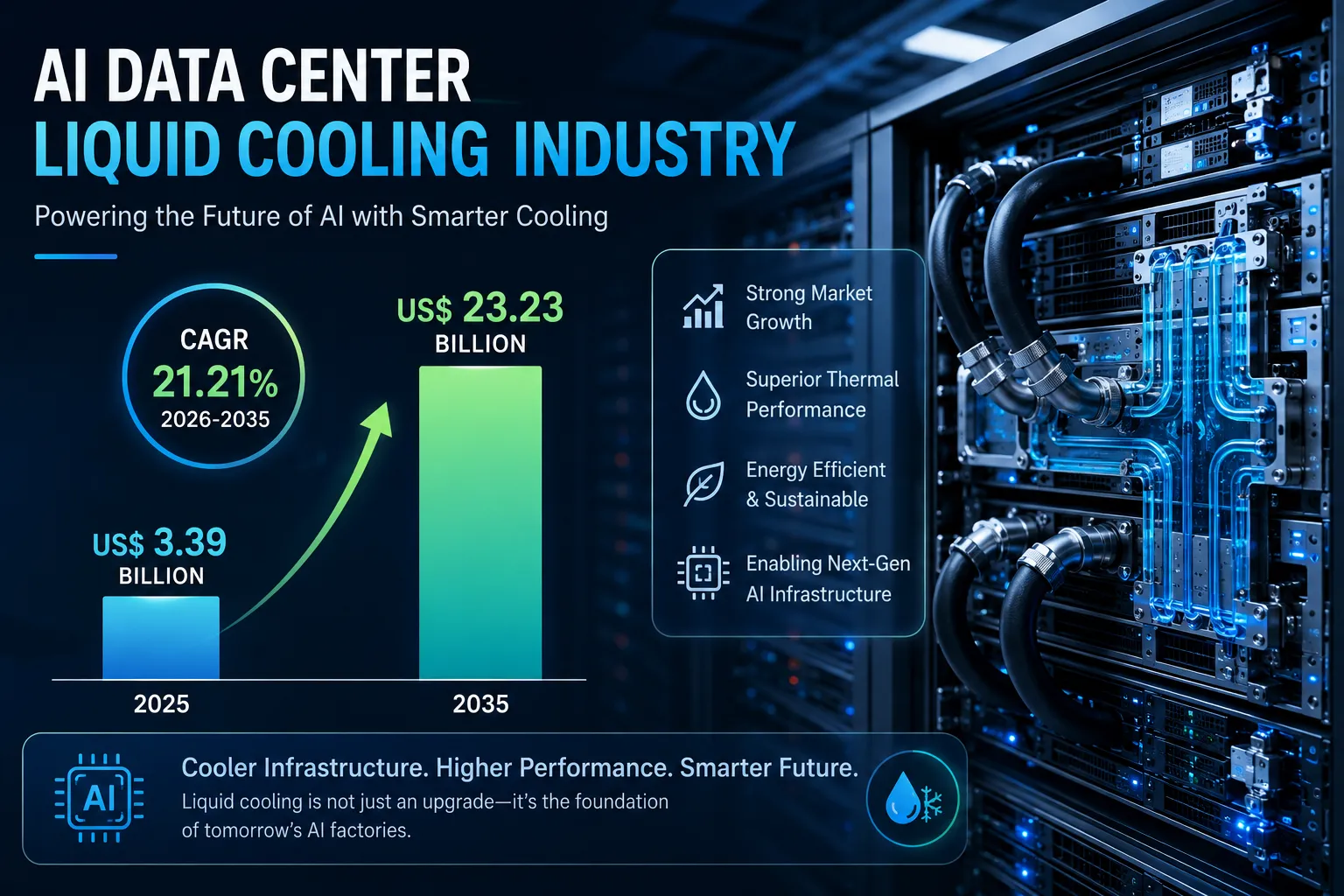
The rise of AI data center liquid cooling is not a temporary trend. It is a structural market shift driven by compute density, GPU platform design, hyperscale investment, and sustainability pressure.
For data center operators, the key question is no longer whether liquid cooling will be needed. The question is which liquid cooling architecture will best support their workload mix, facility constraints, and long-term growth plan.
For equipment manufacturers, the opportunity extends across the entire thermal management value chain. Direct-to-chip cooling, immersion cooling, coolant distribution units, heat exchangers, pumps, manifolds, sensors, controls, and service models are all becoming critical parts of AI infrastructure.
For investors and market researchers, the category is becoming one of the most important segments within AI infrastructure. As AI factories scale globally, cooling will directly influence deployment speed, energy efficiency, operating cost, and infrastructure competitiveness.
The AI infrastructure boom cannot be understood only through GPUs and software models. It must also be understood through power, cooling, water, and physical deployment capacity. Liquid cooling is now central to that conversation.
Explore the Complete AI Data Center Liquid Cooling Market Analysis
The shift from air cooling to liquid cooling is reshaping the future of AI infrastructure. As GPU rack densities rise and hyperscale AI factories expand, organizations need reliable market intelligence to understand technology adoption, competitive dynamics, sustainability risks, and long-term growth opportunities.
For deeper insights, forecasts, market sizing, technology trends, and competitive analysis, explore the complete AI Data Center Liquid Cooling Market Report.