


2026 Could Be the Beginning of a New Battery Era
Sodium ion batteries are one of the most viable alternatives to lithium-ion batteries. While sodium's abundance, affordability and supply chain advantages were long highlighted by researchers, governments and energy firms alike, sodium ion batteries largely stayed in pilot programs, lab tests and specific niche applications. That changed this year.
The most significant battery tech advancement of 2026 is not a leap forward in solid state or a new lithium chemistry. It is the commercial validation of sodium ion batteries by CATL. The company’s declaration of mass production in 2026 and its plan to roll out sodium ion batteries across passenger vehicles, commercial transport and energy storage devices will signify a monumental shift in the battery world. The notion of sodium ion batteries being an interesting, but not yet practical alternative is out. These are now a viable battery platform.
What are the benefits of Sodium ion Batteries?
For the last two decades, the battery world has been largely centered on the lithium-ion battery, but this technology faces long term sustainability concerns, supply chain challenges, critical mineral price volatility and geopolitical issues. This has long been highlighted as problematic in relation to the growing demand for EV batteries and stationary energy storage.
Sodium ion technology overcomes many of these limitations as one of the Earth’s most common elements that is readily available globally. This means greater flexibility in supply chains and the potential for materials to be significantly cheaper while eliminating dependence on critical minerals.
However, for years sodium ion batteries struggled to perform as well as lithium-ion counterparts, specifically on energy density and commercial scalability, but this will be changing.
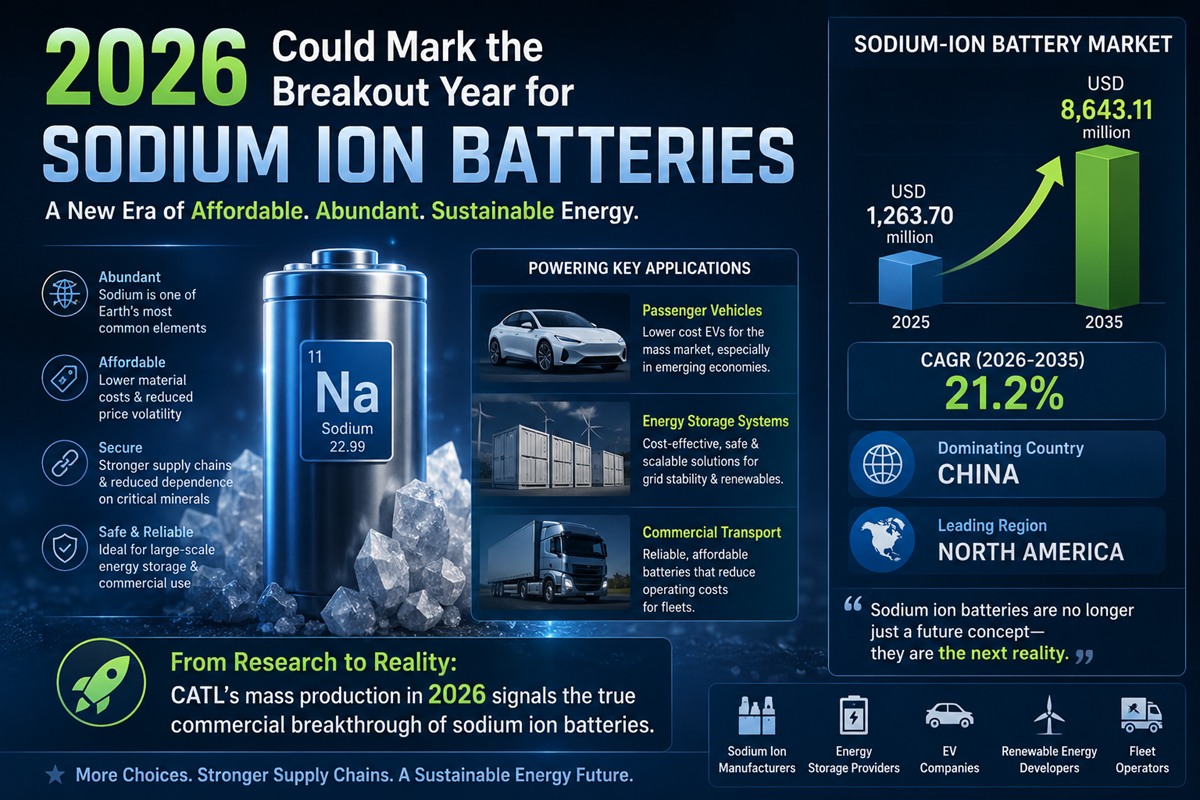
According to DataM Intelligence Research Report, ”Sodium-Ion Battery Market reached is expected to reach US$ 5,891.00 million by 2033, growing with a CAGR of 21.2% during the forecast period 2026-2033.”
From Research Project to Commercial Battery Chemistry
Many battery chemistries demonstrate impressive results in laboratories but do not scale up to viable commercial production; CATL's move means sodium ion is set to break out from a niche role.
Three Markets are going to Drive the initial Adoption:
Passenger vehicles
The application of sodium ion in passenger cars will perhaps be one of the most significant changes, as it will allow many EV manufacturers to cut their costs, especially the ones struggling to gain market share and target the entry level market especially in developing markets.
Energy storage systems
This segment of the market will be even more significant for sodium ion batteries. Battery systems used here in BESS tend to prioritize cost and safety over high energy density, where sodium ion shines. With increased investment in renewable energy, energy storage will be a vital component in providing grid stability.
Commercial transport
Fleet operators have high demands for the reliability and affordability of batteries, where operating costs are the priority over energy density. The cost benefits of sodium ion batteries make them an attractive prospect for commercial vehicle fleets.
Strategic implications for the battery industry
The introduction of mass-produced sodium ion batteries into the global market will provide greater diversification and help reduce a large portion of the risk associated with a supply chain based on critical minerals.
The stakeholders to benefit most are the sodium ion battery manufacturers, energy storage providers, electric vehicle companies, renewable energy developers, and industrial and commercial fleet operators. Competition between battery platforms has a beneficial effect by pushing innovation and cutting costs.
Despite several promising battery technologies having been developed over the years that did not succeed in going from a lab to a commercial venture, CATL's decision to put sodium ion into mass production across different platforms indicates its rise in the global battery market is truly underway, showing it is no longer just a future concept but a reality.
Frequently Asked Questions (FAQ's)
How big is the Sodium-Ion Battery Market?
The Global Sodium-Ion Battery Market reached US$ 1,263.70 million in 2025 and is expected to reach US$ 5,891.00 million by 2033. The market is projected to grow at a CAGR of 21.2% during 2026 to 2033, showing strong commercial momentum for alternative battery chemistries.
Why are sodium-ion batteries gaining market attention?
Sodium-ion batteries are gaining attention because sodium is more abundant than lithium and has a supply chain that can scale more easily. The report highlights that lithium supply constraints could increase long-term demand for sodium-ion batteries as an alternative chemistry.
How is solar energy growth supporting sodium-ion battery demand?
Solar energy expansion is creating opportunities for sodium-ion batteries in stationary energy storage. The report notes that sodium-ion batteries could be more economical than lithium-ion batteries for storing surplus solar energy at scale, especially as solar capacity continues to rise.
Are sodium-ion batteries used in electric vehicles?
Yes, sodium-ion batteries are being tested and adopted in electric mobility, especially electric two-wheelers and next-generation EV platforms. The report highlights TAILG’s sodium-ion electric two-wheelers and CATL’s work on batteries with energy density above 200Wh/kg for future EV use.
What are the main challenges for the Sodium-Ion Battery Market?
The biggest challenge is lower energy density compared to lithium-ion batteries. The report states that sodium-ion batteries typically deliver 90 to 150Wh/kg, while lithium batteries average around 250Wh/kg, making sodium-ion less suitable for high-performance applications today.
Which region leads the Sodium-Ion Battery Market?
North America is listed as both the largest and fastest-growing region in the Sodium-Ion Battery Market. Growth is supported by a strong research ecosystem, venture capital funding, EV-related battery startups, and commercial deployment activity from companies such as Peak Energy and Natron Energy.
What recent developments are shaping the Sodium-Ion Battery Market?
Recent developments show accelerating commercialization. CATL signed a 60 GWh sodium-ion battery supply agreement with Beijing HyperStrong in 2026, BYD launched a grid-scale sodium-ion storage system in 2025, and KPIT partnered with Trentar Energy Solutions for sodium-ion battery commercialization in India.
Who are the major players in the Sodium-Ion Battery Market?
Major players include Faradion, Contemporary Amperex Technology Co., Limited, Tiamat Energy, NGK Insulators Ltd., Li-FUN Technology Corporation Ltd., Natron Energy, Inc., Zhejiang Natrium Energy Co. Ltd., Transimage Sodium-Ion Battery Co. Ltd., HiNa Battery Technology Co., Ltd., and Jiangsu Zoolnasm Energy Technology Co. Ltd.
Read Complete Research Report on Sodium-Ion Battery Market: https://www.datamintelligence.com/research-report/sodium-ion-battery-market