


Vaccines Market Size and Forecast
The Global Vaccines Market reached US$ 83.72 billion in 2025 and is expected to reach US$ 119.54 billion by 2033, growing at a CAGR of 3.9% during the forecast period 2026-2033.
Vaccines are biological substances designed to stimulate the body's immune system to recognize and fight specific pathogens, like viruses or bacteria. They typically contain a weakened or inactivated form of the pathogen, or pieces of it (like proteins), that trigger an immune response without causing illness. This response prepares the body to quickly recognize and combat the pathogen if encountered again, providing immunity.
Vaccines are crucial for preventing infectious diseases, reducing their spread, and protecting vulnerable populations. There is a rising percentage of individuals receiving immunizations. The government initiatives are targeting the population who are yet to receive immunizations to prevent the rise of infectious diseases. For instance, according to the report by UNICEF, every year, nearly 26 million newborns and 34 million pregnant women are targeted for immunization, and over 13 million immunization sessions are held nationwide to vaccinate children and pregnant women.
Vaccines Market Executive Summary
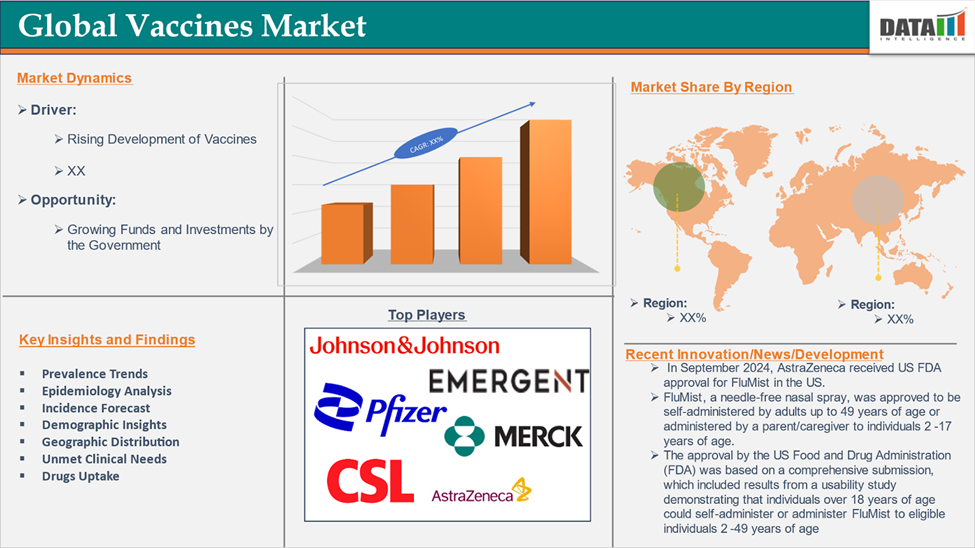
For more details on this report – Request for Sample material
Vaccines Market Dynamics: Drivers & Restraints
Rising development of vaccines
The rising development of vaccines is a key driver for the global vaccine market as it leads to the introduction of new and improved vaccines that address a wider range of diseases. As scientific advancements continue, researchers are developing vaccines for diseases that were once difficult to target, such as certain cancers, malaria, and emerging infectious diseases. This expanded range of vaccines increases market demand, as more people seek protection against a broader spectrum of illnesses.
Moreover, innovations in vaccine technology, such as mRNA vaccines, are making vaccines more effective, easier to produce, and quicker to distribute. These developments not only enhance public health outcomes but also attract investment in the vaccine industry, fueling further growth in the global vaccine market.
Competition from alternative treatments
Competition from alternative treatments is a significant restraint for the global vaccines market because as new therapies like antiviral drugs, monoclonal antibodies, and other treatments emerge, they offer effective solutions for preventing or treating diseases that vaccines typically address. These treatments can be appealing because they often work after infection occurs, making them seem like a more immediate or convenient option compared to vaccination. Additionally, if these treatments are less expensive or easier to access than vaccines, especially in low-income regions, people may choose them over preventive measures. This shift in preference can reduce vaccine demand, particularly if alternative treatments are perceived as more effective, affordable, or simpler to use. As a result, the rise of these alternative therapies can create competition that hampers the global uptake of vaccines, slowing the overall growth of the vaccine market.
Vaccines Market Scope
| Metrics | Details | |
| CAGR | 3.9% | |
| Market Size Available for Years | 2022-2033 | |
| Estimation Forecast Period | 2026-2033 | |
| Revenue Units | Value (US$ Bn) | |
| Segments Covered | Type | Conjugate Vaccines, Inactivated Vaccines, Live-attenuated Vaccines, Recombinant Vaccines, Toxoid Vaccines, Viral Vector Vaccines, Others |
| Category | Monovalent Vaccines, Bivalent Vaccines, Multivalent Vaccines | |
| Disease Indication | Chickenpox, Cholera, Diphtheria, Influenza, Hepatitis, Measles, Mumps, Polio, Rabies, Others | |
| Route of Administration | Intramuscular, Subcutaneous, Intranasal, Others | |
| End User | Community Hospitals, Hospitals, Specialty Centers, Clinics, Others | |
| Distribution Channel | Hospital Pharmacy, Retail Pharmacy, Online Pharmacy | |
| Regions Covered | North America, Europe, Asia-Pacific, South America, and Middle East & Africa | |
Vaccines Market Trends & Insights
Expansion of Next-Generation Vaccine Platforms
Vaccine development is increasingly moving beyond conventional live-attenuated and inactivated approaches toward mRNA, recombinant protein, viral-vector, conjugate and other advanced platforms. These technologies can improve development flexibility and enable researchers to address emerging infectious diseases and previously difficult targets.
mRNA Technology Is Expanding Beyond COVID-19
mRNA technology is increasingly being investigated for influenza, RSV, CMV and oncology applications. The ability to rapidly modify vaccine constructs makes the platform strategically important for future outbreak preparedness and broader preventive healthcare.
Respiratory Vaccines Are Becoming More Important
RSV, influenza and other respiratory infections are creating opportunities for vaccines targeting infants, older adults and high-risk populations. Aging populations and increasing awareness of preventive healthcare are supporting demand for adult respiratory immunization.
Combination Vaccines Are Improving Immunization Efficiency
Combination vaccines can reduce the number of injections required and simplify vaccination schedules. Increasing development of multivalent and combination formulations is particularly relevant to pediatric immunization programs.
Adult Immunization Is Becoming a Larger Opportunity
The market is increasingly moving beyond childhood vaccination toward life-course immunization. Older adults represent an important opportunity for vaccines targeting shingles, pneumococcal disease, influenza and RSV.
Cancer Vaccines Are Creating a New Commercial Frontier
Therapeutic and preventive oncology vaccines are expanding the long-term opportunity for vaccine manufacturers. Personalized cancer vaccines and combinations with immunotherapies are attracting research and investment.
Emerging Infectious Diseases Continue to Influence Vaccine Development
Outbreaks of emerging pathogens are encouraging governments and manufacturers to maintain vaccine-development capabilities and strategic stockpiles.
Thermostable Formulations Could Improve Global Access
Vaccines requiring strict cold-chain conditions can be difficult to distribute in remote and low-resource settings. Research into thermostable formulations and improved delivery technologies could reduce logistical barriers.
Alternative Administration Routes Are Gaining Attention
Intranasal, oral and other non-injectable delivery approaches could improve vaccination acceptance and simplify administration in selected applications.
Digital Technologies Are Improving Vaccine Supply Chains
Digital tracking, automated inventory systems and temperature-monitoring technologies can improve vaccine visibility from manufacturing through administration.
Public-Private Partnerships Remain Important
Government procurement programs, international health organizations, pharmaceutical companies and vaccine manufacturers continue to play a major role in expanding immunization coverage.
Vaccine Manufacturing Localization Is Increasing
Countries are increasingly seeking domestic or regional vaccine manufacturing capabilities to improve supply security and reduce dependence on limited global production hubs.
Vaccines Market Segment Analysis
The global vaccines market is segmented based on type, category, disease indication, route of administration, end-user, distribution channel, and region.
Drug Type:
Conjugate vaccines segment is expected to dominate the global vaccine market share
Conjugate vaccines are a dominant segment in the global vaccine market due to their proven effectiveness in preventing serious bacterial infections, particularly in infants and young children. Vaccines like pneumococcal conjugate vaccines (PCV) and Hib vaccines have drastically reduced diseases such as pneumonia, meningitis, and sepsis. Their ability to enhance immune response, even in infants with immature immune systems, has made them a cornerstone of childhood immunization programs worldwide.
The growing adoption of these vaccines, supported by global health initiatives like GAVI, has expanded their reach to low- and middle-income countries, driving demand. As new conjugate vaccines continue to be developed, targeting a broader range of bacterial diseases, this segment is expected to maintain its stronghold in the global vaccine market. Companies are receiving product approvals by meeting the stringent regulations and the products are proving their efficacy and safety. For instance, in June 2024, Merck received the U.S. Food and Drug Administration (FDA) approval for CAPVAXIVE (Pneumococcal 21-valent Conjugate Vaccine) for active immunization for the prevention of invasive disease caused by Streptococcus pneumoniae serotypes and for the prevention of pneumonia caused by S. pneumoniae serotypes in individuals 18 years of age and older.
Vaccines Market Geographical Analysis
North America is expected to hold a significant position in the global vaccine market share
North America holds a dominant share of the global vaccines market due to the combination of advanced research capabilities, strong pharmaceutical companies’ presence, and government initiatives in the region. The United States, in particular, stands out as a leader in both vaccine innovation and production. The U.S. has been at the forefront of developing new vaccines for influenza, respiratory syncytial virus (RSV), and even newer threats as the country has major market players.
Asia Pacific is at the fastest growing pace in the global vaccines market share
Asia Pacific is currently experiencing the fastest growth in the global vaccine market. The growth is attributed to the increasing investments in R&D Activities, rising innovation of new vaccines, rising campaigns by the governments and the rising strategic collaborations among companies.
Vaccines Market Pipeline & Innovation Opportunities
Next-Generation mRNA Vaccines
Potential applications extend across respiratory infections, emerging diseases and oncology.
Personalized Cancer Vaccines
Individualized vaccines designed around tumor-specific antigens represent a high-value emerging opportunity.
Multivalent Vaccines
Broader antigen coverage can improve protection while simplifying immunization schedules.
Thermostable Vaccines
Improved temperature stability could facilitate distribution in regions with limited cold-chain infrastructure.
Needle-Free Delivery
Microneedles, patches and mucosal delivery systems could improve vaccine acceptance and simplify administration.
Self-Amplifying RNA Platforms
These platforms are being explored as a way to generate strong immune responses using lower quantities of RNA.
Protein-Based Platforms
Protein-subunit technologies continue to provide an alternative to nucleic-acid and viral-vector approaches.
Vaccines Market Market Access Challenges
Vaccine Hesitancy
Concerns about vaccine safety and misinformation can reduce uptake.
Unequal Access
Lower-income regions may face affordability, infrastructure and supply constraints.
Cold-Chain Requirements
Temperature sensitivity can increase transportation and storage costs.
Manufacturing Complexity
Advanced vaccine technologies require specialized manufacturing infrastructure.
Regulatory Requirements
Vaccines require extensive clinical, manufacturing and safety evaluation before approval.
Long Development Timelines
Although some platforms allow faster development, clinical validation and regulatory review can remain lengthy.
Procurement Pressure
Large institutional purchasers can exert significant pressure on vaccine pricing.
Vaccines Market Competitive Landscape
The major global players in the vaccines market include GSK plc., Merck & Co., Inc., Pfizer Inc., CSL, EMERGENT, Johnson & Johnson Services, Inc., AstraZeneca, Bavarian Nordic, Bharat Biotech and Serum Institute of India Pvt. Ltd. among others.
Recent Industry Developments in the Vaccines Market
- August 2026: GSK plc. continued expanding its vaccine portfolio and late-stage pipeline, focusing on respiratory infections, meningococcal disease, shingles and other infectious diseases while strengthening global vaccine supply capabilities.
- July 2026: Merck & Co., Inc. continued advancing its vaccines portfolio, with GARDASIL 9 remaining a major product while the company expanded clinical and manufacturing activities across infectious-disease programs.
- July 2026: Pfizer Inc. continued strengthening its vaccine business, focusing on pneumococcal, respiratory syncytial virus and other infectious-disease vaccines while advancing next-generation vaccine candidates.
- June 2026: CSL continued expanding its vaccine and immunization capabilities through its CSL Seqirus business, with emphasis on seasonal influenza vaccines, pandemic preparedness and next-generation influenza technologies.
- June 2026: Emergent BioSolutions continued strengthening its biodefense and vaccine manufacturing capabilities, supporting preparedness for public-health emergencies and infectious-disease threats.
- May 2026: Johnson & Johnson Services, Inc. continued advancing infectious-disease research and vaccine-related programs, while maintaining investments in global health and pandemic preparedness initiatives.
- May 2026: AstraZeneca continued expanding its vaccine and respiratory-disease portfolio, with research focused on improving protection against respiratory infections and developing next-generation preventive therapies.
- April 2026: Bavarian Nordic continued strengthening its vaccine portfolio, particularly in travel vaccines, smallpox/mpox preparedness and other infectious-disease prevention programs.
- April 2026: Bharat Biotech continued expanding vaccine research and manufacturing capabilities, focusing on affordable vaccines for infectious diseases and strengthening its global supply footprint.
- April 2026: Serum Institute of India Pvt. Ltd. continued expanding vaccine production and global supply capabilities, supporting routine immunization programs and the development of vaccines for emerging infectious diseases.
Why Purchase the Report?
- Pipeline & Innovations: Reviews ongoing clinical trials, and product pipelines, and forecasts upcoming advancements in medical devices and pharmaceuticals.
- Product Performance & Market Positioning: Analyzes product performance, market positioning, and growth potential to optimize strategies.
- Real-World Evidence: Integrates patient feedback and data into product development for improved outcomes.
- Physician Preferences & Health System Impact: Examines healthcare provider behaviors and the impact of health system mergers on adoption strategies.
- Market Updates & Industry Changes: Covers recent regulatory changes, new policies, and emerging technologies.
- Competitive Strategies: Analyzes competitor strategies, market share, and emerging players.
- Pricing & Market Access: Reviews pricing models, reimbursement trends, and market access strategies.
- Market Entry & Expansion: Identifies optimal strategies for entering new markets and partnerships.
- Regional Growth & Investment: Highlights high-growth regions and investment opportunities.
- Supply Chain Optimization: Assesses supply chain risks and distribution strategies for efficient product delivery.
- Sustainability & Regulatory Impact: Focuses on eco-friendly practices and evolving regulations in healthcare.
- Post-market Surveillance: Uses post-market data to enhance product safety and access.
- Pharmacoeconomics & Value-Based Pricing: Analyzes the shift to value-based pricing and data-driven decision-making in R&D.
The Global Vaccine Market report delivers a detailed analysis with 60+ key tables, more than 50 visually impactful figures, and 176 pages of expert insights, providing a complete view of the market landscape.
Target Audience
- Manufacturers: Pharmaceutical, Medical Device, Biotech Companies, Contract Manufacturers, Distributors, Hospitals.
- Regulatory & Policy: Compliance Officers, Government, Health Economists, Market Access Specialists.
- Technology & Innovation: AI/Robotics Providers, R&D Professionals, Clinical Trial Managers, Pharmacovigilance Experts.
- Investors: Healthcare Investors, Venture Fund Investors, Pharma Marketing & Sales.
- Consulting & Advisory: Healthcare Consultants, Industry Associations, Analysts.
- Supply Chain: Distribution and Supply Chain Managers.
- Consumers & Advocacy: Patients, Advocacy Groups, Insurance Companies.
- Academic & Research: Academic Institutions.



























































