


Transformer Oil Market Size and Overview
The global transformer oil market was valued at US$2.8 billion in 2025 and is projected to reach US$4.9 billion by 2035, growing at a CAGR of 5.9% during 2026–2035. The global transformer oil market is driven by the expansion and modernization of electricity transmission and distribution networks, rising global electricity demand and electrification, increasing deployment of renewable energy projects, replacement and refurbishment of aging transformers, and increasing adoption of ester-based transformer fluids due to their high fire resistance, biodegradability, and environmental advantages.
Rapid expansion and modernization of electricity transmission networks is driving demand for transformer oil, as the development of new substations and transformers increases the requirement for insulating and cooling fluids. For instance, India plans to expand its transmission network from approximately 509,000 circuit km in June 2026 to 648,000 circuit km by 2032, while transformation capacity is expected to increase from 1,478 GVA to 2,345 GVA over the same period.
Transformer Oil Market Key Takeaways
- Asia Pacific held the largest regional market share, accounting for approximately 48% of the global transformer oil market in 2025, supported by expanding transmission and distribution infrastructure, rising transformer manufacturing, increasing electricity demand, renewable-energy integration, and grid modernization. The region's large installed base of oil-immersed transformers and growing investments in power infrastructure support substantial consumption of mineral oils, natural ester oils, synthetic ester oils, and other transformer fluids.
- Mineral oil dominates the global transformer oil market accounting for approximately 74% of the market, supported by its established use in power and distribution transformers, proven dielectric and thermal performance, mature supply chains, broad availability, and comparatively lower cost than ester-based insulating fluids. Continued transformer installations, replacement of aging equipment, and expansion of transmission and distribution networks are sustaining demand for mineral transformer oil.
- Power Transformers are projected to be the fastest-growing transformer type in the global Transformer Oil Market, registering an estimated CAGR of 6.5% during 2026–2035. Growth is supported by investment in high-voltage transmission networks, HVDC infrastructure, renewable-energy interconnection projects, and replacement of aging high-capacity transformers, which increases demand for transformer oil used for electrical insulation and heat dissipation.
Transformer Oil Market Industry Trends and Strategic Insight
- Adoption of natural and synthetic ester transformer fluids is increasing as transformer manufacturers and utilities place greater emphasis on fire safety, biodegradability, thermal performance, and environmental characteristics. Transformer-oil manufacturers are expanding natural ester and synthetic ester portfolios alongside conventional mineral oils to serve transformers installed in urban areas, renewable-energy projects, indoor facilities, and other applications with specific fire-safety or environmental requirements.
- Development of high-performance and long-life transformer oils is increasing as transformer operators focus on improving equipment reliability, extending oil service intervals, and managing higher transformer loading. Manufacturers are improving oxidation stability, dielectric strength, thermal performance, moisture tolerance, and low-temperature properties to support transformers operating under demanding electrical and environmental conditions. These developments are particularly relevant to aging transformer fleets, high-voltage networks, renewable-energy installations, and high-load industrial applications.
- Expansion of transformer-oil production, regional distribution networks, and technical capabilities is increasing as grid modernization, transformer manufacturing, renewable-energy integration, and electricity-demand growth raise requirements for insulating fluids. Transformer-oil producers are establishing regional technology centers, expanding production and refining capabilities, and entering distribution and supply partnerships to improve access to transformer fluids.
Transformer Oil Market Scope
| Metrics | Details | |
| 2025 Market Size | USD 2.8 Billion | |
| 2035 Projected Market Size | USD 4.9 Billion | |
| CAGR (2026-2035) | 5.9% | |
| Largest Market | Asia-Pacific | |
| Fastest Growing Market | Asia-Pacific | |
| By Oil Type | Mineral Oil, Natural Ester Oil, Synthetic Ester Oil, Silicone Oil, Other Transformer Fluids | |
| By Transformer Type | Power Transformers, Distribution Transformers, Specialty Transformers | |
| By Voltage | Low Voltage, Medium Voltage, High Voltage, Extra-High Voltage | |
| By End Use | Utilities, Industrial, Renewable Energy, Railways & Transportation, Commercial & Infrastructure | |
| By Region | North America | U.S., Canada, Mexico |
| Europe | Germany, United Kingdom, France, Italy, Spain, Netherlands, Switzerland, Sweden, Norway, Denmark, Belgium, Poland, Austria, Ireland, Portugal, Greece, Finland, and Rest of Europe. | |
| Asia-Pacific | China, Japan, India, South Korea, Australia, New Zealand, Singapore, Malaysia, Thailand, Indonesia, Vietnam, Philippines, Taiwan, and Rest of Asia Pacific. | |
| Latin America | Brazil, Argentina, Rest of Latin America | |
| Middle East and Africa | UAE, Saudi Arabia, South Africa, Israel, Türkiye, Rest of Middle East and Africa | |
| Report Insights Covered | Competitive Landscape Analysis, Company Profile Analysis, Market Size, Share, Growth | |
Transformer Oil Market Disruption Analysis
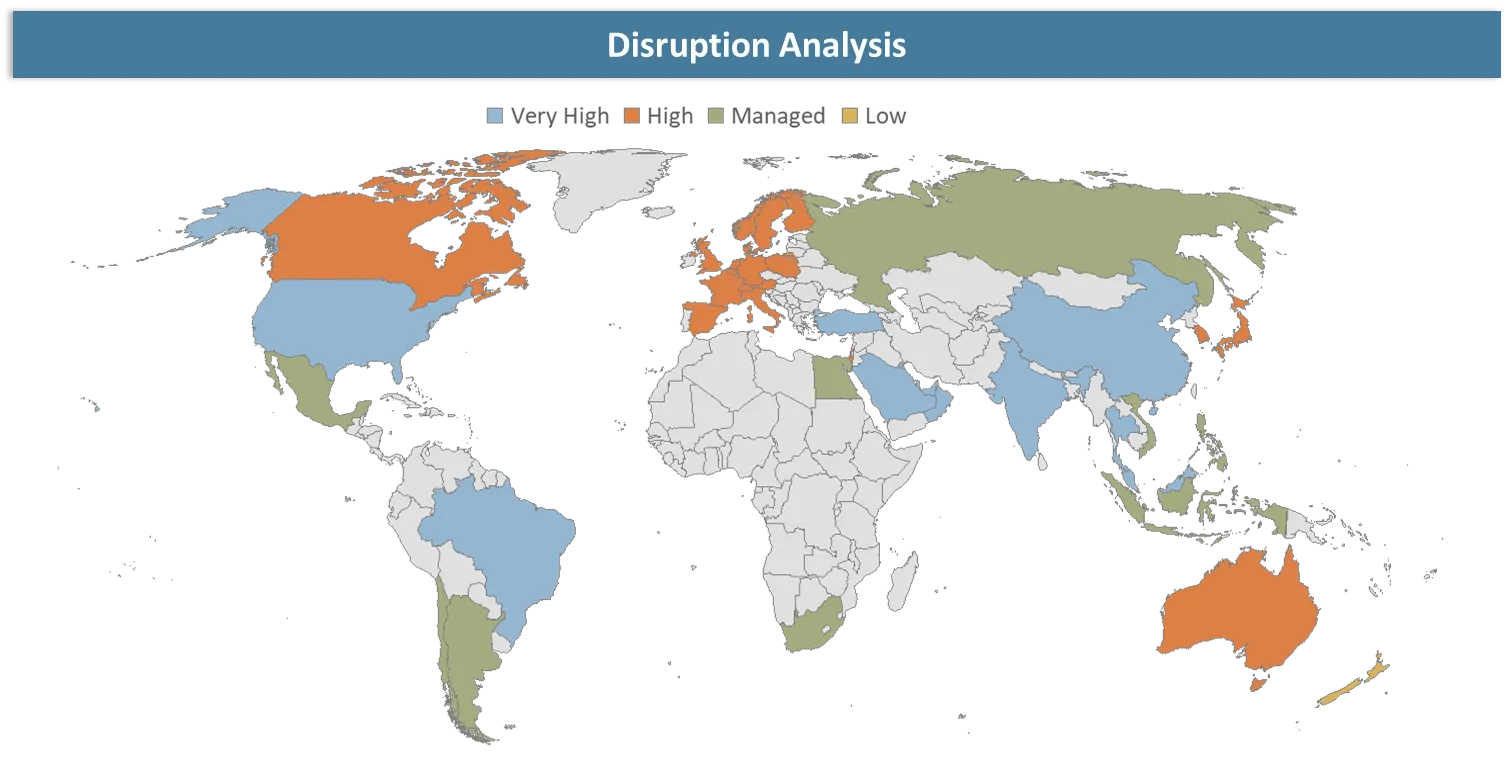
Shift Toward Ester-Based and High-Performance Transformer Fluids
The transformer oil market is experiencing certain changes as utilities, transformer manufacturers, and industry participants are switching to the use of insulating fluids with better heat resistance, oxidation resistance, fire safety, and environmental properties. Natural esters and synthetic esters are being increasingly considered next to the traditional mineral oils used in transformers. The development and improvement of electricity grids, renewable energy, data centers, and industrial electrical facilities have resulted in increased demand for transformers and insulating fluids.
The market is also affected by efforts of transformer oil producers who are developing regional production facilities, logistics channels, technology centers, and supply chains to facilitate the availability of specialty insulating fluids. The supply situation continues to be affected by availability of base oils, refinery capacity, fluctuations in crude oil prices, and transportation costs.
Transformer Oil Market BCG Matrix: Company Evaluation

Ergon, Inc., Nynas AB, Shell Plc, APAR Industries Limited, and China Petrochemical Corporation (Sinopec) are positioned as Stars, supported by established transformer oil portfolios, extensive production capabilities, broad geographic presence, and strong exposure to power transmission, distribution, and industrial transformer applications. China National Petroleum Corporation (CNPC), Exxon Mobil Corporation, Cargill, Incorporated, and Chevron Corporation are positioned as Potential Stars, reflecting strong petroleum and specialty-fluid capabilities, established insulating-fluid portfolios, and broad industrial and energy-sector customer bases.
Gandhar Oil Refinery Limited, Repsol, S.A., Indian Oil Corporation Limited, and Calumet Specialty Products Partners, L.P. are positioned as Question Marks, with established base-oil, specialty-oil, and transformer-fluid capabilities but comparatively narrower positioning within the global transformer oil market. Eastern Petroleum and Paras Lubricants Limited (PALCO) are positioned as Tailenders, reflecting more focused geographic presence and relatively narrower transformer-oil portfolios compared with larger multinational and diversified specialty-fluid manufacturers.
Transformer Oil Market Dynamics
Driver Impact Analysis
| Driver | Market Growth Impact (%) | Demand Concentration | Impacted Areas | Strategic Impact |
Expansion of Power Transmission and Distribution Infrastructure | 30% | Strong demand across Asia-Pacific, North America, Europe, and the Middle East, particularly in China, India, Japan, and the U.S. | Mineral transformer oil, natural ester fluids, power transformers, distribution transformers | Expands demand for transformer oil as utilities add and upgrade oil-immersed transformers across transmission and distribution networks. |
Growing Demand for Power and Distribution Transformers | 25% | Concentrated across Asia-Pacific, North America, and Europe, supported by rising electricity demand, grid expansion, industrial development, and transformer replacement. | Mineral oil, natural ester, synthetic ester, power transformers, distribution transformers | Increases transformer oil consumption through higher transformer production, installation, commissioning, and maintenance requirements. |
Grid Modernization and Replacement of Aging Transformers | 20% | Strong demand in North America and Europe, with increasing requirements across China, Japan, India, and other developed and rapidly electrifying markets. | High-performance transformer oils, natural and synthetic ester fluids, replacement transformers | Supports recurring transformer oil demand as aging equipment is replaced with newer, higher-efficiency transformers requiring insulating and cooling fluids. |
Expansion of Renewable Energy Generation and Grid Integration | 15% | Increasing demand across China, India, the U.S., Europe, and other markets expanding solar, wind, and associated transmission infrastructure. | Natural ester fluids, mineral oil, power transformers, generator transformers, grid-interconnection transformers | Increases demand for transformers at renewable generation sites and grid interconnection points, supporting consumption of transformer insulating fluids. |
Increasing Focus on Transformer Energy Efficiency and Fire Safety | 10% | Broad demand across Europe, North America, Japan, South Korea, China, and India, particularly in urban and high-load applications. | Natural ester, synthetic ester, high-performance mineral oils, distribution and power transformers | Encourages adoption of transformer fluids with improved thermal performance, higher fire points, and suitable environmental and efficiency characteristics. |
Grid Modernization and Replacement of Aging Transformer Infrastructure
Grid modernization initiatives are creating a need for new and improved transmission and distribution networks, which would lead to replacement and upgrades in transformers, and consequently, transformer oil demand. According to The National Conference of State Legislatures (NCSL), the US will need $1.5-$2 trillion in grid modernization investments by 2030 to ensure reliability. In March 2026, DOE launched the SPARK funding opportunity and allocated about $1.9 billion to support reconstruction, advanced transmission technology, and major transmission upgrades. This would enhance the installation and upgrade of power and distribution transformers, which increases demand for transformer oil.
Transformer Oil Market Segment Analysis
The global transformer oil market is segmented based on oil type, transformer type, voltage, end user and region.
Mineral Oil Leads the Market Backed by Cost and Established Infrastructure
Mineral oil is the dominant type in the global transformer oil market, primarily because of its extensive installed base, established use across power and distribution transformers, relatively low cost, and well-developed supply infrastructure. Mineral-based transformer oils have been used for decades and remain the standard insulating and cooling fluid for a large number of transformers worldwide.
The growing focus on sustainable and circular solutions in transformer insulation is encouraging the development and adoption of re-refined mineral oils. For instance, in March 2026, Hitachi Energy successfully tested Nynas’ Nytro RR 900X re-refined mineral oil in a large power transformer at its Córdoba factory in Spain. The solution, sourced entirely from end-of-life transformer fluids, is compliant with IEC 60296:2020 standards and can reduce the carbon intensity of oil production by 90% compared with virgin mineral oil.
Transformer Oil Market Geographical Penetration
Rising Electricity Demand and Grid Expansion Drive the North American Transformer Oil Market
The North American transformer oil market is driven by electricity-grid modernization, rising power demand, renewable-energy expansion, and the replacement of aging electrical infrastructure. In Canada, electricity demand is projected to increase by 44% from 2023 to 2050, while installed electricity capacity is expected to rise from approximately 160 GW to 310 GW over the same period. The expansion of transmission infrastructure and renewable-energy capacity in the region is expected to increase transformer installations, thereby supporting demand for transformer oil.
U.S. Transformer Oil Market Trends
The U.S transformer oil market is driven by the modernization of its aging electricity infrastructure, rising electricity demand from data centers and AI, renewable-energy expansion, electrification, and replacement of aging transformers. According to U.S. Department of Energy study, in 2024, the U.S has approximately 60–80 million distribution transformers, with around 55% of in-service units more than 33 years old and approaching the end of their expected life.
The expansion of domestic transformer manufacturing capacity in the U.S. is supporting demand for transformer oil as utilities and grid operators invest in new electrical infrastructure. For instance, in September 2026, Hitachi Energy announced a $528 million investment in a new transformer manufacturing facility in Mississippi, its largest single U.S. manufacturing investment. The facility is intended to expand U.S. transformer production capacity amid rising demand for grid infrastructure.
Asia-Pacific Transformer Oil Market Trends Driven by Grid Expansion, Renewable Energy Integration, and Rising Transformer Manufacturing Capacity
Asia-Pacific is supported by rapid electricity-demand growth, grid expansion, renewable-energy integration, and increasing transformer manufacturing capacity, particularly in China, India, and Southeast Asia. In large economics of Asia Pacific transformer industry is expanding rapidly. India added 70,728 MVA of transformation capacity during FY2023–24 as part of the national power grid expansion tracked by the Ministry Of Power.
China’s Transformer Oil Market Trends
The China transformer oil market is supported by large-scale expansion and modernization of the country’s electricity grid, rapid growth in renewable-energy capacity, rising electricity consumption, ultra-high-voltage (UHV) transmission projects, and increasing power requirements from data centers and advanced manufacturing. In 2025, China’s power-grid construction investment reached approximately USD$95.4 billion, an increase of 5.1% year on year. Investment in DC transmission projects increased by 25.7%, reflecting continued development of long-distance and UHV transmission infrastructure.
Japan Transformer Oil Market Trends
The Japan represents a mature transformer oil market, with demand supported less by rapid expansion of conventional electricity consumption and more by grid modernization, renewable-power integration, replacement of aging electrical equipment, and new electricity-intensive facilities such as data centers and semiconductor plants. Japan's electricity demand is projected to rise from 803.4 billion kWh in FY2025 to 846.1 billion kWh in FY2035, a 5.3% increase, driven by expanding data centers and semiconductor facilities. The additional electricity load supports investment in substations and transformers, increasing demand for transformer oil for insulation and cooling.
The expansion of transformer manufacturing capacity is expected to support demand for transformer oil, as oil-immersed transformers require insulating and cooling fluids during production and commissioning. For instance, in May 2025, Fuji Electric announced plans to expand transformer production at its Chiba Factory, with transformer and switchgear production capacity targeted to reach 1.5 times the current level by FY2026, the company subsequently confirmed that transformer capacity would increase to 1.5 times the FY2024 level, with production ramp-up planned for Q4 FY2026.
Transformer Oil Market Competitive Landscape
- Ergon, Inc., NYNAS AB, Eastern Petroleum, Gandhar Oil Refinery Limited, Paras Lubricants Limited (PALCO), Shell Plc, APAR Industries Limited, China Petrochemical Corporation (Sinopec), China National Petroleum Corporation (CNPC), Cargill, Incorporated, Exxon Mobil Corporation, Chevron Corporation, Repsol, S.A., Indian Oil Corporation Limited, and Calumet Specialty Products Partners, L.P. are among the notable players. Competition is primarily focused on dielectric strength, oxidation stability, thermal performance, viscosity, pour point, moisture resistance, fire point, compatibility with transformer insulation systems, product purity, transformer-oil re-refining capabilities, production capacity, product consistency, and development of high-performance and ester-based insulating fluids.
- Ergon, Inc. (United States), NYNAS AB (Sweden), Eastern Petroleum (India), Gandhar Oil Refinery Limited (India), Paras Lubricants Limited (PALCO) (India), Shell Plc (United Kingdom), APAR Industries Limited (India), China Petrochemical Corporation (Sinopec) (China), China National Petroleum Corporation (CNPC) (China), Cargill, Incorporated (United States), Exxon Mobil Corporation (United States), Chevron Corporation (United States), Repsol, S.A. (Spain), Indian Oil Corporation Limited (India), and Calumet Specialty Products Partners, L.P. (United States) are among the key companies operating in the global transformer oil market.
Key Developments
- July 2026: ExxonMobil supplied the first large-scale production batch of its next-generation Univolt transformer oil in Europe. The inhibited naphthenic oil is designed to provide cooling, electrical insulation, and long-term stability while supporting transformer reliability and potentially reducing maintenance requirements. The production milestone strengthens ExxonMobil’s supply capabilities for utilities, transformer manufacturers, and industrial operators as demand for reliable transformer infrastructure increases.
- March 2026: Hitachi Energy successfully tested Nynas’ Nytro RR 900X re-refined mineral oil in a large power transformer at its Córdoba factory in Spain. The solution, sourced entirely from end-of-life transformer fluids, is compliant with IEC 60296:2020 standards and can reduce the carbon intensity of oil production by 90% compared with virgin mineral oil.
- January 2026: Ergon, Inc. formalized a transformer-oil distribution agreement with Japan Sun Oil (JSO), granting JSO rights to market, sell, and distribute Ergon's transformer-oil products in Japan. The companies have worked together for more than 30 years, and the agreement covers Ergon's HyVolt and OmniVolt transformer oils.
- November 2025: Shell Indonesia introduced Shell MIDEL transformer fluids for the electrical power sector. The introduction expands Shell's transformer-fluid portfolio in Southeast Asia and supports the adoption of ester-based insulating fluids alongside conventional mineral transformer oils.
- July 2025: Ergon opened its first Transformer Oil Technology Center in Asia in Merak, Indonesia. The facility was established to support research, development, testing, and technical services for premium dielectric fluids, including transformer oils. Ergon stated that the center is intended to support customers and transformer-oil applications as electricity demand and grid infrastructure expand across Asia.
Key Procurement Priorities and Buyer Evaluation Criteria
- Transformer oil buyers prioritize insulating fluids that provide high dielectric strength, strong oxidation stability, effective heat-transfer performance, low moisture content, suitable viscosity, and reliable long-term electrical insulation to support the safe and efficient operation of power, distribution, generator, traction, and specialty transformers.
- Evaluation is based on criteria such as dielectric breakdown strength, oxidation stability, viscosity, pour point, flash point, fire point, moisture content, acidity, interfacial tension, dissipation factor, thermal stability, and compatibility with transformer insulation materials.
- Producers and transformer operators consider factors including material cost, transformer operating temperature, oil service life, maintenance requirements, filtration and treatment requirements, transportation costs, product availability, delivery timelines, storage requirements, and total cost of ownership. Consistent physical and chemical properties, product purity, supply reliability, and compliance with applicable transformer-oil standards are also considered when selecting suppliers.
- Preference is given to manufacturers with proven transformer-fluid performance, broad mineral and ester-based oil portfolios, reliable base-oil and feedstock supply, advanced refining and purification capabilities, strong quality-control systems, and the ability to supply mineral oils, natural ester fluids, synthetic ester fluids, and other specialized insulating fluids for different transformer applications.
- Transformer manufacturers, power utilities, grid infrastructure companies, industrial facilities, renewable-energy operators, railway companies, and commercial infrastructure users particularly prioritize suppliers that can provide consistent dielectric and thermal performance, reliable supply volumes, technical support, long service life, and fluids that improve transformer reliability, reduce maintenance requirements, and address fire-safety and environmental requirements.
Why Choose DataM?
- Technological Innovations: Examines advancements in transformer oil technologies, including high-performance mineral oils, natural ester fluids, synthetic ester fluids, improved oxidation stability, enhanced thermal performance, low-temperature formulations, fire-resistant insulating fluids, re-refined transformer oils, and advanced purification and refining processes. The analysis evaluates how these developments improve electrical insulation, heat dissipation, transformer reliability, fire safety, and service life.
- Real-World Evidence: Highlights the use of transformer oils across power transformers, distribution transformers, generator transformers, traction transformers, renewable-energy transformers, substations, and industrial electrical equipment, providing evidence of actual fluid requirements across power generation, transmission, distribution, renewable energy, transportation, industrial, and infrastructure applications.
- Market Updates & Industry Changes: Tracks key developments such as new transformer-oil production facilities, manufacturing and refining capacity expansions, transformer-fluid technology centers, new product launches, ester-fluid commercialization, strategic partnerships, distribution agreements, acquisitions, and investments aimed at strengthening regional transformer-oil supply chains across North America, Europe, Asia-Pacific, Latin America, and the Middle East & Africa.
- Competitive Strategies: Analyzes how leading transformer-oil manufacturers expand through production and refining capacity additions, geographic expansion, development of natural and synthetic ester fluids, advanced mineral-oil formulations, strategic partnerships, distribution agreements, acquisitions, technical-service capabilities, and investments in high-performance insulating-fluid technologies.
- Pricing & Market Access: Explains variations in transformer oil pricing based on oil type, base-oil quality, dielectric performance, oxidation stability, viscosity, fire point, formulation, refining and purification requirements, order volume, crude and feedstock costs, transportation expenses, and supply availability. The analysis also evaluates market access through direct sales, distributors, specialty-oil suppliers, transformer manufacturers, utilities, and long-term supply agreements with power and industrial customers.
- Market Entry & Expansion: Identifies growth opportunities driven by transmission and distribution-grid expansion, transformer manufacturing capacity additions, replacement of aging transformers, renewable-energy integration, rising electricity demand, data-center and industrial infrastructure expansion, and increasing adoption of natural and synthetic ester fluids for applications requiring enhanced fire safety, environmental performance, and transformer reliability.
Target Audience 2026
- Transformer Oil Manufacturers and Specialty-Fluid Producers
- Base-Oil Refiners and Lubricant Manufacturers
- Transformer Manufacturers and Transformer OEMs
- Power Transformer and Distribution Transformer Manufacturers
- Power Generation, Transmission, and Distribution Utilities
- Electrical Equipment and Grid Infrastructure Companies
- Renewable Energy Companies and Grid-Integration Equipment Providers
- Industrial Electrical Equipment Manufacturers and Large Industrial Users
- Railway and Transportation Electrification Companies
Transformer Maintenance, Testing, and Oil-Reclamation Service Providers




























































