


Refractories Market Size and Overview
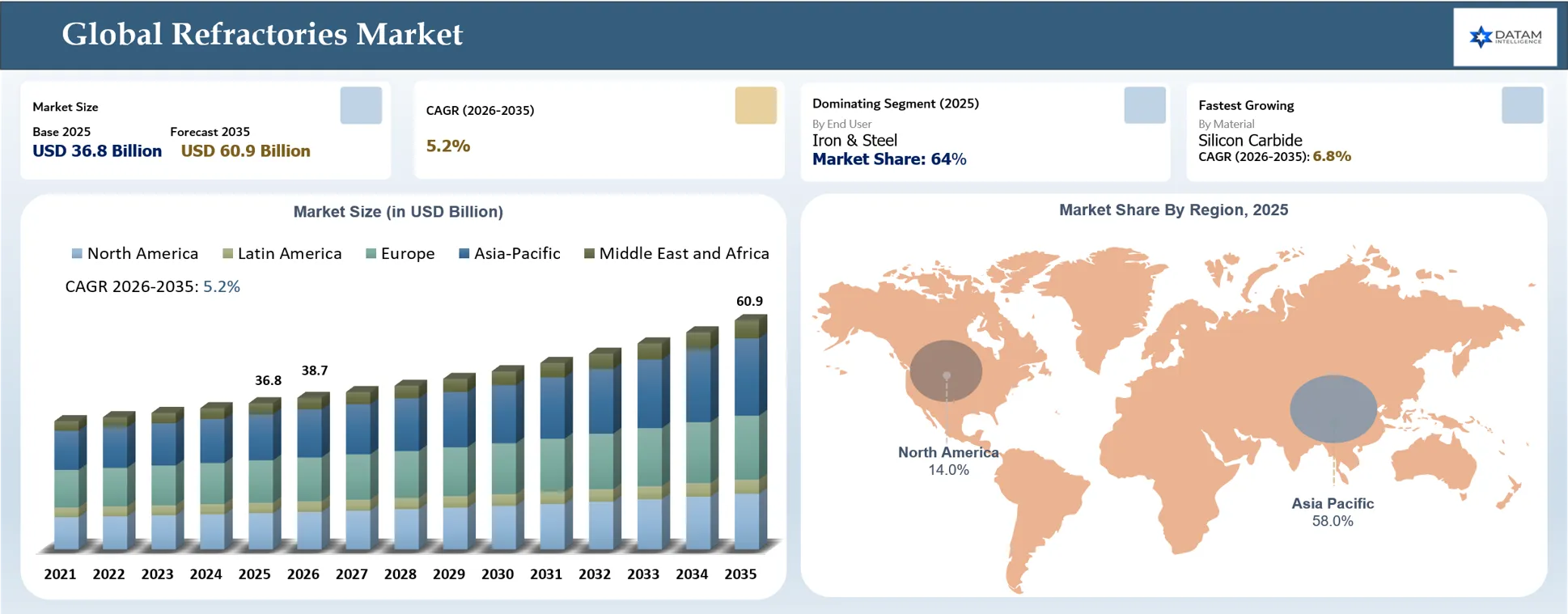
The global refractories market was valued at US$36.8 billion in 2025 and is projected to reach US$60.9 billion by 2035, growing at a CAGR of 5.2% during 2026–2035. The global refractories market is driven by the expansion of steel production, growing cement and infrastructure development, increasing production of non-ferrous metals, rising demand for glass and other high-temperature industrial products, and the continuous need for refractory replacement and maintenance in furnaces, kilns, and other high-temperature processing equipment.
The expansion of industrial furnaces and high-temperature processing facilities is increasing demand for refractories used to withstand extreme temperatures, thermal stress, and chemical exposure. Investments in larger and more efficient furnaces are therefore supporting demand for durable refractory linings and components. For instance, in August 2026, Tenova announced that it will supply a 285-ton electric arc furnace (EAF) to Hüttenwerke Krupp Mannesmann (HKM) in Duisburg, Germany, as part of the steelmaker’s transition to low-emission steel production. The furnace will have a design capacity of 2.5 million tons per year, making it the largest EAF in Germany and one of the largest in Europe.
Increasing Investments in Refractory Manufacturing Capacity and Regional Supply
Rising investments in refractory production capacities are providing scope for market growth through enhanced regional production capacities as well as increased demand from high temperature industries. Increased production capacities also allow the manufacture of a wide variety of specialized refractory materials that can be used in various steel, cement, non-ferrous metal, and other industries. For instance, in April 2026, Calderys opened its CAPES refractory manufacturing plant in Odisha, India, and expanded the production of acidic and basic monoliths, bricks, steel casting fluxes, and other refractory materials for iron and steel, cement, aluminum, petrochemicals, energy, and foundry industries.
Refractories Market Key Takeaways
- Asia Pacific held the largest regional market share, accounting for approximately 58% of the global refractories market in 2025, supported by large-scale steel production, expanding cement manufacturing, growth in non-ferrous metal industries, and increasing demand for high-temperature furnace linings. China, India, Japan, and South Korea remain major contributors due to their extensive metallurgical and industrial manufacturing base, driving consumption of refractory bricks, monolithic refractories, and advanced refractory materials
- Iron & Steel dominated the global refractories market in 2025, accounting for approximately 64% of the market, driven by extensive use of refractory materials in blast furnaces, electric arc furnaces (EAFs), basic oxygen furnaces (BOFs), ladles, tundish systems, and other steelmaking equipment. The continuous expansion of steel production capacity, increasing adoption of advanced steelmaking technologies, and demand for durable furnace linings are supporting refractory consumption across the industry.
- Silicon Carbide refractories are expected to be the fastest-growing material segment, with an estimated CAGR of 6.8% during 2026–2035, driven by their superior thermal conductivity, high wear resistance, corrosion resistance, and ability to withstand thermal shock. Increasing adoption in aluminum processing, foundries, steelmaking, and energy-efficient high-temperature applications is accelerating demand for silicon carbide-based refractory products.
Refractories Market Industry Trends and Strategic Insight
- Adoption of advanced refractory materials and performance-based solutions is becoming a key area of refractory industry development as high-temperature industries increasingly demand materials with improved durability, thermal efficiency, and longer service life. Refractory manufacturers are expanding advanced formulations, including silicon carbide, alumina-based, magnesia-carbon, low-cement castables, and other engineered solutions to improve furnace performance across steel, cement, glass, and non-ferrous metal applications.
- Expansion of sustainable refractory practices and recycling technologies is increasing as industries focus on reducing raw material consumption, operational costs, and environmental impact. Manufacturers and end users are adopting spent refractory recycling, energy-efficient production processes, and optimized furnace lining management to improve resource utilization and reduce waste generation. These practices are gaining importance in steel, cement, and other high-temperature industries undergoing decarbonization efforts.
- Integration of digital monitoring, predictive maintenance, and lifecycle management solutions is increasing as industrial operators look for improved furnace reliability and reduced downtime. Refractory suppliers are incorporating digital technologies, condition monitoring systems, and data-driven maintenance approaches to optimize refractory lining performance, predict failures, and enhance operational efficiency in high-temperature processing equipment.
Refractories Market Scope
| Metrics | Details | |
| 2025 Market Size | USD 36.8 Billion | |
| 2035 Projected Market Size | USD 60.9 Billion | |
| CAGR (2026-2035) | 5.2% | |
| Largest Market | Asia-Pacific | |
| Fastest Growing Market | Asia-Pacific | |
| By Form | Shaped Refractories, Unshaped Refractories | |
| By Chemistry | Acidic Refractories, Basic Refractories, Neutral Refractories | |
| By Manufacturing Process | Dry Pressed Refractories, Fused Cast Refractories, Hand Molded Refractories, Formed Refractories, Unformed (Monolithic) Refractories | |
| By End-Use Industry | Iron & Steel, Cement & Lime, Glass, Non-Ferrous Metals, Petrochemicals & Chemicals, Ceramics, Power Generation, Foundry, Waste Incineration, and Others | |
| By Material | Alumina, Silica, Magnesia, Fireclay, Zirconia, Silicon Carbide, Dolomite, Chromite, Carbon & Graphite, and Others | |
| By Region | North America | U.S., Canada, Mexico |
| Europe | Germany, United Kingdom, France, Italy, Spain, Netherlands, Switzerland, Sweden, Norway, Denmark, Belgium, Poland, Austria, Ireland, Portugal, Greece, Finland, and Rest of Europe. | |
| Asia-Pacific | China, Japan, India, South Korea, Australia, New Zealand, Singapore, Malaysia, Thailand, Indonesia, Vietnam, Philippines, Taiwan, and Rest of Asia Pacific. | |
| Latin America | Brazil, Argentina, Rest of Latin America | |
| Middle East and Africa | UAE, Saudi Arabia, South Africa, Israel, Türkiye, Rest of Middle East and Africa | |
| Report Insights Covered | Competitive Landscape Analysis, Company Profile Analysis, Market Size, Share, Growth | |
Refractories Market Disruption Analysis
Advanced Technologies and Industrial Transition Reshaping the Refractories Market
The global refractories market is witnessing drastic changes due to growing requirements for more durable, energy-efficient, and environmentally friendly products in the industries of steel, cement, glass, non-ferrous metals, and others that operate at high temperatures. The refractory industry is currently going through a change in terms of the emergence of new types of refractories, such as advanced refractory formulations, low-carbon production technologies, monolithic refractories, nanomaterials, recycled spent refractories, and digital technologies for predictive maintenance.
While, availability of raw materials, rising cost of energy, strict environmental laws, need for carbon emissions reduction, and reliance on minerals like bauxite, and graphite may affect the manufacturing and supply of refractories. Additionally, the shift towards low emission techniques in steel manufacturing, through the use of EAFs, hydrogen production techniques, and alternative ways of cement manufacturing needs new kinds of refractory materials.
Refractories Market BCG Matrix: Company Evaluation

RHI Magnesita N.V., Vesuvius plc, Calderys, Krosaki Harima Corporation, and Shinagawa Refractories Co., Ltd. are positioned as Stars, supported by strong global refractory portfolios, established customer bases, extensive manufacturing capabilities, and exposure to major steel, cement, non-ferrous metals, glass, and other high-temperature industries. Saint-Gobain Ceramics, Refratechnik Holding GmbH, and Morgan Advanced Materials plc are positioned as Potential Stars, reflecting established refractory portfolios, specialized technologies, and mature industry presence.
Puyang Refractories Group Co., Ltd. (PRCO), IFGL Refractories Ltd., Chosun Refractories Co., Ltd., Gouda Refractories B.V., Dalmia Bharat Refractories Ltd., Allied Mineral Products, LLC, and Resco Products, Inc. are positioned as Question Marks, with established refractory capabilities and opportunities for further expansion but comparatively narrower global positioning.
Refractories Market Dynamics
Driver Impact Analysis
| Driver | Market Growth Impact (%) | Demand Concentration | Impacted Refractory Areas | Strategic Impact |
Expansion of Steel Production and Electric Arc Furnaces | 30% | Strong demand across Asia-Pacific, Europe, North America, and the Middle East, particularly in China, India, Japan, South Korea, the U.S., and Europe. | Basic refractories, magnesia-carbon bricks, alumina refractories, monolithics, ladle and tundish refractories, EAF linings | Increases demand for high-performance refractories used in furnaces, converters, ladles, tundish systems, and steelmaking equipment while supporting demand for products with longer service life and greater thermal and corrosion resistance. |
Growth of Cement Production and Infrastructure Development | 25% | High concentration across Asia-Pacific, the Middle East, Africa, and Latin America, supported by urbanization, infrastructure projects, and construction activity. | Basic and neutral refractories, alumina refractories, fireclay, monolithics, kiln linings | Expands refractory consumption in rotary kilns, preheaters, precalciners, coolers, and other cement-processing equipment, while increasing demand for abrasion- and thermal-shock-resistant products. |
Increasing Production of Non-Ferrous Metals | 20% | Strong demand across Asia-Pacific, North America, Europe, and Latin America, particularly in major aluminum, copper, zinc, and nickel producing regions. | Alumina, magnesia, silicon carbide, chrome-free refractories, monolithics, furnace linings | Supports demand for specialized refractories capable of resisting molten-metal corrosion, chemical attack, abrasion, and high operating temperatures in smelting, refining, melting, and casting processes. |
Expansion of Glass Manufacturing and High-Temperature Industrial Processing | 15% | Concentrated in Asia-Pacific, Europe, and North America, with increasing production capacity in emerging manufacturing economies. | Silica, alumina, zirconia, zircon, fused-cast refractories, furnace refractories | Creates demand for corrosion-resistant and high-temperature refractory materials used in glass melting furnaces and other industrial furnaces, supporting adoption of longer-lasting and higher-performance products. |
Replacement, Maintenance, and Modernization of Existing Furnaces and Kilns | 10% | Broad demand across all major industrial regions, particularly established steel, cement, metals, glass, and chemical manufacturing markets. | Refractory bricks, monolithics, castables, mortars, repair materials, precast shapes | Generates recurring refractory demand because furnace linings deteriorate through thermal cycling, corrosion, abrasion, and mechanical stress, encouraging manufacturers to develop products with longer operating life and faster installation. |
Increasing Steel Production and Investment in Electric Arc Furnaces
Global rise in steel production and the use of electric arc furnace (EAF) technology acts as one of the key drivers of the refractories market as steel processing equipment requires refractory materials to protect it from very high temperatures, steel in molten form, slag, erosion, and thermal cycles. The global crude steel production was steady at around 1.84 billion tons in 2024, with production in Asia at around 1.36 billion tons or almost 74% of the total global production. China accounted for 960.8 million tons of steel production, which is more than half of the global production.
Growing investments in steel manufacturing capacity along with the shift towards electric arc furnace have resulted in a growing need for refractory materials that can resist high temperature, molten steel, slag, and thermal shock. For instance, in September 2026, ArcelorMittal declared an investment of US$1.51 billion in its low carbon steel plant located in Dunkirk, France, based on large electric arc furnace technology. This plant is expected to start production operations in 2029 with a reduction in greenhouse gas emissions by almost two-thirds compared with conventional blast furnace technology.
Restraint Impact Analysis
| Restraint | Market Growth Impact (%) | Demand Concentration | Impacted Use Case | Strategic Impact |
High Energy and Raw Material Costs | 30% | Strong impact across Asia-Pacific, Europe, North America, and the Middle East, particularly in regions with high energy costs and significant refractory manufacturing activity. | Refractory bricks, monolithics, castables, magnesia-carbon refractories, alumina refractories, furnace linings | High energy consumption during the production of refractory materials, combined with fluctuations in magnesia, alumina, bauxite, graphite, and other raw material prices, increases manufacturing costs and can pressure refractory producers' margins. |
Volatility in Raw Material Supply and Prices | 25% | Significant impact across Asia-Pacific, Europe, North America, and other regions dependent on imported refractory minerals and raw materials. | Magnesia-based refractories, alumina refractories, silica refractories, chrome-based materials, silicon carbide refractories | Dependence on key minerals and geographically concentrated raw material supplies can increase procurement costs and create supply uncertainties, encouraging manufacturers to diversify suppliers and develop alternative material formulations. |
Shorter Service Life Under Severe Operating Conditions | 20% | High impact in steel, cement, non-ferrous metals, glass, and foundry industries, particularly where furnaces operate at extreme temperatures and under high mechanical or chemical stress. | Furnace linings, ladles, tundish systems, rotary kilns, EAFs, converters, glass furnaces | Thermal shock, corrosion, abrasion, slag attack, and mechanical wear can cause premature refractory failure, resulting in unplanned shutdowns, repair costs, and production losses for end users. |
Stringent Environmental and Regulatory Requirements | 15% | Strong impact across Europe, North America, and developed industrial markets, with increasing influence in Asia-Pacific and other emerging economies. | Chrome-containing refractories, refractory manufacturing, furnace linings, waste and emissions management | Environmental regulations governing emissions, hazardous materials, waste disposal, and production processes can increase compliance costs and encourage manufacturers to develop low-emission, chrome-free, and environmentally safer refractory alternatives. |
Substitution by Advanced Furnace Technologies and Improved Refractory Efficiency | 10% | Broad impact across major steel, cement, metal, glass, and industrial manufacturing markets where process efficiency and refractory consumption are being optimized. | Furnace linings, monolithic refractories, precast shapes, repair materials, high-performance refractories | Longer-lasting refractory products, optimized furnace designs, improved process controls, and reduced refractory consumption per tonne of output can lower the replacement frequency and volume of refractory materials required by end users. |
Dependence on Concentrated Global Supply of Key Refractory Raw Materials
The refractories industry depends heavily on specific minerals, and the supply of some important inputs is concentrated in a limited number of countries. China is a major global supplier of magnesia, graphite, bauxite, and other refractory minerals, making changes in Chinese mining policies, exports, energy costs, or production levels capable of affecting global raw-material availability.
Restrictions or tighter controls on graphite exports from China can affect the availability and cost of graphite used in magnesia-carbon refractories for steelmaking. Supply disruptions and price volatility can increase procurement costs, extend lead times, and encourage manufacturers to maintain alternative suppliers or develop substitute formulations.
Refractories Market Segment Analysis
The global refractories market is segmented based on payment method, transaction type, payment mode, enterprise size, end user and region.
Alumina Refractories Dominating High-Temperature Industrial Applications
Alumina is anticipated to hold the largest share of the refractory market due to the diverse use of alumina refractory materials in industries such as steel, cement, non-ferrous metals, foundries, power, petrochemicals, and other high-temperature applications. The use of alumina-based refractory materials is equally widespread in cement kilns, cyclones, coolers, kiln tops, boilers, incinerators, reheat furnaces, and heat treatment equipment.
The considerable growth in the manufacturing of steels and non-ferrous metals, along with increased production capacity of cement and furnaces, will continue to drive demand for alumina-based bricks, castables, and other refractory products. For instance, in 2025, Vedanta Aluminium commissioned a 1.5-million-ton-per-year expansion at its Lanjigarh alumina refinery in India, increasing the facility's total alumina production capacity to 3.5 million tons per year, while Hindalco announced plans including an 850,000-ton-per-year alumina refinery in Odisha.
Refractories Market Geographical Penetration
Expansion of Aluminum Smelting Capacity Supporting Refractory Demand in North America
North America represents a significant market for refractories, supported by its large steel, cement, non-ferrous metals, glass, and other high-temperature processing industries. In 2025, North America produced approximately 107.4 million metric tons of crude steel, accounting for around 5.8% of global crude steel production.
Growing aluminum production and modernization of non-ferrous metal processing facilities are supporting refractory demand in North America. Investments in new smelting capacity are increasing the requirement for high-temperature and corrosion-resistant refractory materials used in aluminum production. For instance, in May 2026, Rio Tinto began commissioning a US$1.5 billion expansion of its Complexe Arvida aluminum smelter in Quebec. The expansion uses Rio Tinto's AP60 low-carbon smelting technology, while the Quebec government separately announced C$100 million (approximately US$72.6 million) to support deployment of ELYSIS technology.
Growth of Steel Production and EAF-Based Steelmaking Strengthening Refractory Demand
The US is one of the leading markets for refractories in North America owing to strong steel industry, cement industry, non-ferrous metal industry, and advanced high temperature process equipment technology. According to World Steel Association, US crude steel production in 2025 was 81.9 million metric tons, and it ranks third worldwide in terms of steel production. Its crude steel production increased from 79.5 million metric tons in 2024. The country also produces about 84 million metric tons of cement in 2025 along with about 100 million metric tons of clinker capacity.
The U.S. steel industry has a substantial EAF presence, whereas investments in U.S. steel production capacities lead to an increased demand for refractory products like refractory lining, bricks, monolithics, castables, and other high-temperature products applied in furnaces and secondary steel making equipment. For instance, in August 2026, the United States Department of Energy made a decision to provide an award of US$500 million to support the investment of US$1 billion made by Cleveland-Cliffs in its Middletown Works facility located in Ohio.
Large-Scale Cement Manufacturing Supporting Refractory Demand Across Asia Pacific
The Asia Pacific region is the major consumer of refractories since it has large scale operations in cement, glass, non-ferrous metal, ceramic, chemical, power generation and manufacturing industries. The high productio n of cement in the region requires refractory bricks, castables, monolithic refractories, and also materials containing alumina, magnesia, silica and silicon carbide. Refractory materials are needed during the production of cement as it acts as a protection for the rotary kiln, pre-heater, calciner, cooler and all other equipment subjected to high temperatures. For instance, in India, around 491.4 million tonnes of cement was produced in 2026, in China about 1.69 billion tonnes of cement were produced in 2025, While Vietnam manufactured 100 million tonnes of cement in 2025.
China Leads Asia Pacific Refractory Demand Through Steel Production
China constitutes the largest consumer of refractories in the Asia Pacific region, owing to its immense steel, cement, non-ferrous metals, glass, and industrial manufacturing base. The blast furnaces, converters, electric furnaces, cement kilns, glass furnaces, and non-ferrous metal processing plants present in the country generate significant recurring requirements for refractory bricks, monolithics, castables, and materials made of alumina, magnesia, silica, and silicon carbide.
Steel production in China constitutes the greatest demand pull factor. As per the World Steel Association, China's crude steel production in 2025 was 960.8 million metric tons, contributing roughly 52% to the worldwide crude steel production. Though crude steel production declined by 4.4% compared to 1,005.1 million metric tons in 2024, China still remained the world's largest producer of steel.
Established Refractory Manufacturing Base and Demand from High-Temperature Industries
Japan is a significant consumer of refractories in the Asian-Pacific region due to its vast steel industry, cement manufacturing, metallurgy of non-ferrous metals, glass manufacture, and other high-temperature industrial processes. As per the World Steel Association, in 2025, Japan manufactured 80.7 million metric tons of crude steel, becoming the third largest steel manufacturer in the world, although there was a slight decrease in steel production compared to 84.0 million metric tons in 2024.
Japan has an advanced refractory production industry that produces materials for use in furnaces, kilns, ladles, converters, and other high-temperature equipment. In July 2026, Japan's total refractory production was reported at approximately 774,000 metric tons in fiscal year 2025, representing a 2.6% decline from the previous year. Although production declined, the scale of domestic refractory output indicates the country's substantial refractory manufacturing and consumption base.
Refractories Market Competitive Landscape
- RHI Magnesita N.V., Vesuvius plc, Calderys, Krosaki Harima Corporation, Shinagawa Refractories Co., Ltd., Saint-Gobain Ceramics, Refratechnik Holding GmbH, and Morgan Advanced Materials plc are among the notable players. Competition is primarily focused on refractory performance, service life, thermal and corrosion resistance, product customization, technical services, production capacity, and development of advanced refractory solutions for demanding high-temperature applications.
- RHI Magnesita N.V. (Austria), Vesuvius plc (United Kingdom), Calderys (France), Krosaki Harima Corporation (Japan), Shinagawa Refractories Co., Ltd. (Japan), Saint-Gobain Ceramics (France), Refratechnik Holding GmbH (Germany), Morgan Advanced Materials plc (United Kingdom), Puyang Refractories Group Co., Ltd. (China), IFGL Refractories Ltd. (India), Chosun Refractories Co., Ltd. (South Korea), Gouda Refractories B.V. (Netherlands), Dalmia Bharat Refractories Ltd. (India), Allied Mineral Products, LLC (United States), and Resco Products, Inc. (United States) are among the key companies operating in the global refractories market.
Key Developments
- September 2026: ArcelorMittal declared an investment of US$1.51 billion in its low carbon steel plant located in Dunkirk, France, based on large electric arc furnace technology. This plant is expected to start production operations in 2029 with a reduction in greenhouse gas emissions by almost two-thirds compared with conventional blast furnace technology.
- August 2026: RHI Magnesita and Khemka Refractories completed their previously announced joint venture and launched MINPRO, a dedicated refractory recycling business in India. The new company will establish a refractory recycling platform in Odisha to recover, process, and reuse spent refractory materials, creating a domestic source of circular minerals for refractory manufacturing and other industrial applications.
- November 2025: Calderys commissioned the basic monolithics production line at its new CAPES facility in Odisha, India, marking another step in expanding its refractory manufacturing capabilities in the country. The facility will produce acidic and basic monolithics and, eventually, refractory bricks, steel casting fluxes, and tap-hole clays. Spanning 45 acres, the plant is designed to serve India’s steel, cement, aluminum, petrochemical, and mining industries while also supporting exports across the Asia Pacific region.
- September 2025: RATH Group and its Indian joint venture partner RATH Avanee officially opened a new refractory production facility in Visakhapatnam, India, strengthening the company’s manufacturing presence in Asia. Production began in March 2025, with the facility initially producing fireclay refractories, while a second tunnel kiln was commissioned in July 2025. The additional furnace brings the plant’s total annual production capacity to approximately 20,000 tons of refractory products.
Key Procurement Priorities and Buyer Evaluation Criteria
- Refractory buyers prioritize products that can withstand high temperatures, thermal shock, chemical corrosion, abrasion, and mechanical stress while maintaining structural integrity in demanding industrial applications.
- Evaluation is based on criteria such as refractoriness, service temperature, thermal shock resistance, corrosion resistance, abrasion resistance, mechanical strength, thermal conductivity, dimensional stability, product life, installation requirements, and compatibility with specific furnace, kiln, ladle, reactor, or processing conditions.
- Producers consider factors including product cost, installation and maintenance expenses, replacement frequency, energy efficiency, delivery timelines, transportation costs, expected service life, and total cost of ownership. Consistent product quality and availability are also considered when selecting refractory suppliers for continuous industrial operations.
- Preference is given to manufacturers with proven refractory performance, broad product portfolios, reliable raw-material sourcing, technical expertise, customized refractory solutions, strong quality-control systems, and the ability to provide shaped and monolithic products for different operating conditions.
- Iron and steel producers, cement and lime manufacturers, glass producers, non-ferrous metal processors, foundries, petrochemical companies, chemical manufacturers, and other high-temperature industries particularly prioritize suppliers that can provide reliable refractory linings, consistent product quality, technical installation support, rapid replacement or replenishment, and products capable of extending furnace and kiln operating cycles.
Why Choose DataM?
- Technological Innovations: Examines advancements in refractory technologies, including high-performance monolithic refractories, advanced shaped refractories, low-cement and ultra-low-cement castables, alumina-magnesia systems, magnesia-carbon refractories, silicon-carbide-based materials, precast shapes, and refractory recycling technologies. The analysis evaluates how these developments improve thermal resistance, corrosion resistance, thermal-shock performance, service life, energy efficiency, and resource utilization across high-temperature industrial applications.
- Product Performance & Market Positioning: Evaluates refractory products based on refractoriness, thermal shock resistance, corrosion and abrasion resistance, mechanical strength, thermal conductivity, dimensional stability, service life, installation requirements, and compatibility with specific operating conditions. The analysis also assesses how manufacturers position shaped, unshaped, basic, acidic, and neutral refractories across major end-use industries.
- Real-World Evidence: Highlights the deployment of refractory products across iron and steel plants, cement and lime facilities, glass furnaces, non-ferrous metal processing plants, foundries, petrochemical and chemical facilities, power plants, ceramics manufacturing, and waste-incineration facilities, providing evidence of actual industrial applications and refractory requirements.
- Market Updates & Industry Changes: Tracks key developments such as new refractory production facilities, manufacturing capacity expansions, plant modernization projects, refractory recycling initiatives, low-carbon production technologies, new product launches, strategic partnerships, acquisitions, and investments in advanced refractory materials across North America, Europe, Asia Pacific, Latin America, and the Middle East & Africa.
- Competitive Strategies: Analyzes how leading refractory manufacturers expand through production capacity additions, geographic expansion, technology development, strategic partnerships, acquisitions, vertical integration, customized refractory solutions, digital monitoring services, and investments in recycling and low-carbon refractory technologies.
- Pricing & Market Access: Explains variations in refractory costs based on material composition, product type, manufacturing process, performance specifications, customization, order volume, energy requirements, raw-material prices, transportation costs, installation requirements, and expected service life. The analysis also evaluates market access through direct sales, industrial distributors, refractory service providers, and long-term supply agreements with steel, cement, glass, foundry, and other high-temperature industries.
- Market Entry & Expansion: Identifies growth opportunities driven by expansion of steel, cement, glass, non-ferrous metals, foundry, and other high-temperature industries, along with furnace modernization, energy-efficiency requirements, longer refractory service cycles, recycling initiatives, and demand for advanced refractory materials. The analysis also outlines strategies such as establishing local production facilities, forming regional partnerships, developing customized products, strengthening technical support, expanding distribution networks, and investing in refractory recycling and advanced manufacturing capabilities.
Target Audience
- Iron and Steel Manufacturers, Steel Producers, and Metallurgical Companies
- Cement and Lime Manufacturers and Kiln Operators
- Glass Manufacturers and Glass Furnace Operators
- Non-Ferrous Metal Producers and Smelting Companies
- Foundries and Metal Casting Companies
- Petrochemical, Chemical, and Process Industry Companies
- Ceramics Manufacturers and High-Temperature Processing Companies
- Power Generation Companies and Industrial Energy Operators
- Waste Incineration and Environmental Treatment Facilities
- Refractory Manufacturers and Specialized Refractory Product Suppliers
- Industrial Furnace, Kiln, and High-Temperature Equipment Manufacturers
- Refractory Raw-Material Producers and Mineral Suppliers
- Industrial Distributors, Refractory Service Providers, and Installation Companies
- Investors, Private Equity Firms, and Financial Institutions
- Research Institutions, Universities, and Materials Science Organizations



























































