


Polyethylene Packaging Market Overview
The global polyethylene Packaging market is estimated at US$ 149.35 billion in 2025 and is expected to reach US$ 237.18 billion by 2035, expanding at a CAGR of 4.73% during 2026-2035. Polyethylene remains the most widely used packaging polymer family because converters can tune density, molecular architecture and additives to deliver stiffness, toughness, clarity, sealability, puncture resistance and chemical resistance. HDPE supports bottles, drums, caps, closures and reusable transport packaging. LDPE and LLDPE dominate films, pouches, liners, shrink packaging, stretch wrap and sealant layers. Specialty metallocene grades support downgauging and higher abuse resistance, while recycled and bio-attributed grades create new procurement categories.
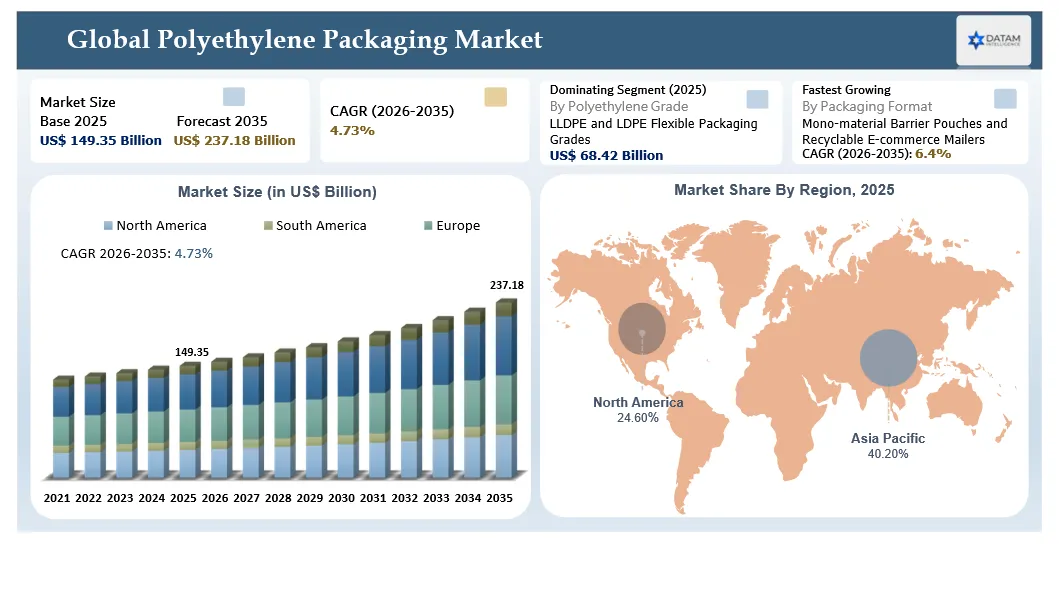
Packaging remains one of the largest resin end markets in North America. The American Chemistry Council’s 2026 Resin Review covers production and sales data through 2025 and continues to identify packaging as a major destination for thermoplastics. U.S. production of major plastic resins reached 9.3 billion pounds in May 2026, up 12.7% from May 2025, while year-to-date production reached 44.5 billion pounds. This supply growth can improve availability for converters, although regional outages, feedstock shifts and export demand can still create short-term price pressure. The market therefore combines structural volume growth with cyclical procurement risk.
Regulation is changing the value proposition. The EU Packaging and Packaging Waste Regulation entered into force in February 2025 and generally begins applying from mid-2026. It introduces mandatory recyclability by 2030, recycled-content requirements for plastic packaging and measures to reduce excessive packaging. These rules make mono-material PE structures, recycled content, label and adhesive compatibility, barrier redesign and traceable mass-balance feedstocks commercially important. RecyClass updated its design-for-recycling guidance for HDPE rigid packaging and PE flexible packaging in 2025, including guidance for barriers, inks, laminating adhesives and small flexible formats.
Recycling remains a constraint and an investment opportunity. The Association of Plastic Recyclers reported that at least 5.1 billion pounds of post-consumer plastic generated in the U.S. were recovered for recycling in 2024, an increase of 114.9 million pounds from 2022. Film recovery improved, yet bottle recovery weakened, highlighting different collection economics across PE formats. The U.S. Environmental Protection Agency reports that HDPE is accepted by a majority of state and territory recycling programs, while film collection remains more fragmented. Buyers need format-specific evidence rather than a general recyclability claim.
Market Snapshot
| Metric | Details |
|---|---|
| 2025 Market Size | US$ 149.35 billion |
| 2035 Market Size | US$ 237.18 billion |
| CAGR 2026-2035 | 4.73% |
| Largest Region | Asia-Pacific |
| Fastest Growing Region | Asia-Pacific |
| Largest Grade | LLDPE and LDPE flexible packaging grades |
| Fastest Growing Grade | Recycled and specialty metallocene polyethylene |
| Largest Format | Films, wraps, bags and pouches |
| Fastest Growing Format | Mono-material barrier pouches and recyclable e-commerce mailers |
Polyethylene Packaging Market Key Takeaways
- The market is estimated at US$ 149.35 billion in 2025 and is projected to reach US$ 237.18 billion by 2035, supported by packaged food, healthcare, e-commerce and industrial logistics.
- Asia-Pacific is the largest regional market because it combines high polyethylene output, dense converting capacity, large food and consumer-goods industries, export packaging and rapid retail modernization.
- Flexible films remain the largest format because they offer low package weight and strong product-to-package efficiency, although collection and sorting remain weaker than for HDPE bottles and rigid containers.
- HDPE remains central to rigid packaging, while LLDPE and metallocene grades gain value through downgauging, puncture resistance and high-speed sealing.
- Mono-material PE packaging is gaining specification weight as brand owners simplify structures that previously combined PE with PET, polyamide, aluminium or other incompatible layers.
- Food-grade recycled polyethylene remains constrained by feedstock quality, odor, color, migration control and regulatory approval, creating a premium opportunity for closed-loop supply chains.
- The EU PPWR will generally apply from mid-2026 and requires recyclability by 2030, raising investment in design verification, recycled-content traceability and package redesign.
- U.S. major plastic resin production reached 9.3 billion pounds in May 2026 and was 12.7% above the same month in 2025, demonstrating continued supply-side expansion despite cyclical industry conditions.
- At least 5.1 billion pounds of post-consumer plastic were recovered for recycling in the U.S. during 2024, although collection performance differs materially between bottles, rigid containers and films.
- RecyClass updates in 2025 expanded guidance for HDPE rigid packaging and PE flexibles, including barriers, inks, labels and laminating adhesives, making component compatibility a procurement requirement.
Polyethylene Packaging Market Scope
| Scope Item | Coverage |
|---|---|
| By Grade | HDPE, LDPE, LLDPE, metallocene and specialty PE, recycled PE, bio-attributed and renewable PE |
| By Format | Films, wraps, bags, pouches, bottles, jars, caps, closures, drums, liners, foams, crates and reusable transport packaging |
| By Process | Blown film, cast film, extrusion coating, blow molding, injection molding, rotational molding and foam extrusion |
| By Application | Primary, secondary, tertiary, aseptic, sterile, temperature-controlled, retail-ready and e-commerce packaging |
| By End Use | Food and beverages, healthcare, household and personal care, industrial and chemical, retail, agriculture, electronics and construction products |
| By Sustainability Position | Virgin, PCR, PIR, bio-attributed, reusable and design-for-recycling mono-material PE |
| By Region | North America, Europe, Asia-Pacific, South America, Middle East and Africa |
Why does this report matter in 2026?
In 2026, polyethylene packaging decisions are being made under conflicting pressures. Brand owners need thinner packages and lower carbon intensity, while operations teams need stronger seals, longer shelf life and reliable filling-line performance. Regulators are introducing recyclability and recycled-content requirements, while procurement teams face volatile feedstock, energy and logistics costs. Recycled resin availability is improving in selected streams, yet food-contact grades and natural-color material remain constrained. These conditions make grade selection, package design, supplier qualification and contract structure strategic decisions rather than routine material purchases.
The report helps resin producers identify which grades need additional capacity, helps converters prioritize equipment and coating investments, helps brand owners understand where mono-material conversion is practical and helps recyclers identify premium feedstock pools. It also supports investors screening mechanical recycling, advanced recycling, digital printing, reusable transport packaging, barrier coatings and high-performance film platforms. The analysis connects resin economics with package performance and regulatory readiness so users can evaluate total commercial value rather than resin price alone.
White Space and Investment Opportunities
- Mono-material PE barrier films for meat, cheese, pet food, coffee, medical products and other applications that currently depend on multi-polymer laminates.
- Food-grade recycled HDPE and LDPE platforms supported by closed-loop collection, decontamination, odor control and traceability.
- Film collection, optical sorting, wash-line modernization and compatibilizer systems that improve the yield and quality of recycled PE.
- Reusable crates, pallets, totes and transport liners linked to pooling, tracking and reverse-logistics services.
- Digital print platforms for short-run pouches, e-commerce mailers, healthcare labels and variable-data packaging.
- Low-seal-temperature, high-puncture metallocene films that allow downgauging without increasing breakage or line disruption.
- Bio-attributed and renewable polyethylene supported by certified mass-balance feedstocks for brand owners seeking lower fossil exposure.
- Design verification, testing and compliance services covering PPWR, food-contact rules, recycled content and recyclability claims.
Polyethylene Packaging Future Market Transformation
The market will move from volume-led resin procurement toward performance and circularity platforms. Conventional grades will remain essential, yet the fastest value creation will occur where suppliers combine resin design, package engineering, recycled feedstocks, processing support and compliance evidence. Flexible packaging will increasingly use all-PE structures with machine-direction oriented film, sealant layers and compatible coatings. Rigid packaging will increase recycled content where color, odor and regulatory requirements permit. Reusable transport packaging will expand in closed industrial and retail loops where asset tracking and return logistics can be controlled.
Manufacturing will become more data-driven. Film lines will use automated gauge control, machine-vision inspection and predictive maintenance to reduce scrap. Converters will simulate seal windows, drop performance and barrier requirements before commercial trials. Recyclers will use optical sorting, digital watermarks and AI classification to improve bale quality. Procurement will increasingly request certificates for recycled content, chain of custody, food-contact compliance and carbon intensity. Companies that provide this information in a consistent digital format will shorten qualification and improve renewal rates.
Polyethylene Packaging Buyer Decision-Making Criteria
Buyers evaluate polyethylene packaging through a combination of performance, conversion economics, compliance and supply risk. Flexible-packaging buyers prioritize seal initiation temperature, hot tack, dart impact, puncture resistance, optical properties, coefficient of friction, gauge consistency and machinability. Rigid-packaging buyers prioritize environmental stress-crack resistance, top-load strength, drop performance, chemical resistance, cap torque, dimensional stability and compatibility with filling and closure systems. Food and healthcare customers add migration, extractables, sterility and traceability requirements.
Procurement teams compare total delivered cost rather than nominal resin price. A lower-cost grade can become expensive if it requires greater thickness, reduces line speed or increases leakage and damage. Recycled content can reduce compliance exposure yet create odor, color and consistency challenges. Mono-material redesign can improve recyclability yet require barrier coatings, tie layers or new equipment. The best suppliers support qualification trials, provide multi-region supply, maintain consistent specifications and document sustainability claims. Buyer preference is strongest where technical support and supply assurance reduce the risk of package failure.
Polyethylene Packaging Economic and Investment Analysis
Polyethylene packaging is attractive because it is tied to essential product protection across food, healthcare, household products and industrial logistics. Demand is resilient, although margins can be cyclical because resin supply responds to large petrochemical investments and global trade. New capacity can lower resin prices and support converter growth, while outages and feedstock inflation can quickly tighten availability. The 2026 rise in U.S. major resin production shows that supply expansion can occur even during uneven converter demand. Investors therefore need to distinguish between commodity resin exposure and differentiated packaging platforms with qualification barriers, specialty performance or closed-loop feedstock access.
Capital is moving into high-output film lines, multilayer blown-film equipment configured for mono-material PE, machine-direction orientation, digital printing, recycling wash lines, deodorization, decontamination, optical sorting and reusable packaging pools. Attractive targets typically have long customer relationships, proprietary formulations, food-contact capability, high line utilization and access to stable feedstock. Risk is higher in undifferentiated film capacity with weak contracts, exposure to one resin benchmark and limited ability to pass through costs. Regional logistics also matter because bulky converted packaging is expensive to transport over long distances.
Strategic Indicators for Polyethylene Packaging Market
High Regulation Impact
Recyclability, recycled-content, EPR and food-contact rules directly affect package design, supplier documentation and customer qualification.
High Investment Activity
Investment is concentrated in mono-material films, recycled PE, film collection, advanced sorting, digital printing and reusable transport packaging.
Supply Chain Exposure
The market depends on ethylene, crackers, polymer plants, additives, energy, transport and converter operating rates. Outages can affect contract availability.
Pricing Volatility
PE pricing follows feedstock, operating rates, exports and inventory. Converter contracts increasingly use formula-based adjustment mechanisms.
Procurement Pressure
Customers demand downgauging, recycled content, lower emissions and stable quality while resisting package-cost increases.
New Technology Adoption
MDO films, high-performance sealants, barrier coatings, AI inspection and advanced recycling are moving into commercial qualification.
Regional Expansion Opportunity
Asia-Pacific offers volume growth, North America offers feedstock advantage, Europe leads regulation-led redesign and the Middle East expands export-oriented resin capacity.
Government Policy Support
EPR, recycled-content mandates and recycling infrastructure programs can create demand for recycled PE and local collection capacity.
Pricing Intelligence
| Pricing Factor | Buyer Impact | Strategic Interpretation |
|---|---|---|
| Ethylene and feedstock | Moves virgin PE contract and spot pricing | Use indexed contracts, alternative grades and inventory discipline |
| Plant operating rates | Changes availability and lead times | Qualify multiple suppliers and monitor maintenance schedules |
| Recycled feedstock quality | Creates premiums for natural and food-grade material | Secure closed-loop contracts and quality specifications |
| Freight and regional balance | Creates geographic price spreads | Local conversion and regional warehouses can protect service |
| Package downgauging | Reduces resin per unit but increases formulation requirements | Evaluate total system savings and failure risk |
| Compliance documentation | Adds testing and traceability cost | Premiums are defensible where documentation reduces buyer risk |
AI Impact Analysis of Polyethylene Packaging Market
AI is entering polyethylene packaging through formulation design, process control, inspection, forecasting and recycling. Resin and additive suppliers can model stiffness, toughness, sealability and optical performance before physical trials. Film converters can use machine learning to stabilize bubble geometry, gauge profile, cooling and winding. Vision systems can detect gels, holes, print defects, contamination and seal problems at line speed. Packaging buyers can connect defect data with filling-line conditions and logistics damage to identify the true source of failure.
Recycling creates another high-value use case. AI-supported optical sorting can distinguish natural HDPE, colored HDPE, LDPE film and contaminating polymers more accurately than manual sorting. Digital watermark and tracer systems can provide product-level information where sorting infrastructure supports them. Demand forecasting can help converters manage resin purchases and reduce inventory exposure. The most practical near-term opportunities are inspection, predictive maintenance, yield optimization and bale-quality improvement because these uses have measurable cost and quality outcomes.
Disruption Analysis of Polyethylene Packaging Market
The market is being disrupted by mono-material design, circular feedstocks and service-based packaging models. Mono-material PE structures challenge conventional laminates by combining oriented PE, sealant layers and compatible barriers. Recycled PE changes sourcing because converters need consistent feedstock, odor control and traceability. Reusable transport packaging changes revenue from one-time unit sales toward pooling, tracking and maintenance. E-commerce changes package dimensions and damage profiles, increasing demand for mailers, protective films and right-sized packaging.
Disruption also comes from regional policy divergence. Europe is moving rapidly toward harmonized recyclability and recycled-content rules. U.S. requirements remain state-led, with different EPR and recycled-content frameworks. Emerging markets may prioritize collection and affordability before high recycled-content targets. Suppliers need modular product portfolios that can meet different local requirements. Companies that treat all-PE structures as a simple material substitution may underestimate the need for line trials, barrier validation and recycling compatibility testing.
Polyethylene Packaging Market BCG Matrix: Company Evaluation
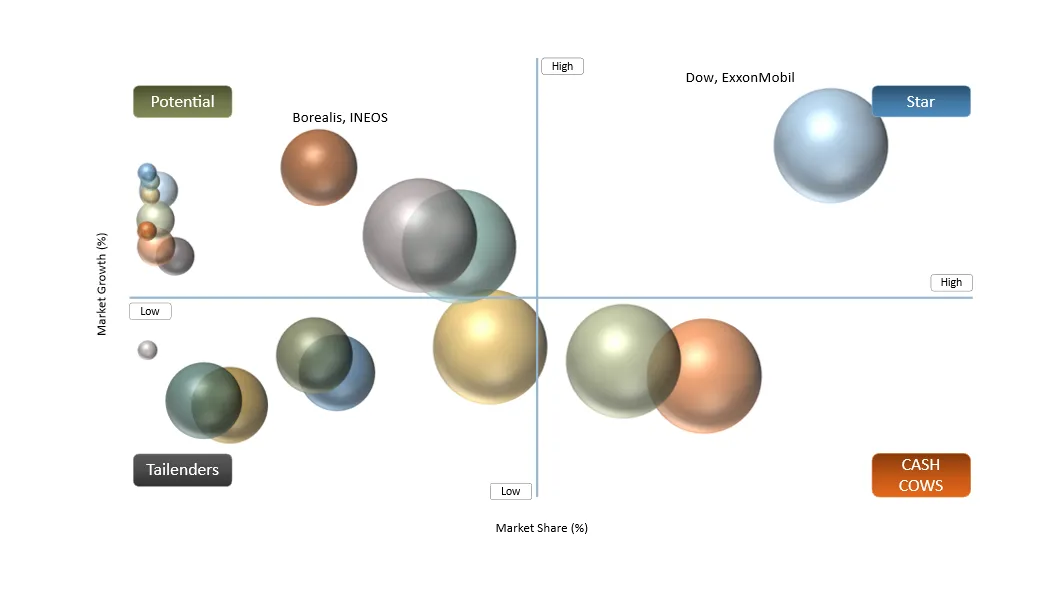
STAR
The Polyethylene Packaging Market Star quadrant includes Dow, ExxonMobil, LyondellBasell, SABIC, Amcor, Berry Global and ALPLA, which possess a diverse range of polyethylene resins, manufacturing facilities around the world, investment in recycled mono-materials packaging solutions and ties with renowned consumer goods and health-care brands. The companies are leveraging rising demand for environmentally friendly and high-quality polyethylene packaging.
POTENTIAL
Companies such as Borealis, INEOS, Chevron Phillips Chemical, Braskem, Formosa Plastics, Mitsui Chemicals, Prime Polymer, SCG Chemicals, Reliance Industries, Sealed Air, Coveris, Constantia Flexibles and Novolex fall into the Potential quadrant because of their developing capabilities in circular polyethylene, recycled polyethylene packaging and specialty PE products. Their growing focus on sustainable packaging innovations, regional market development and collaborations puts them in an ideal position to benefit from future growth opportunities in the recyclable and bio-based polyethylene packaging markets.
Polyethylene Packaging Market Dynamics
Driver Impact Analysis
| Driver | Growth Impact | Demand Concentration | Impacted Use Case | Strategic Impact |
|---|---|---|---|---|
Packaged food, healthcare and household consumption | 27% | Global, Asia-Pacific | Films, bottles and closures | Supports recurring essential demand and qualification-led supply |
E-commerce and logistics expansion | 20% | North America, Europe, Asia-Pacific | Mailers, stretch film and protective packaging | Raises demand for lightweight damage prevention and right-sizing |
Mono-material and recyclability conversion | 19% | Europe, global brands | PE pouches and films | Creates redesign, barrier and testing opportunities |
Recycled-content procurement | 17% | Europe, North America | PCR bottles, films and liners | Supports premium recycled feedstock and closed-loop systems |
Downgauging and performance grades | 14% | Global converters | Metallocene films and oriented PE | Reduces material use while increasing value per kilogram |
Driver: Growth in Essential Packaged Goods and Logistics
Food, healthcare, household products and industrial supplies provide a broad recurring demand base for polyethylene packaging. PE films protect dry foods, frozen foods, meat, cheese, produce and bakery products. HDPE bottles package milk, detergents, personal-care products, pharmaceuticals and industrial chemicals. E-commerce increases the use of mailers, air pillows, stretch wrap, shrink film and protective liners. These applications are sensitive to leakage, moisture, puncture and transport damage, which makes package performance commercially important. Buyers can justify higher-performance grades when downgauging or damage reduction offsets the resin premium.
The demand driver is supported by changes in distribution. Retailers are increasing case-ready and shelf-ready packaging, manufacturers are shipping more mixed loads and direct-to-consumer orders require packages that perform without store-level handling. Healthcare systems need traceable packaging with consistent barrier and seal performance. Industrial users need liners and drums that resist chemicals and rough logistics. These use cases support volume, while specialty grades capture higher value through seal windows, toughness and stiffness. Suppliers should connect each driver to a measurable buyer outcome such as fewer leaks, lower material use or reduced freight damage.
Driver: Circular Packaging Regulation and Mono-material Conversion
Regulation is accelerating redesign toward recyclable and recycled-content packaging. The EU PPWR generally applies from mid-2026 and introduces recyclability requirements for 2030. It also establishes minimum recycled-content requirements for plastic packaging categories and measures to reduce unnecessary packaging. RecyClass updated guidelines for HDPE rigid packaging and PE flexibles in 2025, including barriers, labels, inks and laminating adhesives. These rules affect the entire package system. A PE substrate can lose recyclability when combined with incompatible decoration, adhesives, closures or barrier layers.
The investable trend is the creation of all-PE structures that preserve product protection. Suppliers are developing oriented PE films, low-temperature sealants, compatible coatings and high-barrier layers. Converters need new film orientation, coating, printing and pouch-making capability. Testing companies need to validate sortability and recycling behavior. Recyclers need stable demand for high-quality output. Brand owners need traceability and evidence for regulatory claims. The driver therefore creates spending across resin, machinery, coatings, certification and recycling rather than only increasing polymer volume.
Restraint Impact Analysis
| Restraint | Drag on Growth | Primary Impact Area | Impacted Use Case | Strategic Impact |
|---|---|---|---|---|
| Virgin resin price volatility | 20% | Converter margins | Films, bottles and closures | Creates contract pass-through disputes and inventory risk |
| Weak film collection and sorting | 19% | Circular supply | Flexible packaging | Limits PCR availability and credible recyclability outcomes |
| Food-contact recycled resin constraints | 16% | Premium applications | Food, healthcare and personal care | Restricts recycled content where contamination control is critical |
| Multi-layer performance dependence | 14% | Package redesign | High-barrier pouches | Can slow mono-material conversion and increase trial cost |
| Capacity cycles and regional oversupply | 11% | Resin economics | Commodity grades | Compresses margins and delays investment decisions |
Restraint: Polyethylene Price Volatility and Converter Margin Pressure
Polyethylene converters purchase resin in large volumes while selling finished packaging under contracts that may adjust with a lag. When ethylene, energy, freight or operating rates change quickly, converters can experience margin compression. The challenge is strongest in commodity films and bottles where buyers compare suppliers frequently and qualification barriers are limited. New global PE capacity can reduce resin prices and support demand, yet it can also create regional oversupply and pressure producer margins. Plant outages can produce the opposite effect by tightening specific grades and extending lead times.
Companies respond through indexed contracts, formula-based pass-through, diversified suppliers and inventory discipline. Specialty converters can defend margins through proprietary films, printing, barrier performance and application support. Buyers should evaluate financial resilience because a low-priced supplier can become unreliable during a volatile cycle. Investors should distinguish between converters with contract protection and those exposed to daily spot resin. Pricing intelligence must include feedstock, capacity utilization, freight, export demand and converter inventories rather than relying on one regional benchmark.
Restraint: Film Collection, Recycled-Resin Quality and Food-Contact Constraints
Film and flexible packaging are difficult to collect through conventional curbside systems because bags and wraps can entangle sorting equipment. Store drop-off and dedicated commercial collection capture some material, yet access and consumer participation vary. The Sustainable Packaging Coalition reported that only a portion of North American recycled-PE facilities have the capability to process film. This limits the supply of clean feedstock and can make recycled LDPE and LLDPE more expensive than virgin resin. Contamination, mixed colors, printing and multilayer structures reduce output quality.
Food-contact and healthcare applications add stricter requirements. Recycled resin must demonstrate controlled source, decontamination and migration performance. Natural-color HDPE has higher value because it can be reused in a wider range of applications, while mixed-color material is often downcycled. Odor and gels can disrupt film production. These constraints slow recycled-content adoption even where brands have targets. The opportunity lies in closed-loop collection, better sorting, deodorization, compatibilization and long-term offtake agreements. Policy can support demand, but technical quality determines whether recycled PE can replace virgin resin in a specific package.
Polyethylene Packaging Market Segmentation Analysis
By Polyethylene Grade
HDPE drive the market volume growth.
HDPE is the core rigid-packaging grade because its high stiffness, chemical resistance and environmental stress-crack performance support milk bottles, detergent containers, pharmaceutical bottles, drums, jerry cans, caps and crates. Natural HDPE streams have stronger recycling value than heavily pigmented material. Buyers evaluate top load, drop performance, wall distribution, odor, food-contact status and closure compatibility. Growth is tied to household products, healthcare, industrial chemicals and reusable transport packaging. PCR incorporation is increasing where color and odor are manageable. Suppliers with bimodal grades, consistent blow-molding performance and recycled-content compounds can defend value.
LDPE
LDPE remains important in shrink film, extrusion coating, sealant layers, squeeze bottles, lamination and specialty flexible packaging. It offers clarity, softness, processability and reliable heat sealing. Its branching structure supports melt strength and coating behavior, although mechanical strength can be lower than LLDPE. Buyers use LDPE in blends to balance optics, stiffness and sealing. Growth opportunities include recyclable all-PE laminates, low-temperature seal layers, medical packaging and high-clarity films. Recycled LDPE is gaining use in refuse sacks, construction film, shipping envelopes and non-food applications where color and odor limits are less restrictive.
LLDPE Offers Flexible Packaging Value Pool Acquisition
LLDPE is the largest flexible-packaging value pool because it provides puncture resistance, tensile strength and downgauging potential. It is used in stretch film, heavy-duty sacks, pouches, liners, food packaging and e-commerce mailers. Metallocene LLDPE expands performance through narrower molecular-weight distribution and controlled comonomer placement. Buyers prioritize dart impact, tear resistance, hot tack and line speed. The main commercial opportunity is reducing film thickness without increasing failure. This supports value-based selling because resin cost per kilogram can be higher while package cost per unit declines.
By Packaging Format
Films and Wraps are Creating new Barrier Film demand
Films and wraps are the largest format because PE provides high product protection at low package weight. Stretch film secures pallet loads, shrink film bundles beverages and consumer goods and barrier films protect food and healthcare products. The segment benefits from e-commerce, cold chain and manufacturing logistics. Collection remains a weakness, especially for household films. Growth is shifting toward thinner high-performance films, all-PE barrier structures and recycled-content industrial films. Buyers evaluate puncture, cling, shrink force, optics, sealability and machine efficiency.
By Processing Technology
Blown Film Extrusion Dominates the Production Cycle
Blown film is the dominant process for bags, shrink film, stretch film, liners and barrier structures. It offers flexibility in width and multilayer design. Modern lines use automatic gauge control, internal bubble cooling and advanced winding. Mono-material PE structures can require five, seven or more layers to balance stiffness, barrier and sealing while retaining PE compatibility. Investment is moving toward high-output lines, MDO integration and in-line quality control. Operator skill and resin consistency remain important.
By Application
Secondary and Tertiary Packaging are growing more accepting of recycled content
Secondary packaging groups primary packs through shrink film, collation film, bags and trays. It protects products during handling and supports retail presentation. Recycled content can be higher because direct product contact is limited. Downgauging and high-shrink-performance grades reduce material use. Retail-ready formats create demand for printable films and easy-open features. Buyers focus on pack stability, shrink appearance, puncture resistance and line speed.
Tertiary packaging includes stretch film, pallet covers, liners and heavy-duty sacks used through logistics networks. Demand is linked to manufacturing, warehousing, exports and e-commerce. Recycled content is increasingly accepted, especially in black or colored films. The commercial value comes from load containment and damage prevention. Suppliers can use holding-force data and transport testing to demonstrate savings. Automated wrapping systems also influence film formulation and gauge.
By End-Use Industry
Food and beverages remain the Largest End user
Food and beverages are the largest end-use industry for PE packaging. Applications include milk bottles, frozen-food bags, bread bags, produce films, meat and cheese pouches, beverage shrink film and ingredient liners. Shelf-life requirements drive barrier and seal performance. Food waste reduction can justify high-performance packaging, yet recycling rules push mono-material designs. Buyers need food-contact documentation, migration testing and consistent sensory performance. Growth is strongest in convenience foods, cold chain and emerging-market retail.
Polyethylene Packaging Market Geographical Penetration
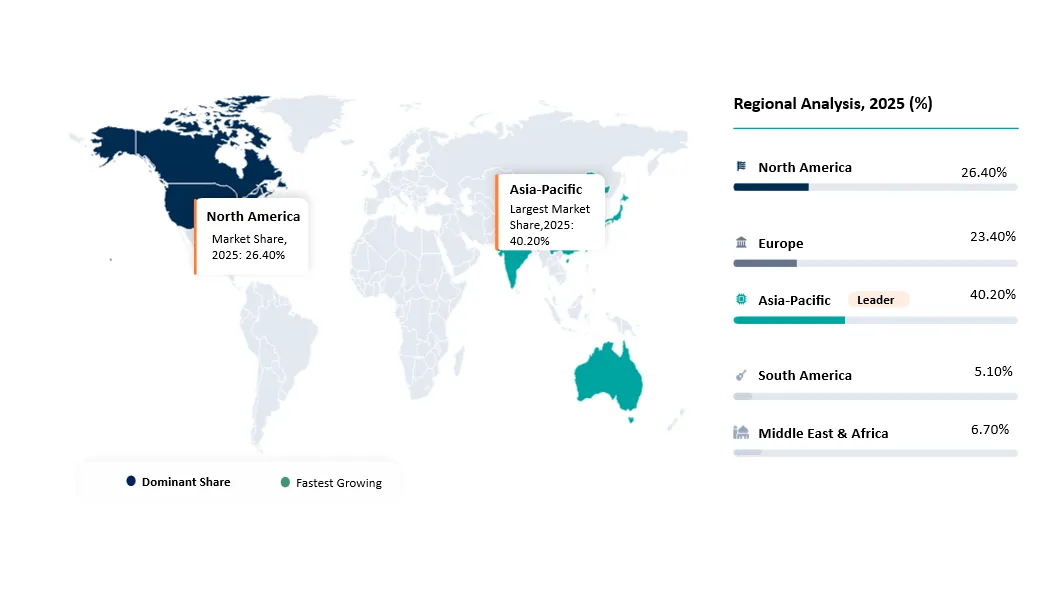
Asia-Pacific Polyethylene Packaging Market Outlook
Asia-Pacific is the largest and fastest growing market, supported by China, India, Japan, South Korea and Southeast Asia. The region combines large PE production, dense film and bottle conversion, food-processing growth, export packaging and rapid e-commerce expansion. China has broad resin and converter scale. India is adding consumer-goods, healthcare and food-packaging demand. Japan and South Korea lead high-performance films, precision packaging and recycling technology. Southeast Asia benefits from manufacturing relocation and rising packaged-food consumption. Buyers remain price sensitive, yet global exporters increasingly require documented recyclability and recycled content.
North America Polyethylene Packaging Market Outlook
North America is a large, feedstock-advantaged market with significant polyethylene production and sophisticated packaging conversion. The U.S. benefits from shale-linked ethylene economics, although capacity cycles can pressure pricing. U.S. major resin production rose strongly in May 2026, reinforcing the region’s supply position. State EPR and recycled-content policies create a fragmented regulatory environment. Canada emphasizes EPR and circular packaging, while Mexico benefits from food, beverage, automotive and nearshoring demand. Film collection and food-grade recycled PE remain key investment gaps.
Europe Polyethylene Packaging Market Outlook
Europe is the leading regulation-driven market. The PPWR entered into force in 2025 and generally applies from mid-2026, with recyclability requirements for 2030 and recycled-content obligations for plastic packaging. This accelerates mono-material PE structures, design-for-recycling testing, recycled-content traceability and package reduction. Germany, France, Italy, the UK, Spain, Poland and the Netherlands have strong converter and brand-owner ecosystems. Energy and feedstock costs can challenge regional resin economics, while policy supports recycling and circular feedstocks.
Country Opportunity Matrix
| Country | Opportunity | Buyer-Intent Insight |
|---|---|---|
| U.S. | High-performance films, HDPE bottles, PCR and e-commerce mailers | Monitor state EPR, secure food-contact PCR and use indexed resin contracts |
| Canada | EPR-compliant formats, household packaging and recycled content | Partner with stewardship systems and regional recyclers |
| Mexico | Food, beverage, automotive and nearshoring packaging | Localize conversion near manufacturing corridors |
| Germany | Mono-material pouches, PCR and compliance services | Lead with PPWR readiness and verified recyclability |
| France | Food, personal care and premium circular packaging | Emphasize design, traceability and consumer-facing claims |
| Italy | Flexible packaging, food pouches and specialty films | Use converter partnerships and MDO capability |
| China | Large-scale films, bottles, export packaging and specialty PE | Compete on scale, quality consistency and export compliance |
| India | Food, household care, pharmaceuticals and e-commerce | Build local converter networks and affordable high-performance grades |
| Japan | High-barrier films, healthcare and precision packaging | Prioritize quality, qualification and recycling compatibility |
| Brazil | Food, agriculture, renewable PE and household packaging | Connect local feedstock, converters and regional brands |
| Saudi Arabia | Resin integration, export films and industrial packaging | Link resin capacity with downstream conversion |
| South Africa | Food, beverage, mining and industrial packaging | Strengthen local distribution, recycling and technical support |
Polyethylene Packaging Market Competitive Landscape
- Resin producers compete through feedstock position, grade breadth, regional supply, technical service and circular feedstock options.
- Converters compete through film orientation, multilayer design, printing, barrier coatings, recycled-content processing, molding capability and customer qualification.
- Recyclers gain bargaining power where natural HDPE, clean commercial film or food-grade feedstock is scarce.
- Brand owners increasingly select suppliers that can provide recyclability evidence, recycled-content traceability and multi-region consistency.
- Mono-material package development is increasing partnerships between resin companies, film converters, coating suppliers, machinery companies and recyclers.
- Capacity expansion can pressure commodity margins, while specialty grades and qualified packaging systems preserve pricing power.
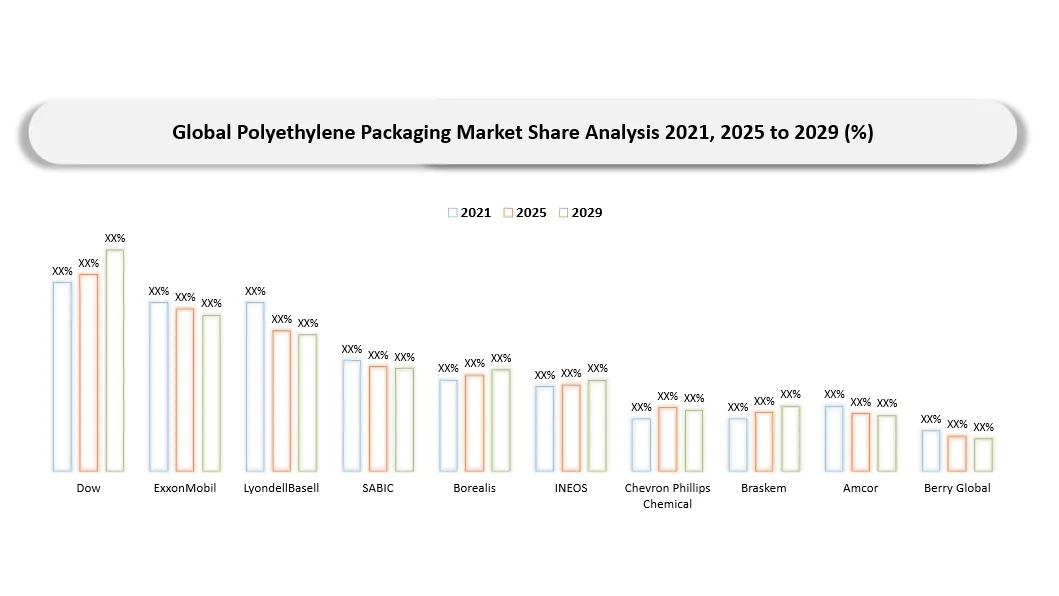
Polyethylene Packaging Market Key Companies
- Dow
- ExxonMobil
- LyondellBasell
- SABIC
- Borealis
- INEOS
- Chevron Phillips Chemical
- Braskem
- Formosa Plastics
- Mitsui Chemicals
- Prime Polymer
- SCG Chemicals
- Reliance Industries
- Amcor
- Berry Global
- Sealed Air
- ALPLA
- Coveris
- Constantia Flexibles
- Novolex
Polyethylene Packaging Market Recent Developments
- June 2026: The American Chemistry Council reported U.S. production of major plastic resins at 9.3 billion pounds in May 2026, up 12.7% from May 2025, with year-to-date production at 44.5 billion pounds.
- March 2026: The European Commission published implementation guidance for the new packaging rules, reinforcing mandatory recyclability by 2030, recycled-content requirements and packaging reduction measures.
- 2026: The ACC 2026 Resin Review expanded industry data through 2025, covering production, sales by end-use market, capacity and utilization for major thermoplastics.
- 2025: RecyClass updated design-for-recycling guidance for HDPE rigid packaging and PE flexible packaging, including barriers, printing inks, laminating adhesives and small flexible formats.
- 2025: The EU Packaging and Packaging Waste Regulation entered into force and was scheduled to generally apply from mid-2026.
- 2025: Dow disclosed startup of new polyethylene capacity directed toward packaging for food, health and hygiene applications during a weak global polymer cycle.
- 2024 data released in 2026: APR and the U.S. Plastics Pact reported at least 5.1 billion pounds of U.S. post-consumer plastic recovered for recycling, 114.9 million pounds above 2022.
- 2025: The Plastics Industry Association highlighted continued development of recycled and bio-circular polyethylene technologies and greater attention to design for recycling.
Polyethylene Packaging Market Major Pain Points
- Volatile resin pricing and contract adjustment lags that compress converter margins.
- Weak household film collection and contamination that limit recycled LDPE and LLDPE supply.
- Insufficient food-grade recycled HDPE and PE film for direct-contact applications.
- Difficulty matching oxygen, aroma and heat-resistance performance with mono-material PE structures.
- Fragmented EPR, labeling and recycled-content rules across countries and U.S. states.
- Color, odor, gels and batch variability in recycled feedstocks.
- High capital requirements for MDO lines, advanced coating, optical sorting and decontamination.
- Customer qualification cycles that delay commercialization of new grades and structures.
- Risk of green claims that are not supported by package-level recyclability testing or traceability.
- Competition from paper, PET, polypropylene, aluminium and reusable formats in selected applications.
Analyst View / Opinion on Polyethylene Packaging Market
Polyethylene will remain the largest packaging polymer family through 2035 because it combines low cost, processing versatility and strong protection. Growth will be moderate in commodity volume and faster in specialty value pools. The most attractive opportunities are mono-material barrier films, recycled-content rigid packaging, food-grade recycled PE, high-performance downgauging grades and reusable transport packaging. Regulation will shift buying from simple resin specifications toward package-level evidence. Suppliers that connect resin, conversion, recycling and documentation will capture more value than companies competing only on tonnes sold.
Polyethylene Packaging Market Target Audience
| Industry | Who Should Buy This Report? | Reason to Buy |
|---|---|---|
| Resin Producers | Strategy, product and commercial leaders | Identify grade demand, capacity priorities and converter needs |
| Packaging Converters | CEOs, plant heads, R&D and sales teams | Prioritize equipment, formats, end markets and customer qualification |
| Brand Owners | Packaging, procurement and sustainability teams | Benchmark mono-material, PCR and supplier options |
| Recyclers | Plant developers, feedstock and offtake teams | Identify premium streams, buyer requirements and regional gaps |
| Machinery Suppliers | Film, molding, printing and recycling equipment teams | Map investment opportunities and converter upgrade needs |
| Retail and E-commerce | Packaging engineering and logistics teams | Assess right-sizing, mailers, reusable systems and damage reduction |
| Investors and Consultants | Private equity, corporate development and advisory teams | Screen specialty platforms, recycling assets and consolidation targets |
Why Choose DATAM?
- Data-driven insights covering market sizing, grade demand, packaging formats, end-use requirements, pricing, regulation, recycling and company strategy.
- Post-purchase analyst support for supplier screening, regional expansion, market entry, product prioritization and client-specific questions.
- Annual updates reflecting resin capacity changes, packaging rules, recycled-content requirements, price movements and competitive developments.
- Specialized coverage of emerging markets and country-level converter opportunities rather than only global aggregates.
- Buyer-intent analysis connecting packaging requirements with qualification, procurement, compliance and investment decisions.
What DATAM Uniquely Provides
- Detailed 2025-2035 forecasts by grade, format, process, application, end use, sustainability position, sales channel and region.
- Package-level buyer criteria covering sealability, toughness, stiffness, barrier, food contact, recycled content and machine performance.
- Circularity analysis covering collection, sorting, mechanical recycling, advanced recycling, mono-material design and traceability.
- Investment screening across MDO film, food-grade PCR, reusable transport packaging, digital printing and recycling infrastructure.
- Country-level recommendations for resin producers, converters, recyclers, brand owners and investors.
Questions This Report Answers
- How will demand for HDPE, LDPE, LLDPE, specialty and recycled polyethylene packaging evolve through 2035?
- Which formats and end-use industries provide the strongest growth and pricing power?
- Where can mono-material PE replace multi-polymer structures without reducing shelf life or line performance?
- How will PPWR, EPR and recycled-content requirements change package design and supplier selection?
- Which regions offer the best combination of resin supply, conversion demand and recycling opportunity?
- Which companies are best positioned across resin, conversion, recycling and packaging services?
Where are the most attractive acquisition and capital-investment opportunities?Polyethylene Packaging Market Overview
The global Polyethylene Packaging market is estimated at US$ 149.35 billion in 2025 and is expected to reach US$ 237.18 billion by 2035, expanding at a CAGR of 4.73% during 2026-2035. Polyethylene remains the most widely used packaging polymer family because converters can tune density, molecular architecture and additives to deliver stiffness, toughness, clarity, sealability, puncture resistance and chemical resistance. HDPE supports bottles, drums, caps, closures and reusable transport packaging. LDPE and LLDPE dominate films, pouches, liners, shrink packaging, stretch wrap and sealant layers. Specialty metallocene grades support downgauging and higher abuse resistance, while recycled and bio-attributed grades create new procurement categories.
Packaging remains one of the largest resin end markets in North America. The American Chemistry Council’s 2026 Resin Review covers production and sales data through 2025 and continues to identify packaging as a major destination for thermoplastics. U.S. production of major plastic resins reached 9.3 billion pounds in May 2026, up 12.7% from May 2025, while year-to-date production reached 44.5 billion pounds. This supply growth can improve availability for converters, although regional outages, feedstock shifts and export demand can still create short-term price pressure. The market therefore combines structural volume growth with cyclical procurement risk.
Regulation is changing the value proposition. The EU Packaging and Packaging Waste Regulation entered into force in February 2025 and generally begins applying from mid-2026. It introduces mandatory recyclability by 2030, recycled-content requirements for plastic packaging and measures to reduce excessive packaging. These rules make mono-material PE structures, recycled content, label and adhesive compatibility, barrier redesign and traceable mass-balance feedstocks commercially important. RecyClass updated its design-for-recycling guidance for HDPE rigid packaging and PE flexible packaging in 2025, including guidance for barriers, inks, laminating adhesives and small flexible formats.
Recycling remains a constraint and an investment opportunity. The Association of Plastic Recyclers reported that at least 5.1 billion pounds of post-consumer plastic generated in the U.S. were recovered for recycling in 2024, an increase of 114.9 million pounds from 2022. Film recovery improved, yet bottle recovery weakened, highlighting different collection economics across PE formats. The U.S. Environmental Protection Agency reports that HDPE is accepted by a majority of state and territory recycling programs, while film collection remains more fragmented. Buyers need format-specific evidence rather than a general recyclability claim.
Market Snapshot
| Metric | Details |
|---|---|
| 2025 Market Size | US$ 149.35 billion |
| 2035 Market Size | US$ 237.18 billion |
| CAGR 2026-2035 | 4.73% |
| Largest Region | Asia-Pacific |
| Fastest Growing Region | Asia-Pacific |
| Largest Grade | LLDPE and LDPE flexible packaging grades |
| Fastest Growing Grade | Recycled and specialty metallocene polyethylene |
| Largest Format | Films, wraps, bags and pouches |
| Fastest Growing Format | Mono-material barrier pouches and recyclable e-commerce mailers |
Polyethylene Packaging Market Key Takeaways
- The market is estimated at US$ 149.35 billion in 2025 and is projected to reach US$ 237.18 billion by 2035, supported by packaged food, healthcare, e-commerce and industrial logistics.
- Asia-Pacific is the largest regional market because it combines high polyethylene output, dense converting capacity, large food and consumer-goods industries, export packaging and rapid retail modernization.
- Flexible films remain the largest format because they offer low package weight and strong product-to-package efficiency, although collection and sorting remain weaker than for HDPE bottles and rigid containers.
- HDPE remains central to rigid packaging, while LLDPE and metallocene grades gain value through downgauging, puncture resistance and high-speed sealing.
- Mono-material PE packaging is gaining specification weight as brand owners simplify structures that previously combined PE with PET, polyamide, aluminium or other incompatible layers.
- Food-grade recycled polyethylene remains constrained by feedstock quality, odor, color, migration control and regulatory approval, creating a premium opportunity for closed-loop supply chains.
- The EU PPWR will generally apply from mid-2026 and requires recyclability by 2030, raising investment in design verification, recycled-content traceability and package redesign.
- U.S. major plastic resin production reached 9.3 billion pounds in May 2026 and was 12.7% above the same month in 2025, demonstrating continued supply-side expansion despite cyclical industry conditions.
- At least 5.1 billion pounds of post-consumer plastic were recovered for recycling in the U.S. during 2024, although collection performance differs materially between bottles, rigid containers and films.
- RecyClass updates in 2025 expanded guidance for HDPE rigid packaging and PE flexibles, including barriers, inks, labels and laminating adhesives, making component compatibility a procurement requirement.
Polyethylene Packaging Market Scope
| Scope Item | Coverage |
|---|---|
| By Grade | HDPE, LDPE, LLDPE, metallocene and specialty PE, recycled PE, bio-attributed and renewable PE |
| By Format | Films, wraps, bags, pouches, bottles, jars, caps, closures, drums, liners, foams, crates and reusable transport packaging |
| By Process | Blown film, cast film, extrusion coating, blow molding, injection molding, rotational molding and foam extrusion |
| By Application | Primary, secondary, tertiary, aseptic, sterile, temperature-controlled, retail-ready and e-commerce packaging |
| By End Use | Food and beverages, healthcare, household and personal care, industrial and chemical, retail, agriculture, electronics and construction products |
| By Sustainability Position | Virgin, PCR, PIR, bio-attributed, reusable and design-for-recycling mono-material PE |
| By Region | North America, Europe, Asia-Pacific, South America, Middle East and Africa |
Why does this report matter in 2026?
In 2026, polyethylene packaging decisions are being made under conflicting pressures. Brand owners need thinner packages and lower carbon intensity, while operations teams need stronger seals, longer shelf life and reliable filling-line performance. Regulators are introducing recyclability and recycled-content requirements, while procurement teams face volatile feedstock, energy and logistics costs. Recycled resin availability is improving in selected streams, yet food-contact grades and natural-color material remain constrained. These conditions make grade selection, package design, supplier qualification and contract structure strategic decisions rather than routine material purchases.
The report helps resin producers identify which grades need additional capacity, helps converters prioritize equipment and coating investments, helps brand owners understand where mono-material conversion is practical and helps recyclers identify premium feedstock pools. It also supports investors screening mechanical recycling, advanced recycling, digital printing, reusable transport packaging, barrier coatings and high-performance film platforms. The analysis connects resin economics with package performance and regulatory readiness so users can evaluate total commercial value rather than resin price alone.
White Space and Investment Opportunities
- Mono-material PE barrier films for meat, cheese, pet food, coffee, medical products and other applications that currently depend on multi-polymer laminates.
- Food-grade recycled HDPE and LDPE platforms supported by closed-loop collection, decontamination, odor control and traceability.
- Film collection, optical sorting, wash-line modernization and compatibilizer systems that improve the yield and quality of recycled PE.
- Reusable crates, pallets, totes and transport liners linked to pooling, tracking and reverse-logistics services.
- Digital print platforms for short-run pouches, e-commerce mailers, healthcare labels and variable-data packaging.
- Low-seal-temperature, high-puncture metallocene films that allow downgauging without increasing breakage or line disruption.
- Bio-attributed and renewable polyethylene supported by certified mass-balance feedstocks for brand owners seeking lower fossil exposure.
- Design verification, testing and compliance services covering PPWR, food-contact rules, recycled content and recyclability claims.
Polyethylene Packaging Future Market Transformation
The market will move from volume-led resin procurement toward performance and circularity platforms. Conventional grades will remain essential, yet the fastest value creation will occur where suppliers combine resin design, package engineering, recycled feedstocks, processing support and compliance evidence. Flexible packaging will increasingly use all-PE structures with machine-direction oriented film, sealant layers and compatible coatings. Rigid packaging will increase recycled content where color, odor and regulatory requirements permit. Reusable transport packaging will expand in closed industrial and retail loops where asset tracking and return logistics can be controlled.
Manufacturing will become more data-driven. Film lines will use automated gauge control, machine-vision inspection and predictive maintenance to reduce scrap. Converters will simulate seal windows, drop performance and barrier requirements before commercial trials. Recyclers will use optical sorting, digital watermarks and AI classification to improve bale quality. Procurement will increasingly request certificates for recycled content, chain of custody, food-contact compliance and carbon intensity. Companies that provide this information in a consistent digital format will shorten qualification and improve renewal rates.
Polyethylene Packaging Buyer Decision-Making Criteria
Buyers evaluate polyethylene packaging through a combination of performance, conversion economics, compliance and supply risk. Flexible-packaging buyers prioritize seal initiation temperature, hot tack, dart impact, puncture resistance, optical properties, coefficient of friction, gauge consistency and machinability. Rigid-packaging buyers prioritize environmental stress-crack resistance, top-load strength, drop performance, chemical resistance, cap torque, dimensional stability and compatibility with filling and closure systems. Food and healthcare customers add migration, extractables, sterility and traceability requirements.
Procurement teams compare total delivered cost rather than nominal resin price. A lower-cost grade can become expensive if it requires greater thickness, reduces line speed or increases leakage and damage. Recycled content can reduce compliance exposure yet create odor, color and consistency challenges. Mono-material redesign can improve recyclability yet require barrier coatings, tie layers or new equipment. The best suppliers support qualification trials, provide multi-region supply, maintain consistent specifications and document sustainability claims. Buyer preference is strongest where technical support and supply assurance reduce the risk of package failure.
Polyethylene Packaging Economic and Investment Analysis
Polyethylene packaging is attractive because it is tied to essential product protection across food, healthcare, household products and industrial logistics. Demand is resilient, although margins can be cyclical because resin supply responds to large petrochemical investments and global trade. New capacity can lower resin prices and support converter growth, while outages and feedstock inflation can quickly tighten availability. The 2026 rise in U.S. major resin production shows that supply expansion can occur even during uneven converter demand. Investors therefore need to distinguish between commodity resin exposure and differentiated packaging platforms with qualification barriers, specialty performance or closed-loop feedstock access.
Capital is moving into high-output film lines, multilayer blown-film equipment configured for mono-material PE, machine-direction orientation, digital printing, recycling wash lines, deodorization, decontamination, optical sorting and reusable packaging pools. Attractive targets typically have long customer relationships, proprietary formulations, food-contact capability, high line utilization and access to stable feedstock. Risk is higher in undifferentiated film capacity with weak contracts, exposure to one resin benchmark and limited ability to pass through costs. Regional logistics also matter because bulky converted packaging is expensive to transport over long distances.
Strategic Indicators for Polyethylene Packaging Market
High Regulation Impact
Recyclability, recycled-content, EPR and food-contact rules directly affect package design, supplier documentation and customer qualification.
High Investment Activity
Investment is concentrated in mono-material films, recycled PE, film collection, advanced sorting, digital printing and reusable transport packaging.
Supply Chain Exposure
The market depends on ethylene, crackers, polymer plants, additives, energy, transport and converter operating rates. Outages can affect contract availability.
Pricing Volatility
PE pricing follows feedstock, operating rates, exports and inventory. Converter contracts increasingly use formula-based adjustment mechanisms.
Procurement Pressure
Customers demand downgauging, recycled content, lower emissions and stable quality while resisting package-cost increases.
New Technology Adoption
MDO films, high-performance sealants, barrier coatings, AI inspection and advanced recycling are moving into commercial qualification.
Regional Expansion Opportunity
Asia-Pacific offers volume growth, North America offers feedstock advantage, Europe leads regulation-led redesign and the Middle East expands export-oriented resin capacity.
Government Policy Support
EPR, recycled-content mandates and recycling infrastructure programs can create demand for recycled PE and local collection capacity.
Pricing Intelligence
| Pricing Factor | Buyer Impact | Strategic Interpretation |
|---|---|---|
| Ethylene and feedstock | Moves virgin PE contract and spot pricing | Use indexed contracts, alternative grades and inventory discipline |
| Plant operating rates | Changes availability and lead times | Qualify multiple suppliers and monitor maintenance schedules |
| Recycled feedstock quality | Creates premiums for natural and food-grade material | Secure closed-loop contracts and quality specifications |
| Freight and regional balance | Creates geographic price spreads | Local conversion and regional warehouses can protect service |
| Package downgauging | Reduces resin per unit but increases formulation requirements | Evaluate total system savings and failure risk |
| Compliance documentation | Adds testing and traceability cost | Premiums are defensible where documentation reduces buyer risk |




























































