


Knee Implant Market Definition & Overview
What is the knee implant market?
The Knee Implant Market covers prosthetic systems used to replace diseased, damaged or failed knee joint structures in total, partial and revision arthroplasty procedures. The market includes femoral components, tibial trays, polyethylene inserts, patellar components, fixation materials, instruments, robotic planning systems and enabling software linked to implant placement. Demand is concentrated in osteoarthritis, rheumatoid arthritis, trauma, obesity associated joint degeneration and revision procedures following implant wear or loosening. The market also includes procurement by hospitals, ambulatory surgery centers, specialty orthopedic centers and distributors that serve surgeons seeking durable implants, faster recovery pathways and more predictable alignment outcomes.
Knee Implant Industry Background & Evolution
Parent market background: The parent orthopedic implants market evolved from trauma fixation and basic joint reconstruction into a precision musculoskeletal platform supported by biomaterials, imaging, robotics and outpatient care models. Knee implants initially used basic metal on plastic designs for late stage arthritis patients. During the 1980s and 1990s, modular total knee systems improved sizing, fixation and survivorship.
From 2000 to 2010, minimally invasive instruments, high flexion implants and better polyethylene increased patient mobility. From 2011 to 2020, patient specific instrumentation, cementless surfaces and early robotics entered mainstream surgery. From 2021 to 2026, robotic assisted arthroplasty, 3D printed porous metals, smart planning and ambulatory care economics are reshaping procurement.
By 2035, the market is expected to shift toward connected surgical ecosystems where implant choice, digital planning, post operative monitoring and revision risk analytics are bundled into outcome based orthopedic care.
Knee Implant Market Snapshot
| Metric | Value |
| Market Name | Knee Implant Market |
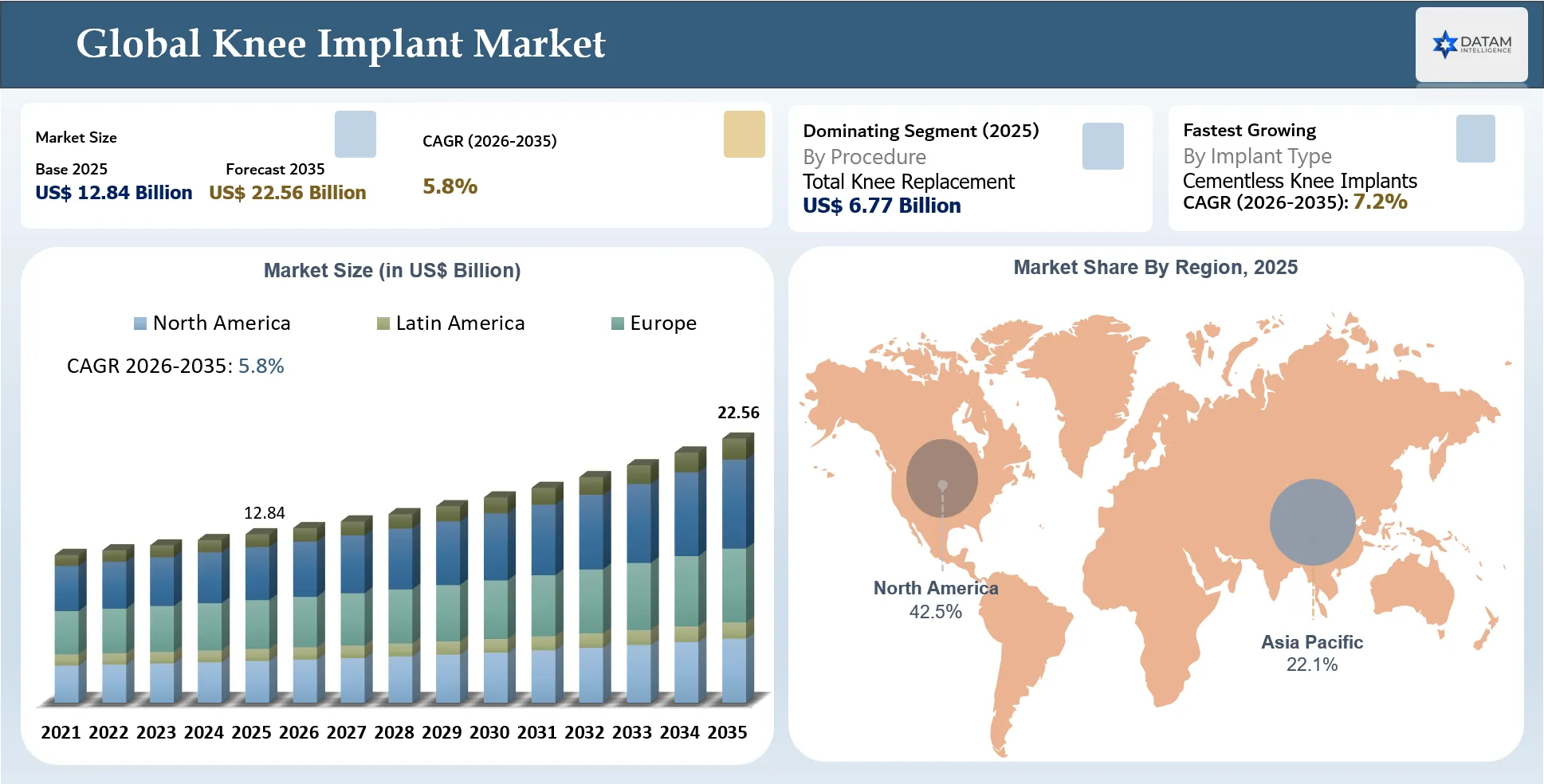
| 2025 Market Size | USD $12.84 Billion |
| 2035 Projected Market Size | USD $22.56 Billion |
| CAGR 2026 to 2035 | 5.8% |
| Largest Segment Name and Share | Total Knee Replacement - 52.7% |
| Fastest Growing Segment Name and Growth Rate | Cementless Knee Implants - 7.2% |
| Largest Region Name and Share | North America - 42.5% |
| Fastest Growing Region Name and Growth Rate | Asia Pacific - 7.4% |
| Geographic Market Share for the 5 Regions | North America: 42.5% Europe: 27.4% Asia Pacific: 22.1% Latin America: 4.8% Middle East & Africa: 3.2% |
| Top Companies | The market is led by multinational orthopedic players with broad knee implant portfolios, robotic compatibility and strong surgeon relationships. • Zimmer Biomet • Stryker • Johnson & Johnson MedTech, DePuy Synthes • Smith+Nephew • B. Braun Aesculap • Medacta • Exactech • Conformis • MicroPort Orthopedics • Waldemar Link |
Global Knee Implant Market Size & Forecast Analysis
The global knee implant market is forecast as a steady growth orthopedic reconstruction market supported by aging population, osteoarthritis prevalence, surgical backlog normalization, robotic assisted adoption and improving implant materials.
Historical Knee Implant Market Trend Analysis
During the last five years, the Knee Implant Market moved from pandemic recovery into a more technology enabled growth cycle. Procedure volumes rebounded as hospitals cleared elective surgery backlogs, while ambulatory surgery centers gained share in uncomplicated primary procedures. Robotic assisted knee arthroplasty moved from flagship academic hospitals into broader community networks because surgeons used it to reduce alignment variability and improve soft tissue balancing.
Cementless fixation gained relevance among younger, more active patients because biological fixation supports longer implant life expectations. At the same time, healthcare systems became more price sensitive, especially in China and other tender driven markets, putting pressure on commodity implant pricing. The net impact has been a bifurcated market, mature standard implants face pricing pressure, while premium robotic compatible, cementless and revision systems retain higher strategic value. The period also increased scrutiny of recalls, packaging quality and post market surveillance.
Knee Implant Growth Outlook Summary
Short term growth will be shaped by procedure backlog conversion, aging demographics and rising outpatient knee replacement capacity. Hospitals are expected to continue standardizing vendor contracts while keeping premium lines for robotic assisted cases and complex revisions.
Mid term growth will be led by cementless fixation, porous titanium, personalized alignment software and ambulatory surgery center adoption, especially in the United States, Japan, Germany and selected urban markets in Asia Pacific. Long term growth through 2035 will depend on whether manufacturers can prove better survivorship, fewer revisions and lower episode of care costs. The biggest market shift will be from implant selling toward platform selling.
Vendors that combine implants, robotics, planning software, instruments, data analytics and surgeon training will capture higher wallet share. The market outlook remains positive because osteoarthritis prevalence is structurally high, life expectancy is rising and patients increasingly expect mobility restoration. Price controls will limit growth in standardized implants, while premium differentiated portfolios should drive margin resilience.
Knee Implant Market Key Takeaways
- Total knee replacement remains the largest procedure category because end stage osteoarthritis accounts for most surgical volume
- North America remains the largest region because of high procedure rates, premium implant adoption and strong robotic penetration
- Cementless fixation is the fastest growing implant theme because younger and more active patients need longer lasting biological fixation
- Asia Pacific is the fastest growing region because China, India and Japan are expanding orthopedic capacity and aging populations are increasing demand
- Revision implants will become strategically important because older primary procedure cohorts are creating a larger pool of worn or failed implants
- Robotic compatibility is becoming a procurement differentiator, especially for hospitals seeking precision claims and marketing advantage
- Value based purchasing will force companies to support clinical data, registry evidence and post market monitoring rather than compete only on implant design
Knee Implant Market White Space & Investment Opportunities
White space opportunities are opening in revision planning, smart surgical workflows, outpatient service models and differentiated fixation systems that address unmet clinical and procurement needs.
- Bundled implant plus robotics plus analytics contracts remain underpenetrated in mid tier hospitals and can create recurring revenue through service, software and implant pull through
- Patient specific revision planning remains a major white space because complex revisions need better pre operative defect mapping, modular planning and inventory optimization
- Emerging market surgeon training networks offer investment potential because implant adoption depends on procedural confidence, local clinical champions and regional centers of excellence
Knee Implant Market Procurement & Buyer Behavior Analysis
Procurement behavior is shifting from implant unit price toward total value, including survivorship data, robotic workflow support, tray efficiency, revision coverage, supplier reliability and service capability.
Knee Implant Market Buyer Decision-Making Criteria
Hospitals and surgery centers procure knee implant systems based on clinical reliability, surgeon preference, contract economics and operational efficiency. Buyers increasingly request evidence that implants support better outcomes and lower total episode cost
- Long term survivorship and revision data
- Compatibility with robotics or navigation systems
- Availability of cemented, cementless and revision options
- Tray efficiency and sterilization simplicity
- Reliable inventory support and rapid replenishment
- Surgeon training and technical support
- Competitive pricing across bundled contracts
- Compliance with FDA, EU MDR and local medical device requirements
Knee Implant Market Buyer Decision Making Criteria
Decision making is influenced by surgeon confidence, hospital procurement committees, payer economics and patient demand for advanced procedures. Large health systems often standardize vendors to reduce cost and complexity, while surgeons influence final implant selection through clinical preference. ASCs weigh workflow speed and inventory efficiency heavily. Premium systems must justify price through evidence, robotics, marketing advantage or reduced revision risk.
Knee Implant Market Economic & Investment Analysis
Economic performance depends on demographic demand, hospital budgets, procedure capacity, inflation in medical device inputs, payer reimbursement and investment into robotics and outpatient surgery infrastructure.
Knee Implant Market Macroeconomic Impact Factors
Macroeconomic conditions influence knee implant demand through healthcare spending, patient affordability, hospital capital budgets and currency exposure. In high income markets, aging populations support durable procedure demand, yet inflation increases hospital operating costs and pressures procurement teams to negotiate lower implant prices.
Higher interest rates can slow capital purchases such as robotics, although large hospital systems continue investing when technology supports patient acquisition or workflow efficiency. In emerging markets, currency weakness raises the cost of imported implants, limiting premium adoption and favoring domestic suppliers. Public budget constraints can lengthen waiting lists, while private insurance expansion supports faster procedure conversion.
Labor shortages also affect market realization because implant demand depends on operating room capacity, anesthesia staffing and rehabilitation access. Overall, macroeconomic pressure is shifting the market toward value-based purchasing where companies must prove that premium implants and digital systems reduce revisions, improve throughput or lower total episode cost.
Knee Implant Investment Trends in the Market
Investment is shifting from standalone implant design toward robotics, cementless fixation, outpatient workflows and data backed reconstruction platforms. Capital is flowing toward technologies that improve surgical precision and support value-based care
- Robotic assisted arthroplasty platforms
- 3D printed porous implant manufacturing
- Ambulatory surgery center compatible instrument systems
- AI planning and outcomes analytics
Knee Implant Market Funding & M&A Activity
Funding and M&A focus is expected to remain centered on robotic surgery, revision planning software, additive manufacturing and orthopedic portfolio restructuring. Large companies are likely to acquire technologies that strengthen platform control, while private investors may target niche implant makers with differentiated materials
- September 2025: Exactech exited Chapter 11 bankruptcy after court approval of a sale to lenders led by Strategic Value Partners and Stellex Capital Management, reshaping ownership in joint reconstruction
- October 2025: Johnson & Johnson announced plans to separate its orthopedics business into DePuy Synthes, potentially creating a focused orthopedic growth platform
- 2025 to 2026: Investment interest remains high in surgical robotics and AI planning companies that can attach software revenue to implant procedure volumes
Knee Implant Market Regulatory & Policy Analysis
The regulatory framework for knee implants is built around medical device safety, biocompatibility, mechanical performance, clinical evidence and post market surveillance. In the United States, knee implants generally follow FDA orthopedic device pathways, often through 510(k) clearance when substantial equivalence is demonstrated. In Europe, EU MDR has raised requirements for clinical evaluation, technical documentation and post market follow up. Other markets such as Japan, China, India and Brazil require local registration and may impose pricing or tender controls. Regulatory requirements directly impact launch timelines, evidence costs and quality systems
- March 2025: EU MDR implementation continues to increase clinical evidence expectations, raising compliance cost for orthopedic manufacturers
- 2025: FDA attention to orthopedic device safety and recall communication reinforces packaging, wear and post market monitoring standards
- 2025 to 2026: China procurement reforms continue to pressure implant prices while expanding access through volume purchasing
Knee Implant Market Regulatory Framework Overview
The Knee Implant Market is regulated as a high-risk medical device category because implants remain inside the body and must perform under long term mechanical stress. Regulatory agencies require evidence on materials, wear, fixation, sterilization, packaging, labeling, manufacturing quality and clinical performance. FDA pathways in the United States emphasize safety and substantial equivalence or premarket evidence depending on design. EU MDR has strengthened clinical evaluation and post market surveillance. China, Japan, India and Brazil require local approvals and may apply tender or price controls. Regulatory compliance increasingly shapes market entry costs and competitive advantage.
Knee Implant Market Policy Impact on Market Growth
Government policy influences market growth by changing reimbursement access, procurement prices and evidence requirements. Policies that expand elective surgery access support volumes, while tender controls compress prices
- Public reimbursement reforms can increase patient access to knee replacement but may reduce implant average selling prices
- Investments in surgical capacity and ambulatory care support procedure throughput and reduce waiting lists
- Stronger post market surveillance policies favor companies with robust registry evidence and quality systems
Knee Implant Market Trends & Innovation Landscape
Innovation is moving from standalone implant geometry toward connected reconstruction platforms that combine biomaterials, robotics, preoperative planning, intra operative guidance and outcomes monitoring.
Knee Implant Key Market Trends
- Knee implant trends are being shaped by durability expectations and surgical workflow change. Hospitals want lower revision risk, faster recovery and consistent outcomes across wider surgeon groups
- Cementless fixation is gaining share as younger active patients increase demand for biological fixation and long term survivorship
- Ambulatory knee replacement is increasing demand for simplified trays, rapid recovery protocols and implants suitable for same day discharge
Knee Implant Market Technology Advancements
- Technology advancement is concentrated in robotic guidance, porous implant surfaces and digital planning. These innovations help companies defend premium pricing and build ecosystem loyalty
- March 2025: Stryker showcased next generation Mako Smart Robotics at AAOS, supporting expanded robotic adoption in knee procedures
- November 2025: Zimmer Biomet highlighted mBôs TKA and ROSA Knee enhancements, signaling a deeper shift toward semi autonomous and intelligent planning workflows
Knee Implant Industry Transformation Trends
The market is transforming from an implant replacement category into a data supported orthopedic reconstruction ecosystem. Orthopedic companies are increasingly selling workflow reliability, training, robotics, consumables and outcome evidence alongside implants. Hospitals are standardizing vendors to reduce complexity, while surgeons seek systems that support personalized alignment and faster recovery. Outpatient migration is also shifting power toward centers that prioritize turnover time and predictable logistics.
Knee Implant Market Disruption Analysis
Robotics and outpatient economics are the two most disruptive forces. Robotics changes competitive advantage from component design to ecosystem integration, while ambulatory surgery changes inventory, tray design and service expectations. Companies that lack digital planning, training infrastructure or ASC friendly logistics risk losing relevance even if their implant systems remain clinically acceptable.
Knee Implant Market Disruption & Structural Shift Analysis
The market is structurally shifting toward technology enabled reconstruction where implant systems are linked to robotics, digital planning, outpatient workflows and evidence-based procurement.
Knee Implant Market Technology Disruption Impact
- Technology disruption is visible in robotics, porous materials and digital data capture
- Robotic assisted surgery disrupts conventional instrumentation by making alignment, planning and balancing more reproducible, increasing demand for compatible implants and service ecosystems
- 3D printed porous components disrupt traditional cemented fixation by enabling biological ingrowth, premium positioning and improved appeal among younger active patients
Knee Implant Future Market Transformation
By 2035, the Knee Implant Market will be transformed by platform-based business models. Manufacturers will sell integrated systems that include implants, robotics, planning software, training, service contracts and outcome analytics. Hospitals will demand proof that premium systems reduce variability, revisions and total episode cost. Ambulatory centers will push for workflow efficiency and inventory simplification. Revision planning will become more data driven as older implant cohorts create complex replacement needs. The winning companies will control surgeon ecosystems and clinical evidence loops, while commodity suppliers will face continued price pressure in standard primary procedures.
Knee Implant Market Growth Dynamics
The market growth dynamics are shaped by aging demographics, high osteoarthritis burden, surgical technology adoption, reimbursement controls, hospital procurement discipline and stronger expectations for durable patient outcomes.
Knee Implant Market Drivers
- Aging population and osteoarthritis burden increase procedure volumes as more patients progress to end stage joint degeneration and seek mobility restoration. Market impact is strongest in North America, Japan, Western Europe and China where elderly populations are expanding quickly
- Robotic assisted knee replacement improves planning, alignment and surgeon confidence, which supports premium implant adoption and helps vendors defend price in competitive hospital tenders
- Cementless and porous metal implant adoption is rising because younger active patients need longer survivorship and lower revision risk, creating premium growth beyond standard cemented systems
Knee Implant Market Driver Impact Assessment
| Driver | Market Growth Impact (%) | Demand Concentration | Impacted Use Case | Strategic Impact |
| Aging Osteoarthritis Population | 2.20% | North America, Europe, Japan, China | Primary Total Knee Replacement | Expands procedure volumes and drives sustained demand for knee implants as the elderly population continues to grow. |
| Robotic-Assisted Arthroplasty Adoption | 1.70% | Large hospitals and premium orthopedic centers | Total Knee Replacement and Partial Knee Replacement | Accelerates adoption of premium implant systems, improves surgical precision, and strengthens long-term partnerships between hospitals and implant manufacturers. |
| Cementless Fixation Transition | 1.10% | Younger, active patients and high-volume orthopedic surgeons | Primary Knee Replacement | Supports higher-value implant adoption through improved long-term fixation, product innovation, and differentiation among manufacturers. |
Knee Implant Market Restraints
- Price pressure from tenders, value based purchasing and group purchasing organizations limits revenue growth for standard implants, particularly in hospitals where implant systems are treated as comparable commodities
- Revision risk, recalls and implant litigation increase post market scrutiny, raise quality assurance costs and can shift surgeon preference away from brands associated with failures
- Reimbursement constraints and hospital capacity shortages slow adoption in price sensitive markets where patients need surgery but public systems face budget, staffing and operating room limitations
Knee Implant Market Restraint Impact Assessment
| Restraint | Drag on Market Growth (%) | Primary Impact Area | Impacted Use Case | Strategic Impact |
| Tender-Based Price Compression | 1.50% | Hospital procurement and emerging markets | Standard Primary Knee Implants | Compresses profit margins, intensifies price competition, and encourages manufacturers to focus on premium, value-added implant portfolios. |
| Recall and Litigation Exposure | 0.90% | Quality systems and brand confidence | Primary and Revision Knee Replacement | Raises regulatory compliance and post-market surveillance costs while affecting surgeon confidence and brand preference. |
| Reimbursement and Capacity Limits | 1.20% | Public healthcare systems and lower-income markets | Elective Knee Replacement | Slows procedure volumes by limiting patient access, extending waiting lists, and constraining market expansion despite growing clinical demand. |
Emerging Knee Implant Growth Factors
Emerging growth factors are reshaping knee implants through robotics, cementless fixation, outpatient migration and data supported procurement that connects implant selection with long term outcomes.
- AI based planning and registry analytics are helping surgeons select implant size, alignment strategy and fixation method with greater precision, improving confidence in premium systems
- 3D printed porous metals are supporting better biological fixation and creating design flexibility for cementless tibial and femoral components
- Outpatient arthroplasty pathways are shifting demand toward simplified instruments, faster sterilization cycles and implants compatible with shorter procedure times
Knee Implant Market Segmentation Analysis
Market segmentation reflects how procedure type, fixation, material, end user and technology enablement influence demand, pricing, growth and supplier strategy.
Knee Implant Market by Procedure Trends
Total knee replacement remains the major procedure segment because advanced osteoarthritis commonly affects the full joint surface and requires comprehensive reconstruction. The major trend is increasing use of robotic assisted total knee replacement to improve alignment consistency and patient specific planning. Procedure volumes are heading higher as aging populations remain active for longer and expect restored mobility. Partial knee replacement will grow faster in selected patients due to tissue sparing benefits, yet total knee replacement will remain the revenue anchor because it covers the broadest eligible population and has strong surgeon familiarity.
Knee Implant Market by Fixation Trends
Cemented fixation remains the major fixation segment because it is familiar, predictable and widely reimbursed across hospitals. The major trend is rising cementless adoption driven by porous metal designs and younger patients who need longer lasting fixation. The market is headed toward more selective fixation strategies where surgeons match bone quality, age and activity level with fixation choice. Cementless systems will gain share in premium centers, while cemented systems will remain important in elderly patients and cost sensitive public tenders.
Knee Implant Market by End User Trends
Hospitals remain the major end user segment due to high case volumes, revision expertise and access to robotics. The major trend is migration of appropriate primary knee procedures to ambulatory surgery centers, supported by improved anesthesia, patient selection and rapid recovery protocols. The market is headed toward a dual channel model where hospitals retain complex cases and ASCs become important growth outlets for standardized procedures. Suppliers must support different inventory models, tray designs and commercial strategies for each setting.
Knee Implant Market Regional Analysis
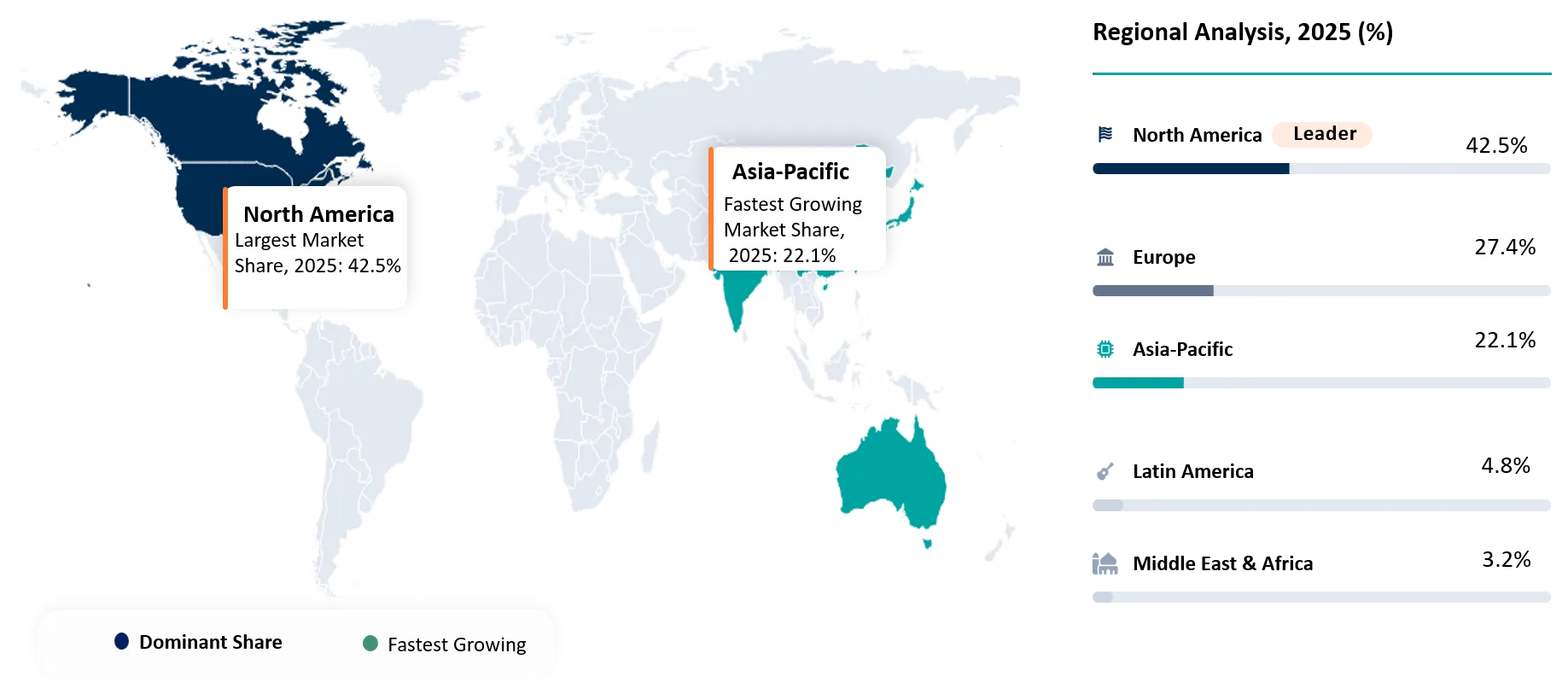
Regional market performance is driven by procedure volume, aging demographics, reimbursement access, robotic adoption, procurement policy and local orthopedic manufacturing capability.
North America Knee Implant Market
North America represents the largest Knee Implant Market because the United States has high orthopedic procedure rates, strong private insurance coverage, premium implant adoption and rapid robotic penetration. The region benefits from high surgeon specialization and a large base of ambulatory surgery centers that are increasingly performing lower risk knee replacement procedures. Demand is supported by obesity, osteoarthritis and active elderly populations seeking mobility restoration.
Production and supply remain concentrated around major multinational companies with established distribution networks, hospital contracts and surgeon education programs. The major regional shift is a move from implant based competition toward platform based purchasing, with hospitals comparing robotics, planning software, instruments, service support and implant economics together.
Price pressure still exists through group purchasing organizations, yet premium cementless and robotic compatible portfolios can defend value. Through 2035, North America will remain the benchmark market for innovation launches, clinical evidence generation and outpatient care model development.
Europe Knee Implant Market
Europe is a mature knee implant region with strong public healthcare systems, registry culture and high clinical scrutiny. Germany, France, the UK, Italy and Spain account for much of the demand because of aging populations and established orthopedic hospital networks. The region is characterized by strong adoption of high quality implants but slower premium technology uptake in some public systems due to budget controls.
EU MDR has increased regulatory documentation, clinical evidence and post market surveillance requirements, raising compliance cost for manufacturers. Demand is expected to grow steadily as waiting lists normalize and older patients seek mobility preserving surgery. Production and distribution remain supported by multinational orthopedic firms and European specialty manufacturers.
Through 2035, Europe will favor suppliers that provide proven survivorship data, efficient procurement economics and compliance strength.
Asia Pacific Knee Implant Market
Asia Pacific is the fastest growing region due to aging populations in Japan and China, increasing private hospital capacity in India and rising patient affordability across urban centers. China is shifting through tender based procurement, which reduces prices for standard implants but expands access to larger patient pools. Japan has high elderly demand and a preference for clinically proven implants, while India is becoming a volume growth market through private hospitals and medical tourism.
Production capacity is increasing as local manufacturers improve quality and multinational companies localize distribution. Robotic adoption is growing in leading hospitals, especially for premium patients. Through 2035, the region will expand strongly, although growth will vary by reimbursement, procurement policy and surgeon training availability.
Knee Implant Market: Country-Level Analysis
Country level performance depends on reimbursement, hospital capacity, surgeon training, procurement policy, patient affordability and local regulatory pathways.
United States Knee Implant Market Size/Forecast
The United States is the largest country market due to high knee replacement procedure rates, strong private payer coverage and rapid adoption of robotic assisted arthroplasty. Demand is supported by obesity, aging, sports related joint degeneration and high patient willingness to undergo elective mobility restoring procedures. Production and distribution are led by major orthopedic companies with strong surgeon relationships and hospital contracts. Ambulatory surgery centers are reshaping demand by moving lower risk procedures out of hospitals. Through 2035, growth will be driven by cementless implants, revision systems, robotics and value based care expectations that require better outcomes evidence.
Japan Knee Implant Market Size/Forecast
Japan is a high value mature market because it has one of the world’s oldest populations and a strong clinical focus on implant durability. Demand is driven by osteoarthritis, long life expectancy and patient need for mobility preservation. Hospitals generally favor clinically proven products and stable supplier relationships. Production includes local distribution partnerships with global manufacturers, while premium adoption is influenced by reimbursement rules and surgeon preference. Robotic assisted knee replacement is gaining attention in advanced hospitals. Through 2035, Japan will remain a quality focused market where survivorship data, low revision risk and elderly patient outcomes matter more than rapid volume expansion.
China Knee Implant Market Size/Forecast
China is one of the most important growth markets due to a large aging population and rising orthopedic access in urban hospitals. Demand is expanding as more patients receive diagnosis and surgical treatment for advanced osteoarthritis. However, volume based procurement has reduced prices for standard implants, reshaping supplier strategy and margins. Local manufacturers are gaining share in commodity categories, while multinational firms focus on premium products, surgeon training and complex revision cases. Robotic adoption is emerging in leading hospitals. Through 2035, China will grow strongly in volume, although revenue growth will depend on premium differentiation and procurement policy stability.
India Knee Implant Market Size/Forecast
India is a high growth market supported by urban private hospital expansion, increasing osteoarthritis prevalence and medical tourism. Demand is concentrated in metropolitan hospitals where patients can pay privately or through insurance. Production remains a mix of imported premium implants and domestic value oriented systems. Affordability is a key issue, so suppliers must balance quality, price and surgeon training. Robotic assisted knee replacement is expanding in premium hospital chains as a differentiator for patient acquisition. Through 2035, India will become more important as insurance penetration improves and middle income patients seek mobility restoring surgery earlier.
Knee Implant Market Other Key Countries
Germany Knee Implant Market: Germany is a mature orthopedic hub with high surgical standards, strong hospital capacity and emphasis on registry evidence. Growth is steady, with demand supported by elderly patients and surgeon preference for proven implants. EU MDR compliance and public procurement discipline make evidence and pricing central to supplier success.
United Kingdom Knee Implant Market: The UK market is driven by NHS procedure demand and private sector growth as waiting lists push some patients toward private care. Procurement favors evidence backed systems and value. Outpatient pathways are developing gradually, while robotic adoption is concentrated in leading public and private orthopedic centers.
Brazil Knee Implant Market: Brazil is Latin America’s largest knee implant opportunity, with demand from private hospitals, orthopedic centers and aging urban populations. Currency volatility and public system access barriers limit premium adoption. Growth will come from insurance expansion, surgeon training and better distribution coverage outside major cities.
South Korea Knee Implant Market: South Korea has advanced hospital infrastructure, high technology adoption and strong patient interest in mobility restoration. Demand is supported by aging and medical tourism. Robotic assisted arthroplasty is gaining visibility, while local and multinational suppliers compete through clinical support and surgeon education.
Australia Knee Implant Market: Australia has a mature joint replacement ecosystem, strong registry culture and a quality focused procurement environment. Demand is supported by active elderly patients and obesity related osteoarthritis. Suppliers must demonstrate survivorship, safety and cost-effectiveness, making post market evidence a key differentiator.
Knee Implant Market Competitive Landscape
The competitive landscape is concentrated among global orthopedic companies that combine implant portfolios, surgeon education, robotic platforms and hospital contracts
- Zimmer Biomet
- Stryker
- Johnson & Johnson MedTech, DePuy Synthes
- Smith+Nephew
- B. Braun Aesculap
- Medacta
- Exactech
- Conformis
- MicroPort Orthopedics
- Waldemar Link
Knee Implant Market Competitive Benchmarking
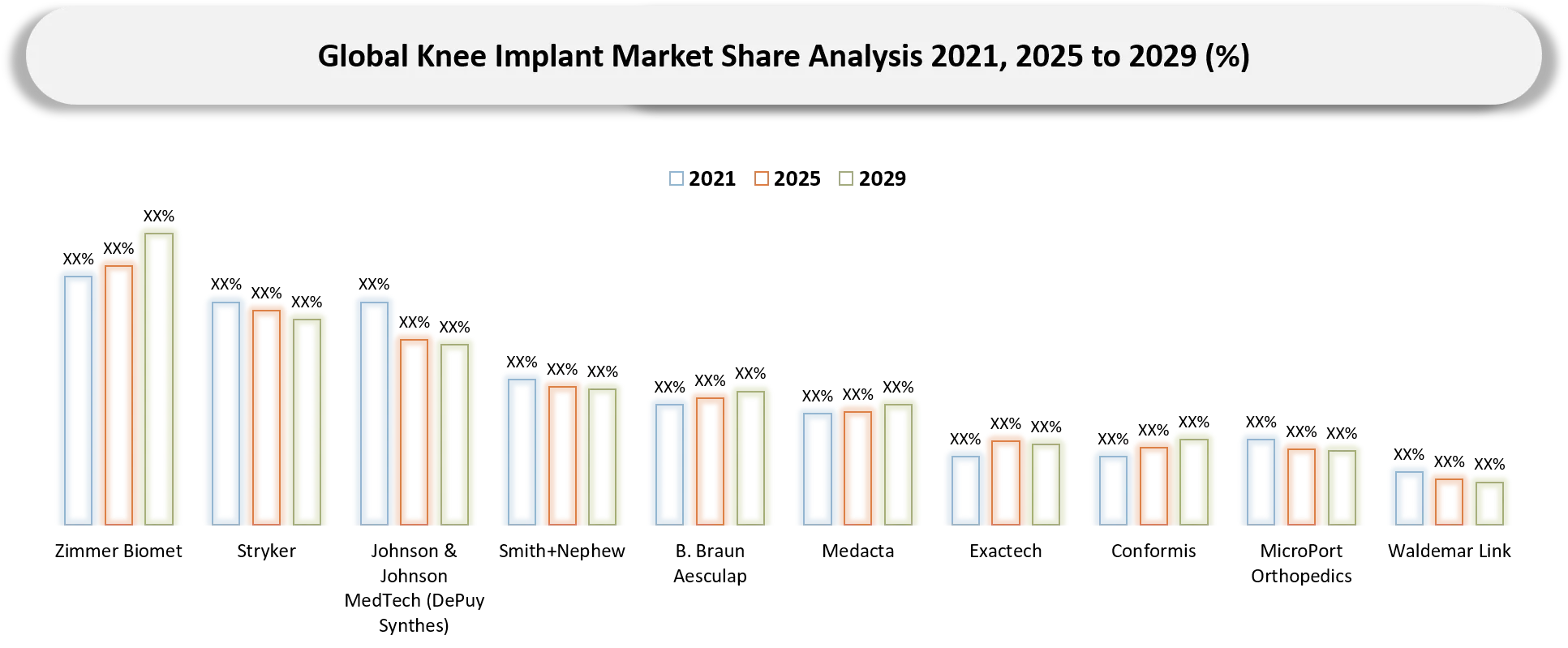
Competitive benchmarking shows that leading companies are differentiating through platform depth, robotics, fixation technology and evidence generation. Zimmer Biomet: Strong Persona knee franchise, ROSA robotics and cementless innovation support a premium reconstruction strategy focused on surgeon flexibility and personalization. Stryker: Triathlon implants and Mako SmartRobotics create a powerful ecosystem strategy focused on robotic workflow, high volume hospital penetration and premium pull through. DePuy Synthes: Attune and Velys digital surgery support a broad orthopedic strategy focused on clinical evidence, global reach and digital enabled reconstruction. Smith+Nephew: Journey, Legion and CORI robotics support a strategy focused on kinematic philosophy, ASC relevance and image agnostic robotics.
Knee Implant Market BCG Matrix List
Stars: Stryker, Zimmer Biomet
Question Marks: Smith+Nephew, Medacta
Cash Cows: DePuy Synthes, B. Braun Aesculap
Dogs: Smaller regional commodity implant suppliers, recall exposed niche manufacturers
Knee Implant Market BCG Matrix Analysis
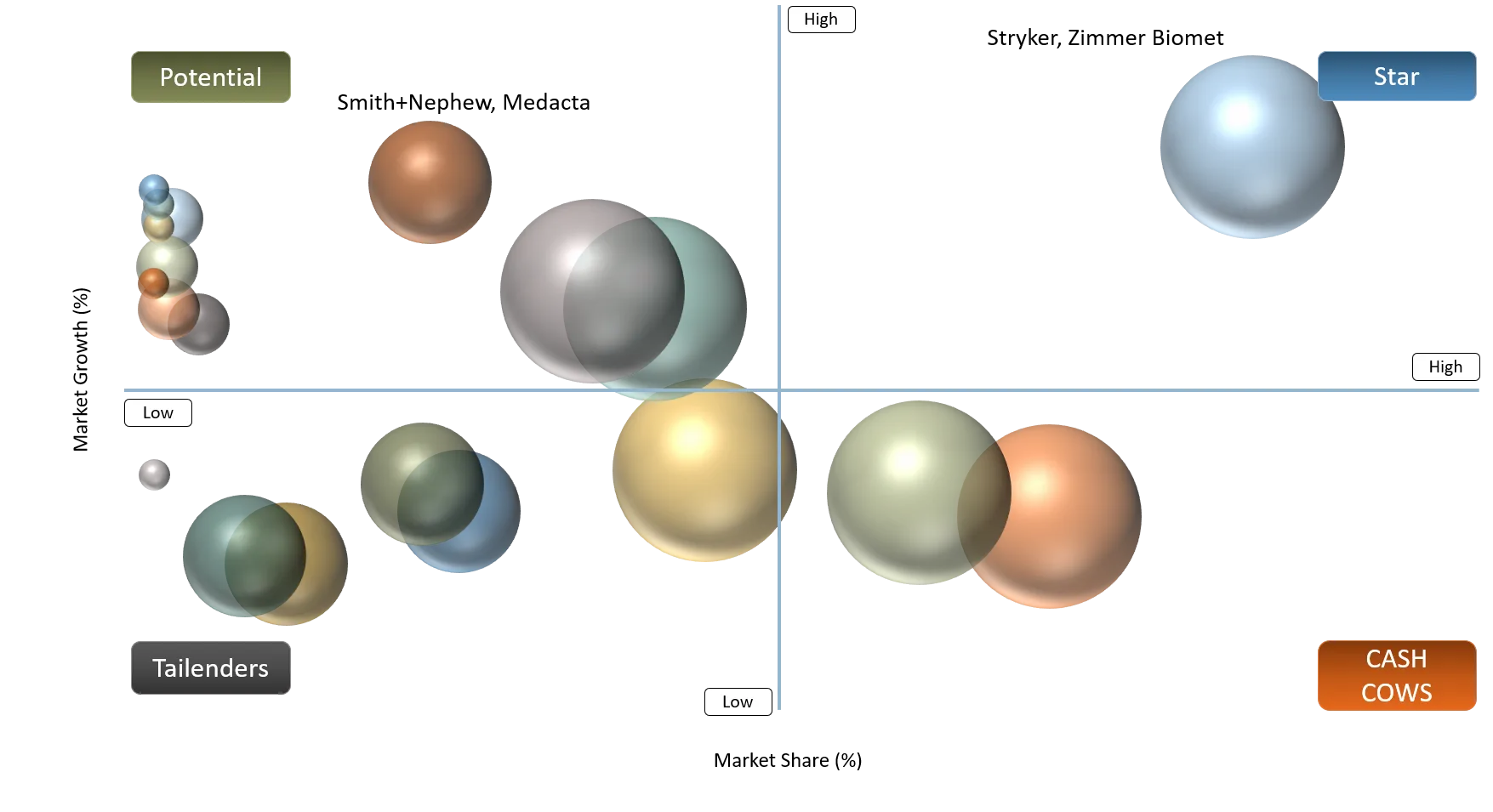
Stryker and Zimmer Biomet fit the Stars category because they combine strong market share, premium implant franchises and high growth robotic platforms. Their ability to link implants with digital planning and surgeon ecosystems gives them above average strategic momentum. Smith+Nephew and Medacta fit Question Marks because they have differentiated technologies and focused strategies but need broader scale, faster share capture and stronger execution in major markets. DePuy Synthes and B. Braun Aesculap fit Cash Cows because they have established implant portfolios, hospital relationships and dependable procedure demand, although their growth depends on how quickly they strengthen digital and robotic differentiation. Smaller regional commodity implant suppliers and recall exposed niche manufacturers fit Dogs because they often compete on price, lack platform depth and face rising regulatory, clinical evidence and quality expectations.
The matrix shows that future advantage will depend on ecosystem control rather than implant supply alone.
Knee Implant Market Company Profiles & Strategy Analysis
Major companies are competing through price discipline, premium innovation, robotic ecosystem strategies, surgeon education and global procurement reach.
Knee Implant Market Expansion & Partnership Strategy
Expansion and partnership strategies are centered on robotics, portfolio launches and corporate restructuring that can reshape competitive focus. March 2025: Stryker showcased next generation Mako SmartRobotics at AAOS, strengthening its robotic ecosystem and supporting continued implant pull through in knee replacement. The expansion reinforces Stryker’s position in premium orthopedic centers.
March 2025: Zimmer Biomet showcased Persona OsseoTi Keel Tibia and musculoskeletal innovations at AAOS, highlighting cementless growth and implant design evolution. The move supports premium adoption among surgeons treating younger active patients. October 2025: Johnson & Johnson announced plans to separate its orthopedics business into DePuy Synthes, creating a more focused reconstruction company. The change could sharpen investment priorities in knees, hips and trauma.
Knee Implant Major Industry Developments
Recent developments show that knee implant competition is becoming more technology centered, while corporate restructuring and quality events are influencing supplier strategy
- August 2026: Zimmer Biomet continued expanding its orthopedic technology portfolio, with a strong focus on robotic-assisted surgery, personalized implants and digital surgical workflows.
- August 2026: Stryker continued strengthening its Mako robotic-arm-assisted surgery ecosystem, supporting broader adoption of robotic technology across total knee and other joint-replacement procedures.
- July 2026: DePuy Synthes continued advancing its knee-reconstruction portfolio and digital/robotic-assisted surgical capabilities to improve implant positioning and procedural efficiency.
- July 2026: Smith+Nephew continued expanding adoption of its CORI Surgical System and related knee-replacement technologies, emphasizing robotic-assisted procedures and personalized surgical planning.
- June 2026: B. Braun Aesculap continued developing its orthopedic and joint-replacement portfolio, with emphasis on implant solutions and surgical technologies supporting personalized procedures.
- June 2026: Medacta continued expanding its MyKnee patient-specific technology and M.O.R.E. robotic surgery ecosystem, strengthening its position in personalized knee replacement.
- May 2026: Exactech continued rebuilding and strengthening its orthopedic implant portfolio while focusing on product development, surgeon engagement and market expansion following its restructuring activities.
- May 2026: Conformis continued focusing on customized knee implants designed around individual patient anatomy, supporting the broader shift toward personalized joint-replacement solutions.
- April 2026: MicroPort Orthopedics continued expanding its orthopedic implant and robotic-assisted surgery capabilities, with emphasis on advanced knee-replacement solutions and international market development.
- April 2026: Waldemar Link continued strengthening its knee and joint-reconstruction portfolio, focusing on implant innovation, surgeon support and expansion across international orthopedic markets.
Knee Implant Recent Market Announcements
October 2025: Johnson & Johnson announced plans to separate its orthopedics business into a standalone DePuy Synthes company. This is a major structural announcement because the orthopedic unit includes knee, hip and trauma products and has historically competed against Stryker, Zimmer Biomet and Smith+Nephew. A focused DePuy Synthes platform could increase investment discipline in reconstruction, sharpen portfolio strategy and improve commercial execution. The move may also trigger competitive responses from other orthopedic companies as they evaluate whether scale, focus or digital platform depth matters most in knee implant growth through 2035.
Knee Implant Market Technology Launches & Partnerships
Technology launches and partnerships are centered on robotic ecosystems, cementless fixation and digital surgical planning
- March 2025: Stryker showcased next generation Mako SmartRobotics at AAOS, emphasizing expanded robotic capabilities for orthopedic procedures
- March 2025: Zimmer Biomet showcased Persona OsseoTi Keel Tibia with a 3D printed porous tray, supporting cementless primary knee replacement
- November 2025: Zimmer Biomet highlighted mBôs TKA System and ROSA Knee improvements at AAHKS, signaling movement toward semi autonomous and intelligent planning workflows
Knee Implant Market Strategic Insights & Analyst Perspective
DataM Intelligence views the knee implant market as a mature but strategically attractive reconstruction market entering a new platform cycle. Traditional growth from aging and osteoarthritis remains solid, but the more important change is how revenue quality is shifting. Commodity primary knee implants face increasing price pressure from tenders and hospital standardization.
At the same time, premium segments such as robotic compatible implants, cementless fixation, porous materials and revision systems are creating differentiated growth pockets. The market is headed toward a structure where implant companies must act as procedural productivity partners. Hospitals need lower variability, shorter stays and better evidence, while surgeons need workflow support and patient specific planning.
This benefits companies with robotics, digital planning, training and broad implant portfolios. DataM Intelligence expects North America to remain the innovation and margin anchor, while Asia Pacific becomes the main volume expansion region. The critical success factor through 2035 will be the ability to link implant design with measurable outcomes, efficient care pathways and procurement value.
Companies without technology ecosystems will remain exposed to price competition, while platform leaders can capture stronger share and sustain premium positioning.
Analyst Insights of Knee Implant Market
DataM Intelligence believes the Knee Implant Market is moving from a replacement volume story to an ecosystem value story. Demand fundamentals remain favorable because osteoarthritis prevalence, obesity and aging populations are increasing the eligible patient pool. However, hospitals and payers are becoming more disciplined about implant spending, especially for standard primary procedures where products are often viewed as clinically comparable.
This creates a market where premium growth must be earned through evidence and workflow value. Robotic assisted surgery, cementless fixation and digital planning are therefore more than technology trends, they are tools for defending price and deepening customer relationships. The most attractive growth areas are revision systems, cementless primary implants and outpatient knee replacement solutions.
Asia Pacific will generate meaningful volume growth, but pricing pressure in China will require careful portfolio segmentation. North America will remain the strongest premium market due to robotic adoption and ASC migration. Europe will reward companies that can meet MDR requirements with strong survivorship evidence. From DataM Intelligence perspective, the winners will be companies that integrate implants, instrumentation, robotics, service and outcomes data into a unified value proposition.
Smaller implant only firms can still grow in niche categories, but they will face rising compliance costs, clinical evidence demands and competitive pressure from platform leaders. By 2035, market leadership will depend less on the number of implant SKUs and more on the ability to improve procedural predictability, reduce revision risk and support value based orthopedic care.
Strategic Recommendations of Knee Implant Market
Recommendation 1: Companies should prioritize integrated knee platforms rather than isolated implant launches. A competitive strategy should combine cemented, cementless and revision implants with robotic compatibility, planning software, training and inventory services. This helps suppliers defend price because hospitals can evaluate total procedural value rather than component cost.
Manufacturers should build evidence packages showing reduced alignment variability, lower revision risk, faster procedure workflow or better outpatient suitability. The strongest commercial returns will come from platform contracts that improve implant pull through and create recurring service revenue. Recommendation 2: Companies should build region specific portfolio strategies to protect margins while expanding access.
In North America, suppliers should emphasize robotics, ASC workflows and premium cementless implants. In Europe, evidence, registry performance and MDR compliance should lead messaging. In China and India, companies should separate value portfolios from premium systems, using local manufacturing, surgeon training and selective digital partnerships.
This approach avoids relying on a single global pricing model and helps protect share in tender markets while still capturing premium demand in private hospitals and advanced orthopedic centers.
Knee Implant Future Market Outlook 2035 Vision
In 2025, the Knee Implant Market is still anchored by traditional total knee replacement volumes, established implant brands and hospital based procedures. Robotics, cementless fixation and outpatient surgery are already growing, yet many procedures still use conventional instruments and standard cemented implants. By 2035, the market will look more platform driven and data supported.
Robotic assisted workflows will be more common in high volume centers, while ASCs will handle a larger portion of low risk primary procedures. Cementless and porous metal designs will capture greater share among active patients and revision systems will become more important as prior implant cohorts age. Procurement will focus on total episode value, not component price alone.
Companies will compete through integrated offerings that include implants, robotics, planning, training, service and outcomes analytics. Market growth will remain steady, but the quality of growth will favor premium, digitally enabled and evidence backed reconstruction ecosystems.
Knee Implant Market Target Audience
- Orthopedic implant manufacturers: Need market intelligence on product strategy, segment growth and competitive positioning
- Surgical robotics companies: Need insight into implant pull through, adoption barriers and hospital purchasing priorities
- Hospitals and ambulatory surgery centers: Need evidence on procurement, technology adoption and supplier benchmarking
- Distributors and channel partners: Need regional opportunity mapping and portfolio prioritization
- Private equity and strategic investors: Need visibility into premium growth areas, M&A themes and regulatory risks
- Biomaterial and additive manufacturing suppliers: Need demand outlook for porous metals, polyethylene and specialized coatings
- Payers and policy stakeholders: Need analysis of cost drivers, access trends and value based care implications
Who Should Buy this Report?
- This report is designed for stakeholders that need actionable understanding of the Knee Implant Market, including market size, growth outlook, competitive positioning, regulation, procurement and investment direction. It is especially useful for teams making portfolio, pricing, expansion or acquisition decisions
- Orthopedic device manufacturers planning knee portfolio expansion
- Surgical robotics companies building implant partnerships
- Hospitals and ASCs evaluating procurement strategy
- Investors assessing orthopedic reconstruction opportunities
- Distributors targeting regional growth markets
- Biomaterial suppliers serving implant manufacturers
- Consultants supporting market entry and pricing strategy
Why Choose DataM Intelligence?
- DataM Intelligence connects market size, share and forecast analysis with business decisions, helping clients move from information gathering to growth planning
- The report identifies premium growth pockets such as robotics, cementless fixation, revision systems and ASC workflows that can guide portfolio investment
- Competitive analysis benchmarks major players by strategy, product focus and ecosystem strength rather than relying only on company lists
- Regional and country specific market analysis helps clients prioritize where to expand, partner or localize manufacturing
- Procurement insights clarify what hospitals and surgery centers value when selecting knee implant systems
- Analyst recommendations translate market intelligence into practical actions for pricing, product positioning and strategic partnerships



























































