


Global Sjögren’s Syndrome Market: Industry Outlook
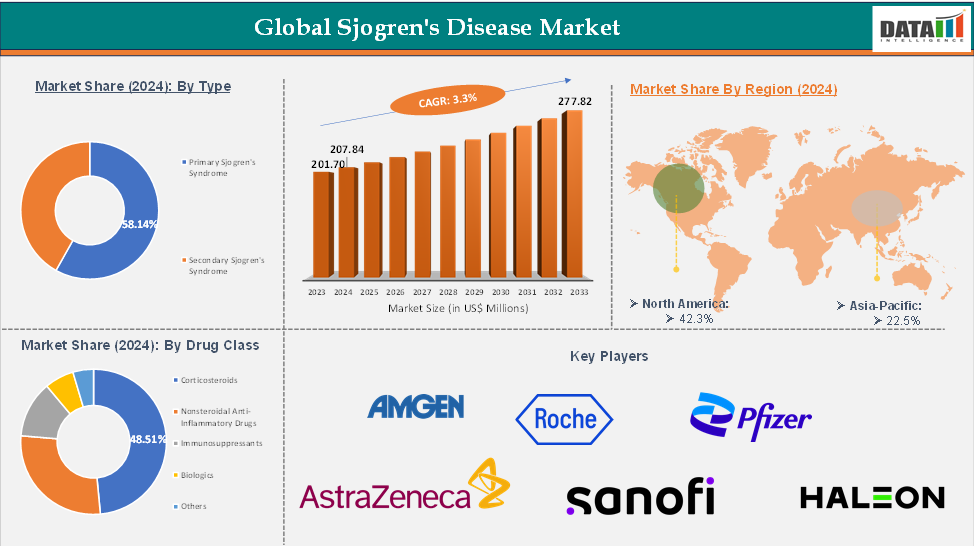
The global Sjögren’s Syndrome Market reached US$201.70 Million in 2023, with a rise of US$207.84 Million in 2024 and is expected to reach US$277.82 Million by 2033, growing at a CAGR of 3.3% during the forecast period 2025-2033, according to DataM Intelligence report.
The global Sjögren’s Syndrome Market is thriving due to increased awareness, diagnostic rates, and advancements in immunology and autoimmune disease treatments. This chronic autoimmune disorder affects the exocrine glands, causing symptoms like dry eyes, dry mouth, and fatigue. The disease is underdiagnosed due to symptom overlap and a lack of specific tests.
However, recent initiatives are improving detection. The market is supported by immunosuppressive therapies, corticosteroids, and biologics, but no curative treatment exists. Pharmaceutical companies are focusing on targeted immunotherapies and anti-inflammatory agents. As investment in rare and chronic diseases increases and regulatory bodies encourage orphan drug development, the Sjögren’s Syndrome Market is expected to expand significantly in the coming years.
Global Sjögren’s Syndrome Market: Executive Summary
Global Sjögren’s Syndrome Market Dynamics: Drivers & Restraints
Driver: Increasing autoimmune disease prevalence globally
The rise in autoimmune diseases, including Sjögren’s disease, is driving the market for autoimmune diagnostic and treatment solutions. Healthcare systems are seeing a surge in demand for these solutions, as millions worldwide are affected by disorders like systemic lupus erythematosus, rheumatoid arthritis, and multiple sclerosis. Environmental triggers, genetic predisposition, hormonal factors, and lifestyle changes contribute to the growing incidence of autoimmune conditions. As physicians conduct more comprehensive screening, Sjögren’s is being identified earlier, leading to a growing patient base and increased demand for long-term treatments and disease-modifying agents.
For instance, A study by Mayo Clinic researchers and collaborators has revealed that approximately 15 million people in the U.S. are estimated to have one or more of 105 autoimmune diseases, marking the first time such a prevalence has been reported.
Driver: Advancements in immunotherapy and biologic drugs
Advancements in immunotherapy and biologic agents are transforming the treatment of Sjögren’s disease. Traditional treatments, such as artificial tears and saliva substitutes, are based on symptomatic treatments. However, understanding autoimmune pathophysiology has led to the development of targeted therapies, such as rituximab, which modulates immune response more precisely.
Clinical trials are also exploring novel biologics and small molecules targeting specific immune pathways. These innovations represent a shift towards more effective and personalized management approaches, expected to elevate treatment standards and expand market opportunities over the next decade.
Restraint: Lack of specific diagnostic biomarkers and delayed diagnosis
The sjogren's disease market faces challenges due to the lack of definitive diagnostic biomarkers and delayed diagnosis. The disease often presents non-specific symptoms, which can be mistaken for benign conditions. Diagnostic tests like ANA, SSA/SSB antibodies, and salivary gland biopsies are not consistently conclusive, leading to underreporting and delayed treatment initiation. This uncertainty limits the eligible patient population for advanced therapies and contributes to disease progression and complications. Until more specific, accessible, and rapid diagnostic tools are developed, early detection and therapeutic intervention will remain a significant barrier to market growth.
Opportunity: Development of targeted biologics and orphan drug designations
The Sjögren's disease market is experiencing significant opportunities due to the development of targeted biologic therapies and the rise of orphan drug designations. Due to the limited availability of approved therapies and complex immune mechanisms, there is a strong unmet need for disease-modifying drugs. Pharmaceutical companies are exploring monoclonal antibodies and small-molecule inhibitors targeting B-cells, cytokine signaling, and T-cell activity. Regulatory bodies like the FDA and EMA are providing incentives for these treatments, reducing time to market and encouraging innovation in small patient populations.
For more details on this report- Request a sample.
Global Sjögren’s Syndrome Market Segment Analysis
The global Sjögren’s Syndrome Market is segmented based on type, drug class, route of administration, distribution channel, and region.
Drug Class:
The corticosteroids segment from the drug class is expected to hold 48.51% of the Sjögren’s Syndrome Market
Corticosteroids, such as prednisone, are crucial in treating Sjögren’s disease due to their anti-inflammatory and immunosuppressive properties. They are prescribed to manage systemic complications like arthritis, interstitial lung disease, vasculitis, and severe glandular inflammation. Their ability to control flare-ups and reduce immune-mediated tissue damage makes them essential in moderate to severe cases.
Their widespread availability, low cost, and physician familiarity support their continued use. In regions with limited access to biologics or advanced immunotherapies, corticosteroids remain the first-line systemic option. Clinical efforts to optimize dosing strategies and develop corticosteroid-sparing regimens sustain this segment's relevance, making corticosteroids a cornerstone in acute symptom control and broader management.
Global Sjögren’s Syndrome Market - Geographical Analysis
North America dominated the global Sjögren’s Syndrome Market with the highest share of 42.3% in 2024
North America is expected to dominate the global sjogren's disease market due to its advanced healthcare infrastructure, high disease awareness, and robust research ecosystem. The US leads in autoimmune disease diagnosis and treatment, with a high number of specialty rheumatologists and access to advanced diagnostic labs. Patient organizations like the Sjögren’s Foundation have increased awareness and patient engagement. Major pharmaceutical players, supportive regulatory environments, and partnerships between academia and the private sector drive rapid adoption of emerging therapies. The region also benefits from significant investment in personalized medicine and immunological research.
For instance, in March 2025, Johnson & Johnson received investigational nivolumab Fast Track designation from the FDA for treating adult patients with moderate-to-severe Sjögren’s disease. The therapy was previously granted Breakthrough Therapy designation in late 2018. No advanced therapies are currently approved for this disease.
Asia-Pacific is the global Sjögren’s Syndrome Market with a market share of 22.5% in 2024
The Asia-Pacific region is experiencing significant growth in the Sjögren’s Syndrome Market due to increased healthcare investment, improved diagnostic capabilities, and rising autoimmune disease incidence. Countries like China, Japan, South Korea, and India are seeing better access to specialist care and increased awareness about autoimmune disorders. Japan's rheumatology infrastructure and the growing aging population contribute to the prevalence of autoimmune conditions in the region. Pharma companies are also targeting the Asia-Pacific for clinical trials due to cost advantages and regulatory reforms. These trends are expected to significantly boost Sjögren’s diagnosis and treatment in the region over the next decade.
For instance, in December 2024, Ainos, a leading healthcare company, signed a Memorandum of Understanding (MOU) with Taiwan Tanabe Seiyaku Co., Ltd., a subsidiary of Mitsubishi Tanabe Pharma Corporation. The MOU aims to advance the manufacturing and Taiwan market promotion of Ainos' groundbreaking Sjögren’s syndrome drug, VELDONA. The partnership will allow both parties to work together to further define the partnership.
Global Sjögren’s Syndrome Market – Key Players
The key players in the Sjögren’s Syndrome Market include Amgen, F. Hoffmann-La Roche Ltd., Pfizer Inc., Haleon Group of Companies, AstraZeneca, Sanofi SA, Bristol-Myers Squibb Company, Teva Pharmaceutical Industries Ltd, Horizon Therapeutics plc, and Bausch Health Companies Inc.
Global Sjögren’s Syndrome Market – Key Developments
In April 2024, Immunovant plans to launch a potential registrational clinical trial this summer to test its treatment candidate IMVT-1402 in Sjögren’s disease patients. The company has cleared its investigational new drug application, a formal request to the FDA, and expects top-line data from the trial by 2028.
Global Sjögren’s Syndrome Market: Scope
Metrics | Details | |
CAGR | 3.3% | |
Market Size Available for Years | 2022-2033 | |
Estimation Forecast Period | 2025-2033 | |
Revenue Units | Value (US$ Mn) | |
Segments Covered | Type | Primary Sjögren’s Syndrome, Secondary Sjögren’s Syndrome |
Drug Class | Corticosteroids, Immunosuppressive agents, Monoclonal antibodies, Others | |
Route of Administration | Oral, Injectable | |
| Distribution Channel | Hospital Pharmacies, Retail Pharmacies, Online Pharmacies |
Regions Covered | North America, Europe, Asia-Pacific, South America, and the Middle East & Africa | |
DMI Insights:
The global sjogren's disease market is growing due to increased awareness, improved diagnostic practices, and advancements in autoimmune and immunological treatments. Traditional therapies like corticosteroids are still widely used, but biologic and targeted immunotherapies are reshaping the treatment landscape. North America dominates the market due to advanced healthcare infrastructure and strong research support, while the Asia-Pacific region is emerging as a key growth area. Key industry players are engaging in strategic partnerships, clinical trials, and product innovations, with companies like Immunovant progressing with promising drug candidates for Sjögren’s disease.
The global Sjögren’s Syndrome Market report delivers a detailed analysis with 67+ key tables, more than 55+ visually impactful figures, and 185 pages of expert insights, providing a complete view of the market landscape.



























































