


High-Performance Fluoropolymers Market Size
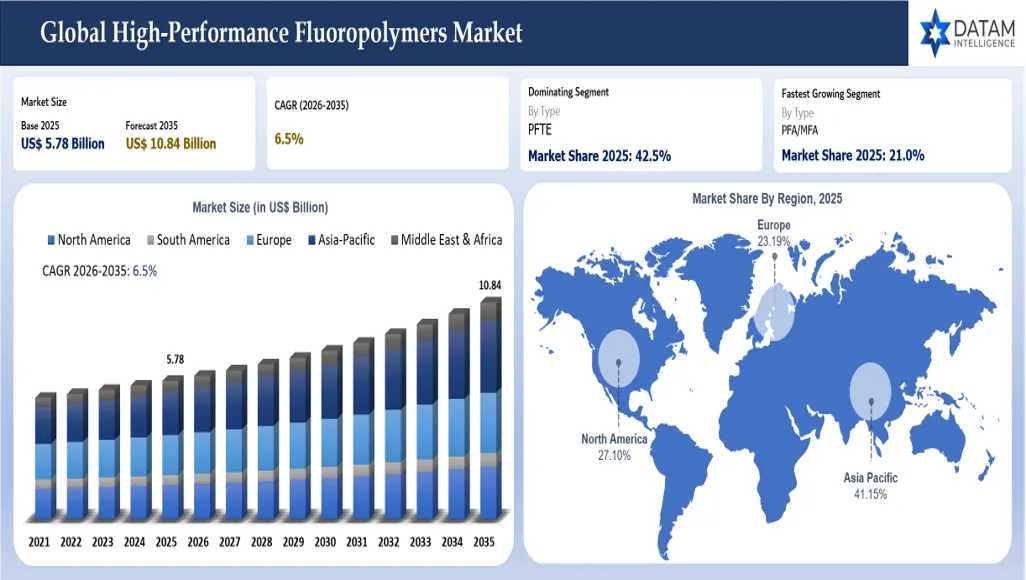
The global High-Performance Fluoropolymers market reached US$ 5.78 billion in 2025 and is expected to reach US$ 10.84 billion by 2035, growing with a CAGR of 6.5% during the forecast period 2026-2035.
Advanced Manufacturing industries are increasingly relying on high-performance fluoropolymers where durability, chemical stability, temperature resistance and electrical insulation are critical performance requirements. From aerospace systems and semiconductor equipment to automotive components and pharmaceutical processing, these specialty materials are becoming essential for applications where conventional polymers cannot meet operating conditions.
The market outlook is supported by rising demand from electronics, aerospace, automotive, chemical processing, healthcare and industrial equipment manufacturers. High-performance fluoropolymers provide advantages such as low friction, resistance to aggressive chemicals, low moisture absorption, non-flammability and long service life, making them valuable in high-reliability environments.
For industrial buyers and investors, the market represents a strategic materials opportunity where performance requirements often outweigh cost considerations. However, sustainability concerns, recycling challenges, regulatory pressure and the availability of alternative materials influence purchasing decisions and long-term adoption strategies.
High-Performance Fluoropolymers Market Key Takeaways
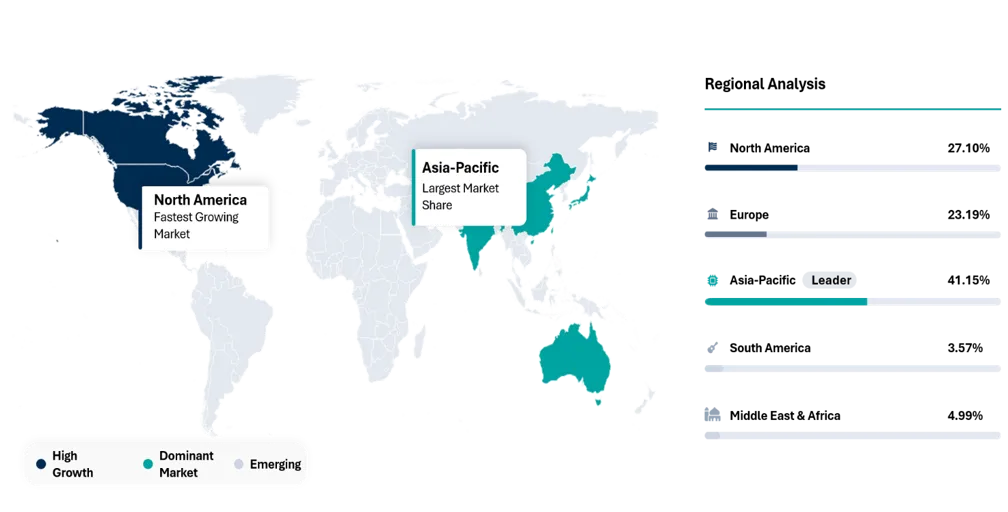
- Asia-Pacific dominates the market with a 41.5% share in 2025, supported by strong semiconductor manufacturing, electronics production, automotive manufacturing and industrial processing activities.
- Demand is being reinforced by the need for materials offering high chemical resistance, thermal stability, low friction and electrical insulation.
- PTFE remains the leading material segment, owing to its extensive industrial applications, chemical inertness, low friction and high-temperature resistance.
- Sustainability and regulatory pressures surrounding fluorinated materials are encouraging manufacturers to improve recycling, recovery and material-management practices.
- Leading High-Performance Fluoropolymers companies are competing through capacity expansion, product development, process innovation and specialized application solutions.
High-Performance Fluoropolymers Market Scope
| Metrics | Details | |
| 2025 Market Size | US$ 5.78 Billion | |
| 2035 Projected Market Size | US$ 10.84 Billion | |
| CAGR (2026-2035) | 6.5% | |
| Largest Market | North America | |
| Fastest Growing Market | Asia-Pacific | |
| By Type | PTFE, FEP, PFA/MFA, ETFE and Others | |
| By Form | Granular/Suspension, Fine Powder & Dispersion and Micropowder | |
| By Application | Coatings & Liners, Components, Films, Additives and Others | |
| By End-User | Automotive and Transportation, Aerospace and Defense, Pharmaceutical and Biotechnology, Building and Construction, Electronics and Telecommunications, Oil and Gas, Energy and Utilities and Others | |
| By Region | North America | U.S., Canada, Mexico |
| Europe | Germany, UK, Russia, France, Spain, Italy, Poland | |
| Asia-Pacific | China, India, Japan, Australia, South Korea, Indonesia, Malaysia, Singapore, Vietnam, Thailand, Philippines, Taiwan | |
| South America | Brazil, Argentina | |
| Middle East and Africa | UAE, Saudi Arabia, South Africa, Israel, Turkiye, Nigeria | |
| Report Insights Covered | Competitive Landscape Analysis, Company Profile Analysis, Market Size, Share, Growth | |
High-Performance Fluoropolymers Market White Space & Investment Opportunities
- Fluoropolymers of semiconductor grade present promising returns on investment, especially in ultra-high purity tubing, fittings, valves, seals and wafer processing products.
- The expansion of production facilities in Asia-Pacific presents possibilities for manufacturing PTFE, PFA, FEP, ETFE and specialty fluoropolymers for the electronics, automotive and industrial industries.
- EV and battery applications offer possibilities of white space in fluoropolymer insulation, seals, binders and chemical resistance parts.
- Fluoropolymer sustainability is an area of potential growth through increased recycling, recovery, waste reduction and more environmentally friendly manufacturing methods.
- Specialty grades for use in the aerospace industry, medicine, chemical processing and electronics may provide opportunities for value-added growth through their performance attributes.
High-Performance Fluoropolymers Market Buyer Decision-Making Criteria
The buyers in the high-performance fluoropolymers market judge the materials in terms of their capability of maintaining performance even when subjected to difficult chemical, thermal, mechanical and electrical situations. The choices are made according to factors such as application performance needs, material purity, processibility, consistency, compliance, availability, cost and others. In semiconductor, aerospace, pharmaceutical, automotive and chemical processing industries, customers attach more importance to performance over time, purity, chemical resistance and technical service support of the suppliers than simply cost.
Major Decision-Making Criteria
- Chemical Resistance and Compatibility
- Temperature Resistance and Thermal Stability
- Electrical Insulation and Dielectric Performance
- Material Purity and Contamination Control
- Mechanical Strength and Dimensional Stability
- Friction and Wear Resistance
- Product Quality and Batch-to-Batch Consistency
- Regulatory and Environmental Compliance
- Supply Reliability and Production Capacity
- Total Cost of Ownership
- Customization and Grade Availability
- Technical Support and Application Engineering
High-Performance Fluoropolymers Market BCG Matrix: Company Evaluation
STAR
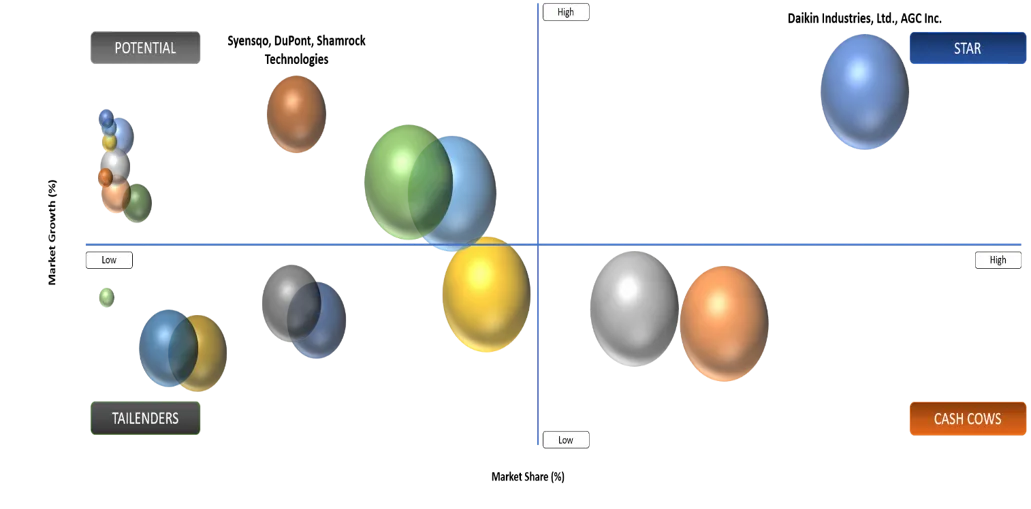
Daikin Industries, Ltd., AGC Inc. and Gujarat Fluorochemicals Limited (GFL) have excellent opportunities to benefit from the positive outlook in the Asia-Pacific region thanks to their already available fluoropolymer product ranges, their manufacturing operations in the region and their involvement in sectors such as electronics, automotive and chemical processing. The capacity to increase production volume and produce specialized grades will be beneficial for them.
POTENTIAL
Syensqo, DuPont, Shamrock Technologies, HaloPolymer, Fluorseals SpA, Hubei Everflon Polymer Co., Ltd. and Shanghai Huayi 3F New Materials Co., Ltd. stand to gain from increasing demand for specialized and application-oriented fluoropolymers. These companies can capitalize on opportunities in high purity semiconductors, coatings and liners, specialty PTFE, seals, films and automotive, aerospace, pharmaceutical, electronics and chemical processing uses of fluoropolymers.
High-Performance Fluoropolymers Market Dynamics
Driver Impact Analysis
| Driver | Market Growth Impact (%) | Demand Concentration | Impacted Use Case | Strategic Impact |
Semiconductor manufacturing expansion | 24% | Asia-Pacific, North America | Wafer processing, chemical handling, seals, tubing | High-purity fluoropolymers enable contamination control and chemical resistance in advanced fabs |
Electrification and EV component growth | 21% | Asia-Pacific, Europe | Battery systems, wire & cable, seals, thermal management | Expands demand for high-temperature and chemically resistant fluoropolymer components |
Growth in chemical processing | 19% | Asia-Pacific, North America, Europe | Linings, gaskets, valves, pipes, pumps | Supports substitution toward durable fluoropolymer components in aggressive chemical environments |
Increasing demand for high-performance materials in aerospace and electronics | 16% | North America, Europe, Asia-Pacific | Insulation, connectors, coatings, seals | Drives adoption of lightweight, electrically insulating, thermally stable fluoropolymers |
Driver: Expansion of Semiconductor and Advanced Electronics Manufacturing
The expansion of semiconductor fabrication and advanced electronics manufacturing is a major driver of the High-Performance Fluoropolymers Market. Semiconductor processing requires materials that can withstand aggressive chemicals, elevated temperatures and stringent contamination limits, increasing the use of PFA, PTFE and FEP in tubing, fittings, valves, seals, wafer-processing components and chemical-delivery systems. Growing investments in semiconductor production capacity, particularly across Asia-Pacific, are therefore creating sustained demand for high-purity fluoropolymer materials and components.
Restraint Impact Analysis
| Restraint | Drag on Market Growth (%) | Primary Impact Area | Impacted Use Case | Strategic Impact |
| Increasing PFAS regulatory scrutiny | 26% | Product compliance and material selection | Fluoropolymer manufacturing and processing | Encourages development of compliant formulations and alternative technologies |
| High production and processing costs | 21% | Material economics | High-performance components, coatings and films | Limits adoption in cost-sensitive applications and increases pressure for process optimization |
| Recycling and end-of-life challenges | 18% | Sustainability and waste management | Industrial components, liners and coated products | Drives investment in recovery, recycling and circular-material solutions |
Availability of alternative high-performance materials | 14% | Material substitution | Seals, coatings, insulation and chemical-resistant components | Intensifies competition from advanced polymers, ceramics and other engineered materials |
Restraint: Increasing Regulatory Scrutiny of PFAS and Fluorinated Materials
The rising focus on regulation and restrictions related to PFAS and other fluorine-based materials is one of the major factors restraining the High-Performance Fluoropolymers Market. The changing environmental regulations and issues with the persistence and disposal of the fluorine-based materials can lead to increased compliance expenses and risks. This can push customers to explore different options in certain applications and compel the producers of fluoropolymers to develop compliant products and implement recycling/recovery solutions which may further raise the cost of production.
High-Performance Fluoropolymers Market Geographical Penetration
U.S. High-Performance Fluoropolymers Market Landscape
Drivers behind the United States High-Performance Fluoropolymers Market include high demand from the sectors of semiconductor manufacture, aerospace and defense, chemical processing, automotive, pharmaceutical and electronics. The presence of a well-established high-tech manufacturing industry and constant investment in semiconductor manufacturing in the country has fueled the demand for high-purity PTFE, PFA, FEP and other specialty fluoropolymers used in chemical handling, seals, tubing, insulation, coatings and other components. At the same time, regulatory requirements related to PFAS and sustainability trends are impacting product development and material choices.
Japan High-Performance Fluoropolymers Market Outlook
Japan’s High-Performance Fluoropolymers market is boosted by the presence of advanced semiconductor, electronics, automotive, chemical process and precision industries in the country that need materials having high resistance to chemicals, temperature and electricity, as well as dimensional stability. Advanced material manufacturing industry and the ongoing investments in the semiconductor and advanced electronics are driving demand for PTFE, PFA, FEP, ETFE and other specialty fluoropolymers used in fluid handling, sealing applications, coatings, insulation and precision parts. On the other hand, increasing environmental regulations are pushing the Japanese manufacturers towards producing environment-friendly fluoropolymer products.
High-Performance Fluoropolymers Market Competitive Landscape
- Leading firms are building market strength through capacity expansion and localized production, especially in response to increased demands from semiconductor, electronics, automotive and chemical processing industries.
- Product diversification is another competitive approach, where firms are coming up with specialized products made from PTFE, PFA, FEP, ETFE and other fluoropolymers.
- More customized products are being made for specific applications, including those with high purity needed for semiconductors, aerospace, EVs, pharmaceutical process equipment and chemical-resistant equipment.
- Process innovation and quality improvement have become very crucial, as this will allow manufacturers to enhance material uniformity, purity, thermal performance and processing capabilities.
- Regulations and environmental concerns are dictating competition, thus leading to investment in formulation compliance, recycling and fluoropolymer lifecycle management.
Key Companies of the High-Performance Fluoropolymers Market
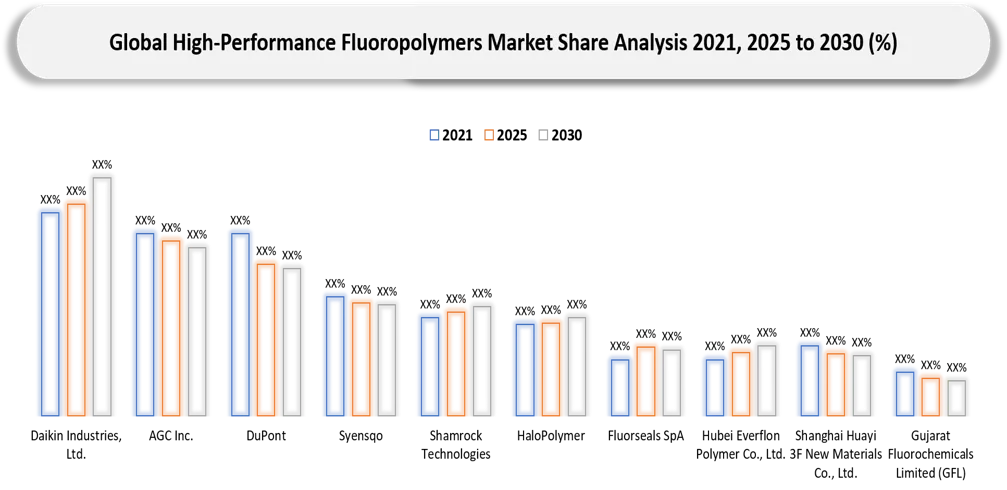
- Daikin Industries, Ltd.
- AGC Inc.
- DuPont
- Syensqo
- Shamrock Technologies
- HaloPolymer
- Fluorseals SpA
- Hubei Everflon Polymer Co., Ltd.
- Shanghai Huayi 3F New Materials Co., Ltd.
- Gujarat Fluorochemicals Limited (GFL)
High-Performance Fluoropolymers Market Recent Developments
- August 2026 - PFAS Regulatory Development: The Environmental Appeals Board of the United States directed the EPA to examine the need for PFAS standards in a New Hampshire wastewater permit, paving the path for PFAS discharge standards in EPA permits.
- August 2026 - AGC Inc.: AGC confirmed its participation in SEMICON INDIA 2026, where it plans to demonstrate fluoropolymers and other semiconductor materials, including the ETFE mold release film, along with the fluorochemical recycling projects.
- August 2026 - Daikin Industries, Ltd.: Daikin is planning to commission its new FFKM manufacturing facility in its Kashima Plant by August 2026 and will launch commercial operations in 2027, increasing its capacity to meet the demands of the semiconductor industry.
- July 2026 - Syensqo: Syensqo reported the growth in its Specialty Polymers in Q2 2026, which was due to rising demand for semiconductors and the company’s initiatives to bolster the business.
- June 2026 - Gujarat Fluorochemicals Limited (GFL): On June 26, 2026, GFCL set up GFCL Semiconductor and Advanced Materials Limited as a wholly owned subsidiary, giving an added emphasis on the application of semiconductors and advanced materials.
What DATAM Uniquely Provides
- Market size and forecast analysis including detailed analysis at the global, regional and country level markets.
- Segmentation and opportunity analysis by type, form, application and end-use industry verticals.
- Competitive analysis including positioning, portfolio analysis, capacity expansions and latest developments.
- Market dynamics and impact analysis including quantitative factors driving and restraining market growth and investment opportunities.
- Insights for businesses that highlight growth geographies, emerging applications, white spaces and purchase criteria.



























































