


Computed Tomography Market Size
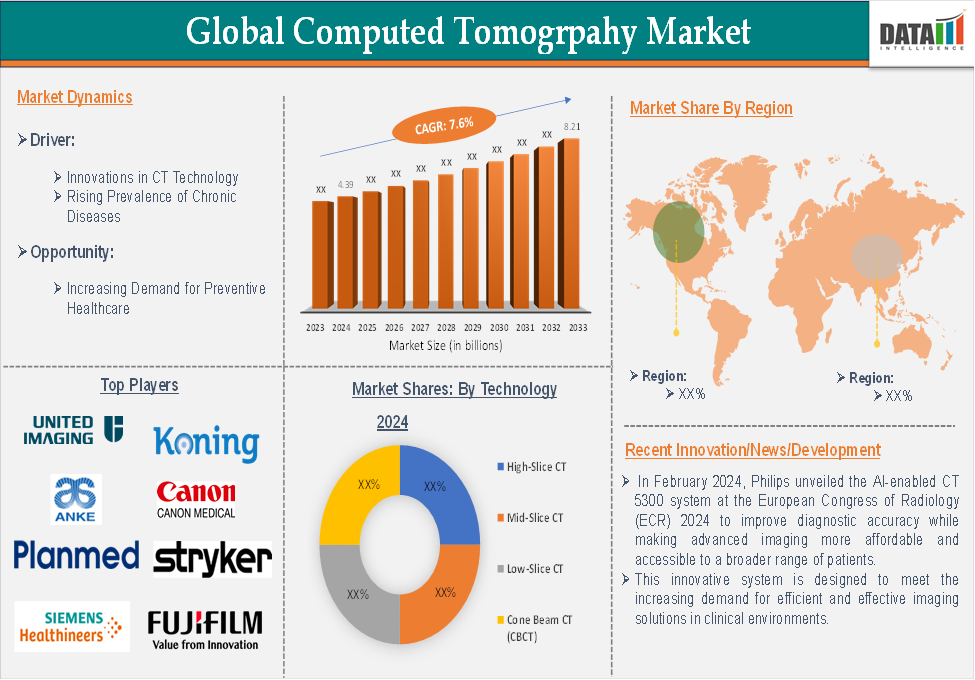
Global Computed Tomography Market reached US$ 4.72 billion in 2025 and is expected to reach US$ 8.21 billion by 2033, growing at a CAGR of 7.6% during the forecast period of 2026-2033.
Computed tomography (CT), also known as computerized axial tomography (CAT), is a sophisticated imaging technique that utilizes a narrow beam of X-rays directed at a patient, which rapidly rotates around the body. This process generates signals that are processed by a computer to create cross-sectional images, referred to as "slices." These tomographic images provide clinicians with more detailed information compared to conventional X-rays.
During the procedure, the CT machine's computer captures multiple successive slices. These slices can then be digitally combined to form a three-dimensional (3D) representation of the patient's anatomy. This 3D imaging facilitates the easier identification of fundamental structures, as well as potential tumors or abnormalities, thereby enhancing diagnostic accuracy and aiding in treatment planning.
Computed Tomography Market Key Takeaways
- The global computed tomography market stood at US$ 4.72 billion in 2025 and is expected to expand at a 7.6% CAGR through the forecast period.
- High-slice CT is positioned as the leading technology segment, supported by faster scanning, greater patient throughput, high image resolution, and applications across oncology, cardiology, neurology, gastroenterology, and pediatrics.
- North America holds a significant market position, supported by healthcare infrastructure investment, chronic disease burden, advanced imaging adoption, and strong manufacturer activity.
- AI-enabled image reconstruction, photon-counting detectors, dose-reduction technologies, and workflow automation are becoming important product differentiation factors.
- CT scanner economics remain a major consideration. Source data from 2024 places entry-level scanners at US$ 80,000 to US$ 100,000, intermediate systems at US$ 120,000 to US$ 160,000, and premium systems at US$ 200,000 to US$ 300,000.
- Procurement opportunities extend beyond new installations to replacement cycles, infrastructure upgrades, portable imaging, cloud-connected radiology workflows, and advanced CT adoption in emerging healthcare markets.
Computed Tomography Market Scope
| Metric | Details |
| Market Size in 2025 | US$ 4.72 billion |
| Market Size in 2033 | US$ 8.21 billion |
| CAGR | 7.60% |
| Historic Years | 2023-2024 |
| Base Year | 2025 |
| Forecast Period | 2026-2035 |
| Segments Covered | Type, Technology, Application, End-User, Region |
| Leading Region | North America |
| Key Technology Segment | High-Slice CT |
| Technology Covered | High-Slice CT, Mid-Slice CT, Low-Slice CT, Cone Beam CT (CBCT) |
| Type Covered | Stationary CT, Portable CT |
| Applications Covered | Oncology, Cardiology, Emerging Medicine, Neurovascular, Musculoskeletal, Others |
| End Users Covered | Hospitals, Diagnostic Imaging Centers, Others |
Executive Summary
For more details on this report, Request for Sample
Computed Tomography Market Dynamics: Drivers & Restraints
Innovations in CT Technology
Innovations in CT technology are crucial drivers for the global computed tomography market. Ongoing innovations in CT technology, such as high-slice scanners, dual-energy CT, and the integration of artificial intelligence, significantly improve imaging quality and diagnostic accuracy. Furthermore, key players in the industry integrate innovations in the technology that would drive this market growth.
For instance, in June 2024, FUJIFILM Healthcare Americas Corporation made notable advancements in the computed tomography (CT) market by launching its compact, 128-slice CT system known as the FCT iStream. This system has received FDA 510(k) clearance, allowing it to be utilized in clinical settings.
Additionally, in February 2024, Philips unveiled the AI-enabled CT 5300 system at the European Congress of Radiology (ECR) 2024 to improve diagnostic accuracy while making advanced imaging more affordable and accessible to a broader range of patients. This innovative system is designed to meet the increasing demand for efficient and effective imaging solutions in clinical environments.
High Costs of Equipment
The high costs associated with purchasing and installing advanced computed tomography (CT) systems create a significant barrier for many healthcare facilities, particularly smaller clinics and hospitals. This initial investment can restrict access to the latest imaging technologies, especially in resource-constrained environments.
Understanding the cost of a CT scanner involves navigating various options, each designed to meet specific imaging needs and accommodate different budgets. There are three distinct price tiers for CT scanners: Entry Level, Intermediate, and Premium. Each category is defined not only by its price range but also by the level of technology and diagnostic capabilities offered, providing healthcare facilities with choices that align with their operational requirements.
According to the Block Imaging, Inc. data in 2024, stated that entry-level CT scanners are the most accessible option, with prices ranging from $80,000 to $100,000. The intermediate tier of CT scanners, priced between $120,000 and $160,000, provides enhanced technology and capabilities. Meanwhile, the premium tier of CT scanners, which range from $200,000 to $300,000, features advanced imaging technologies for more complex diagnostic needs.
Computed Tomography Market Segment Analysis
The global computed tomography market is segmented based on type, technology, application, end-user, and region.
Technology:
The high-slice CT segment in technology is expected to dominate the global computed tomography market with the highest market share
High-slice CT scanners, typically encompassing systems with more than 128 slices (such as 256-, 320-, and 640-slice models), these systems offer faster scan times, increased patient throughput, and lower radiation doses, making them ideal for advanced diagnostic imaging across multiple medical disciplines, including cardiology, neurology, oncology, gastroenterology, and pediatrics.
High-slice CT scanners provide enhanced image clarity, which is crucial for detecting microcalcifications, vascular abnormalities, and early-stage cancers. Innovations such as AI integration, improved dose reduction techniques, and photon-counting CT technology (as seen in Siemens Healthineers' Naeotom Alpha series) are propelling this segment forward. These CT scanners are highly valuable for non-invasive coronary imaging, offering precise assessment of cardiovascular diseases, particularly in patients with irregular heart rates.
For instance, in December 2024, Siemens Healthineers’ introduction of the Naeotom Alpha.Pro and Naeotom Alpha. Prime represents a breakthrough in high-slice CT imaging by integrating photon-counting detector (PCD) technology into the field. These additions mark a significant advancement in CT imaging, offering higher resolution, reduced radiation dose, and improved workflow efficiency.
High-slice CT scanners, such as 128-slice, 256-slice, and 320-slice systems, capture large volumes of data with greater speed and resolution. However, conventional high-slice CT scanners still rely on energy-integrating detectors (EIDs), which have limitations in signal processing and image quality. These factors have solidified the segment's position in the global computed tomography market.
Computed Tomography Market Geographical Share
North America is expected to hold a significant position in the global computed tomography market with the highest market share
The increasing incidence of chronic illnesses, such as cancer and cardiovascular diseases, is a major driver of CT scanner demand. In particular, oncology applications are seeing significant growth due to higher rates of cancer diagnoses and expanded screening programs, such as low-dose CT scans for lung cancer detection in high-risk groups.
North America, especially the U.S., is witnessing rapid advancements in CT scanner technology, including AI-powered image analysis, photon-counting detectors, and improved resolution with lower radiation doses. Companies like Siemens Healthineers, GE Healthcare, and Canon Medical Systems are investing heavily in research and innovation.
The U.S. government and private institutions are increasing investments in healthcare infrastructure, particularly in advanced diagnostic imaging. The National Institute of Health (NIH) has allocated billions of dollars for cancer and cardiovascular disease research, further boosting the adoption of CT imaging for early disease detection.
Furthermore, key players' product launches and approvals would drive this market growth. For instance, in June 2025, Fujifilm Healthcare Americas Corporation received FDA 510(k) clearance for its new 128-slice computed tomography (CT) system, the FCT iStream. This CT system is designed to provide high-quality imaging while enhancing efficiency and reducing patient radiation exposure. Thus, the above factors are consolidating the region's position as a dominant force in the global computed tomography market.
Computed Tomography Market Global Players
The major global players in the computed tomography market include Siemens Healthcare Private Limited, GE HealthCare, Canon Medical Systems, USA., Koninklijke Philips N.V., FUJIFILM India Private Limited, Neusoft Medical Systems, United Imaging Healthcare Co., Ltd., Koning Health, NeuroLogica Corp., Shenzhen Anke High-tech Co., Ltd., Planmed Oy, and Stryker among others.
Computed Tomography Market Key Developments
August 2026: In North America, CT innovation increasingly centered on AI-assisted reconstruction, cardiac CT, low-dose imaging, and photon-counting technology. GE HealthCare, Siemens Healthineers, and Philips remain key companies advancing next-generation CT platforms.
July 2026: In Europe, adoption of advanced CT technologies continued expanding, particularly photon-counting CT, spectral imaging, and AI-enabled workflows. Bracco also announced the installation of a photon-counting CT scanner at an Italian research center to support next-generation contrast agent and AI imaging research.
June 2026: In Asia-Pacific, particularly India, hospitals continued upgrading to advanced CT systems. Philips and ACTREC Tata Memorial Centre partnered on Spectral CT for cancer imaging, while Siemens Healthineers expanded CT infrastructure through a clinical prevention center in Bengaluru.
May 2026: In North America, GE HealthCare received FDA clearance for Photonova Spectra, its photon-counting CT platform using Deep Silicon detector technology and eight-bin energy resolution, strengthening competition in high-resolution spectral CT.
April 2026: Globally, the CT industry increasingly focused on photon-counting detectors, AI reconstruction, low-dose imaging, spectral imaging, automated workflows, and advanced cardiac and oncology applications. Canon Medical, GE HealthCare, Siemens Healthineers, Philips, and United Imaging Healthcare continued developing next-generation CT technologies.
Why Purchase the Report?
- Pipeline & Innovations: Reviews ongoing clinical trials and product pipelines and forecasts upcoming advancements in medical devices and pharmaceuticals.
- Product Performance & Market Positioning: Analyzed product performance, market positioning, and growth potential to optimize strategies.
- Real-World Evidence: Integrates patient feedback and data into product development for improved outcomes.
- Physician Preferences & Health System Impact: Examines healthcare provider behaviors and the impact of health system mergers on adoption strategies.
- Market Updates & Industry Changes: This covers recent regulatory changes, new policies, and emerging technologies.
- Competitive Strategies: Analyze competitor strategies, market share, and emerging players.
- Pricing & Market Access: Reviews pricing models, reimbursement trends, and market access strategies.
- Market Entry & Expansion: Identifies optimal strategies for entering new markets and partnerships.
- Regional Growth & Investment: Highlights high-growth regions and investment opportunities.
- Supply Chain Optimization: Assesses supply chain risks and distribution strategies for efficient product delivery.
- Sustainability & Regulatory Impact: Focuses on eco-friendly practices and evolving regulations in healthcare.
- Post-market Surveillance: Uses post-market data to enhance product safety and access.
- Pharmacoeconomics & Value-Based Pricing: Analyzes the shift to value-based pricing and data-driven decision-making in R&D.
The global computed tomography market report delivers a detailed analysis with 76 key tables, more than 67 visually impactful figures, and 176 pages of expert insights, providing a complete view of the market landscape.
Target Audience
- Manufacturers: Pharmaceutical, Medical Device, Biotech Companies, Contract Manufacturers, Distributors, Hospitals.
- Regulatory & Policy: Compliance Officers, Government, Health Economists, Market Access Specialists.
- Technology & Innovation: AI/Robotics Providers, R&D Professionals, Clinical Trial Managers, Pharmacovigilance Experts.
- Investors: Healthcare Investors, Venture Fund Investors, Pharma Marketing & Sales.
- Consulting & Advisory: Healthcare Consultants, Industry Associations, Analysts.
- Supply Chain: Distribution and Supply Chain Managers.
- Consumers & Advocacy: Patients, Advocacy Groups, Insurance Companies.
- Academic & Research: Academic Institutions.




























































